Your Secret Weapon: Leading Effective Teams with ChatGPT
Ever wish you had a super-smart assistant who could brainstorm, draft, and even play devil's advocate without needing a coffee break? Well, dear managers, meet your new best friend: ChatGPT! We're diving into how this AI marvel isn't just a techy toy, but your ultimate co-pilot for cultivating more effective, engaged, and downright awesome teams.
Overview
ChatGPT represents a transformative opportunity for modern managers seeking to enhance team leadership effectiveness. Rather than replacing human judgment, this AI tool functions as a strategic co-pilot—a always-available assistant capable of handling brainstorming, drafting, analysis, and problem-solving tasks that traditionally consume valuable management time. This guide explores how to harness ChatGPT's capabilities across four critical leadership domains: foundational prompt engineering, team communication, employee development, and strategic decision-making. By mastering these applications, managers can become more effective, empathetic, and innovative leaders while freeing cognitive resources for high-level strategic thinking.
What You'll Learn
- Understand the RCTFC framework and apply it to craft effective ChatGPT prompts that deliver precise, actionable outputs
- Leverage ChatGPT to draft clear, empathetic communications and personalized feedback that resonates with teams
- Utilize AI-generated insights to develop personalized growth plans and brainstorm engaging team-building activities
- Employ ChatGPT as a thought partner for complex problem-solving and strategic decision-making
- Recognize ChatGPT as an augmentation of human leadership rather than a replacement for managerial judgment
The AI Co-Pilot for Managers: Mastering the RCTFC Framework
The foundation of effective ChatGPT usage lies in understanding that the quality of output is directly proportional to the clarity and structure of your input. This principle introduces the RCTFC framework—a systematic approach to prompt engineering designed specifically for managerial applications. RCTFC stands for Role, Context, Task, Format, and Constraints. Each component serves a distinct purpose in guiding the AI toward generating responses that precisely address your needs. The framework operates as a communication protocol between you and the AI. By specifying your role, you establish the lens through which the AI should consider the problem. Context provides the background information necessary for the AI to understand the situation's nuances and urgency. Task articulates exactly what you need accomplished. Format defines how the information should be structured or presented. Constraints establish boundaries—what to focus on, what to avoid, and any limitations on scope or implementation. Think of RCTFC as your personal GPS for AI interactions. Without it, you might receive generic, overly broad responses that require significant editing and rethinking. With it, you receive targeted, actionable outputs that often require minimal revision. This systematic approach transforms ChatGPT from a novelty tool into a reliable strategic partner. The framework isn't about rigid adherence to a formula; rather, it's about ensuring that every critical element of your request is communicated with precision. Managers who master RCTFC consistently report that their ChatGPT interactions yield immediately usable results, dramatically reducing the iteration cycles previously required.
- RCTFC framework components (Role, Context, Task, Format, Constraints) work together to eliminate ambiguity in AI prompts
- Well-structured prompts yield outputs requiring minimal revision, saving significant time and ensuring consistency
- The framework applies across all managerial applications—from brainstorming to communication drafting to strategic analysis
- Prompt engineering is a learnable skill that improves with practice and intentional refinement
Lab: Lab Exercise
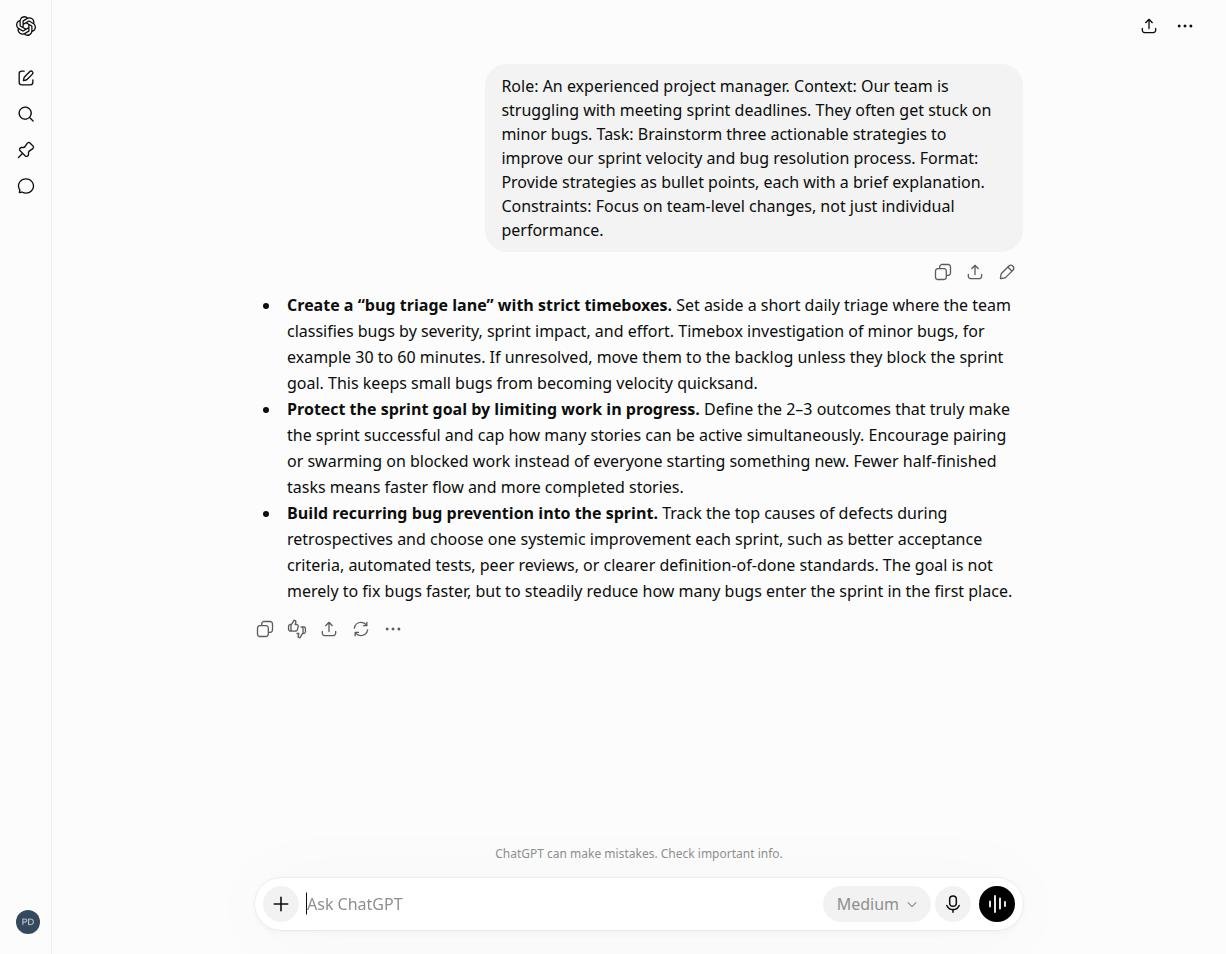
Consider a project manager facing sprint velocity challenges. Rather than asking ChatGPT 'How do we improve sprint velocity?' (vague and generic), apply RCTFC: Role: 'You are an experienced project manager.' Context: 'Our team struggles with meeting sprint deadlines and gets stuck on minor bugs, impacting overall velocity.' Task: 'Brainstorm three actionable strategies to improve sprint velocity and bug resolution processes.' Format: 'Provide strategies as bullet points, each with a brief explanation.' Constraints: 'Focus on team-level changes, not individual performance metrics.' This structured approach prompts ChatGPT to generate targeted strategies such as implementing bug triage protocols, establishing clear definition-of-done standards, or creating a minor-bug resolution workflow—all directly applicable to the specific situation, all implementable at the team level. The manager receives not generic advice but contextually relevant solutions ready for immediate team discussion and implementation.
Streamlining Communication and Feedback with AI
Communication stands as the connective tissue of effective teams, yet crafting messages that strike the right balance—clear yet warm, directive yet supportive, transparent yet encouraging—represents one of management's most delicate challenges. ChatGPT serves as a communication strategist, helping managers translate complex ideas into accessible language while maintaining appropriate tone and emotional resonance. This application proves particularly valuable when announcing policy changes, delivering performance feedback, or updating teams on strategic shifts where missteps can breed confusion, resistance, or disengagement. The AI's linguistic capabilities allow it to model multiple communication approaches, helping you find language that aligns with both your authentic voice and your communication objectives. For instance, when announcing a new requirement that some team members may resist, ChatGPT can help you structure messaging that acknowledges concerns while clearly explaining the rationale and maintaining psychological safety. This is not about manipulation; rather, it's about articulating your genuine intent with clarity and empathy. Beyond tone, ChatGPT helps managers personalize feedback at scale. Rather than generic performance comments, it can help structure feedback that acknowledges individual context, connects performance observations to development opportunities, and suggests specific growth pathways. This capability proves especially valuable for remote teams where written communication becomes the primary channel and where misunderstandings can fester without the clarifying benefit of face-to-face conversation. The AI can also help managers review their own draft communications for unintended negative tone, jargon that obscures meaning, or language that might alienate rather than unite.
- ChatGPT helps managers find the right tone and language to ensure messages are understood and motivate positive action
- Well-crafted communications acknowledge context and concern while maintaining clarity on expectations and rationale
- AI assistance is particularly valuable for remote teams where written communication is the primary interaction channel
- Personalized feedback at scale becomes feasible through structured AI-assisted drafting
- Human review remains essential; use ChatGPT to augment your communication instincts, not replace your judgment
Lab: Lab Exercise
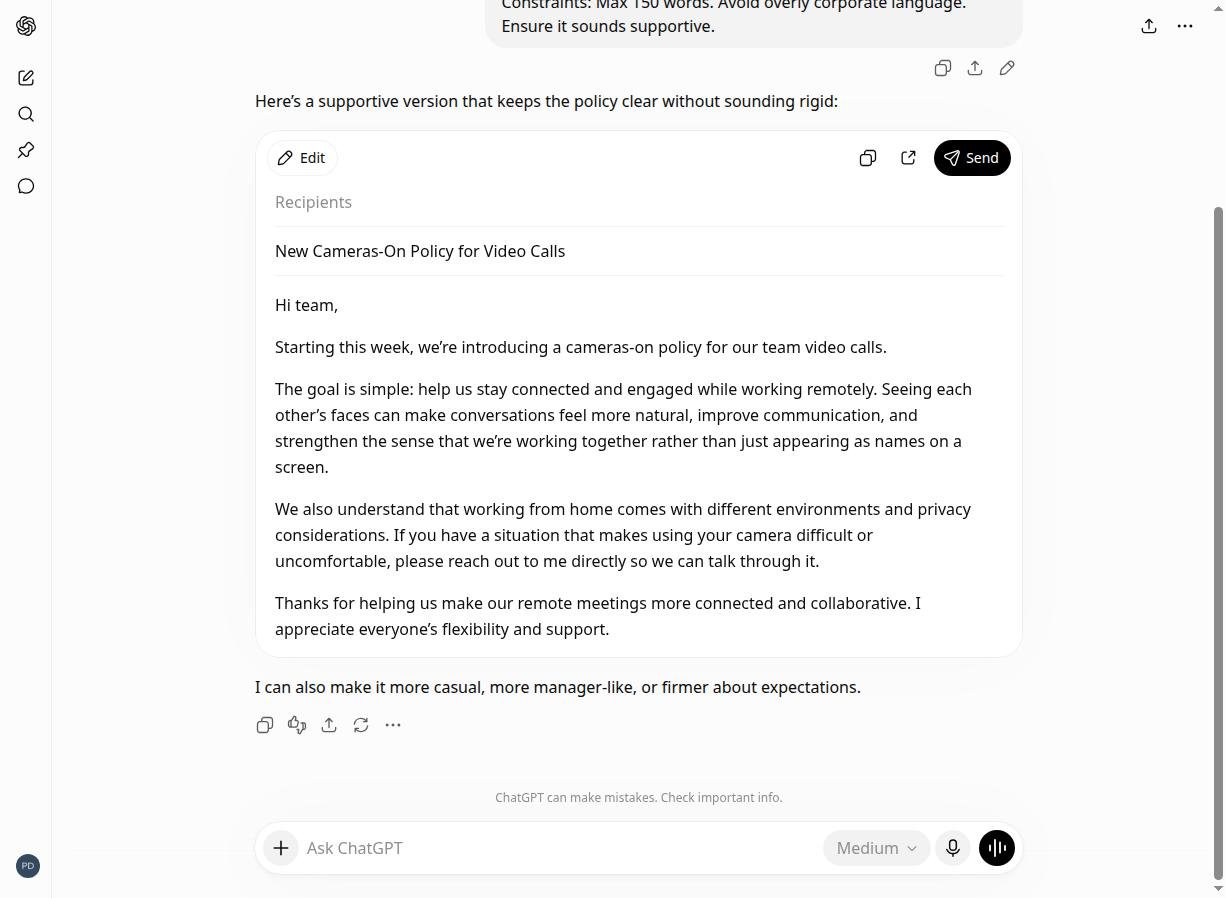
A team lead needs to announce a new policy requiring cameras on during video calls—a change that may provoke resistance around privacy and personal comfort. Using RCTFC: Role: 'You are an empathetic team lead.' Context: 'We have 8 remote developers across distributed locations; some may have privacy concerns about cameras during video calls.' Task: 'Write a concise, encouraging announcement for the new cameras-on policy.' Format: 'Email body, friendly tone, explain the business rationale (connection and engagement) and provide a contact for questions.' Constraints: 'Maximum 150 words, avoid corporate language, ensure the tone is supportive rather than punitive.' ChatGPT might generate something like: 'Hi team, we're implementing a new cameras-on norm for our video calls. Here's why: over the past months, we've noticed that seeing each other face-to-face strengthens our connection and makes collaboration feel less isolating. We know this adjustment might feel uncomfortable at first, and that's okay. If you have privacy concerns or need accommodations, please reach out—we're committed to making this work for everyone. Questions? Let's chat.' This approach acknowledges resistance without being defensive, explains the genuine business rationale, and invites dialogue rather than commanding compliance. The manager reviews this draft, adjusts it to match their voice, and sends a message that typically generates far less pushback than would an impersonal policy announcement.
Boosting Team Development and Engagement with AI
Team engagement and professional development represent ongoing management challenges where one-size-fits-all approaches consistently underperform. Different team members thrive under different conditions: some need clear skill-building pathways, others seek mentorship, still others crave challenging projects or leadership opportunities. ChatGPT can serve as a source of personalized development ideas and engagement activities that go beyond the generic team-building exercises that often feel forced or ineffective. When it comes to professional development, ChatGPT can help managers design learning pathways aligned with individual career aspirations, current skill gaps, and team needs. Rather than defaulting to annual training budgets spent on standardized courses, managers can use AI to brainstorm targeted micro-learning opportunities, mentoring structures, stretch projects, and skill-building activities customized to their specific team. The tool can suggest both formal learning resources and informal development approaches—peer knowledge-sharing sessions, reverse mentoring, cross-functional projects—that often prove more engaging and immediately applicable than traditional training. Similarly, ChatGPT can assist in brainstorming engagement activities that feel authentic rather than forced. Remote and distributed teams present particular challenges; generic virtual team-building often falls flat, yet in-person activities aren't feasible. AI can generate creative, low-cost, asynchronous or flexible-timing activities that genuinely foster connection without consuming excessive time or creating artificial competition. The key lies in feeding the AI specific constraints about your team—size, time zones, budget limitations, past activities that didn't resonate—so that suggestions feel practically implementable.
- ChatGPT generates personalized development ideas that move beyond generic training approaches
- AI-assisted brainstorming produces creative, context-appropriate engagement activities that teams actually enjoy
- Development and engagement activities are most effective when tailored to specific team composition, constraints, and preferences
- Informal learning and peer-based development often outperform formal training in driving skill growth and engagement
- Remote and distributed teams benefit particularly from AI assistance in designing activities that feel natural despite physical distance
Lab: Lab Exercise
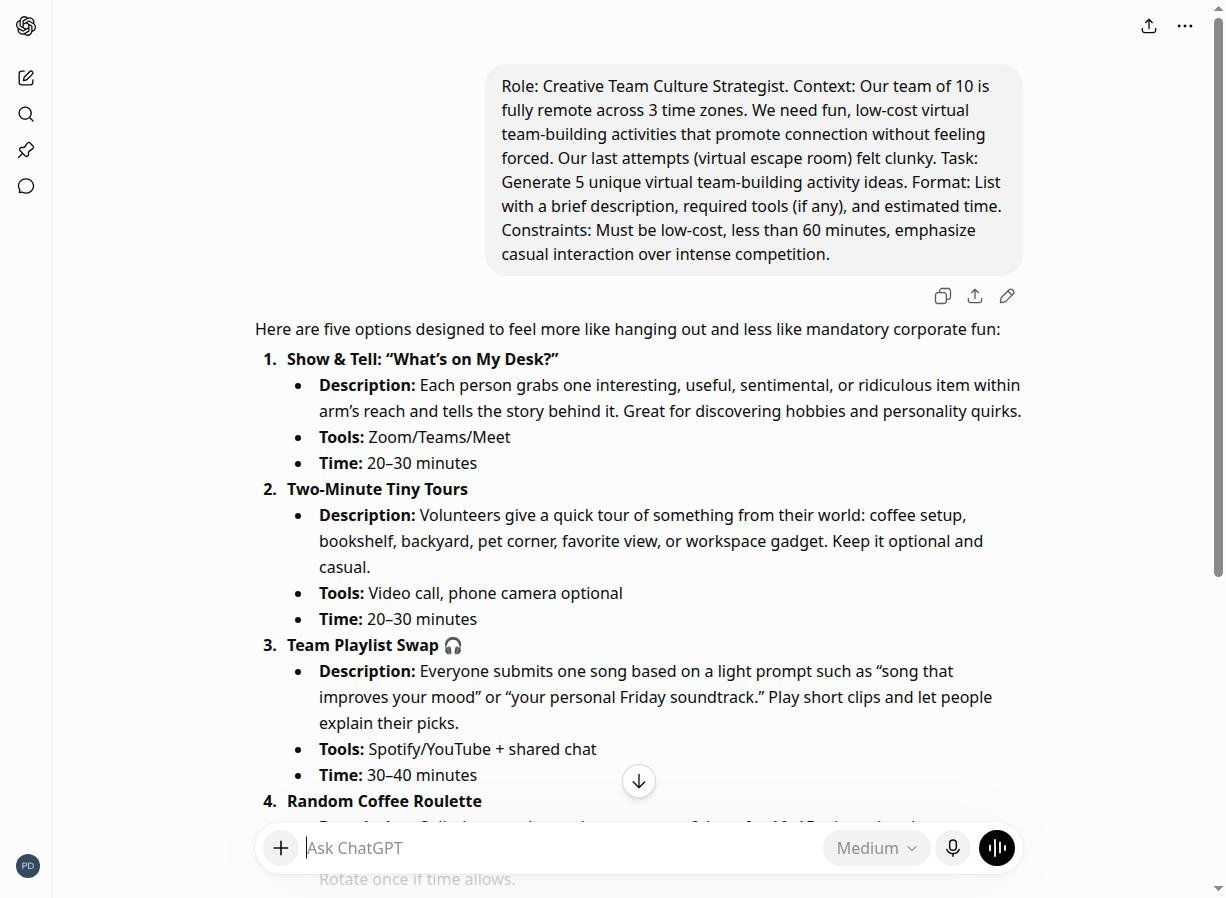
A team culture strategist managing 10 fully remote employees across 3 time zones wants to boost connection without relying on activities that have fallen flat previously (like virtual escape rooms). Using RCTFC: Role: 'You are a creative team culture strategist.' Context: 'Remote team of 10 across 3 time zones; previous virtual team-building (escape rooms) felt clunky and disconnected.' Task: 'Generate 5 unique virtual team-building activity ideas.' Format: 'List with brief description, required tools, and estimated time.' Constraints: 'Low-cost, less than 60 minutes, emphasize casual interaction over intense competition.' ChatGPT might suggest activities like rotating skill-share sessions where team members teach each other personal skills (photography, cooking, language basics) in 20-minute slots; asynchronous 'show and tell' where people share meaningful objects with written context; spontaneous virtual coffee buddy matching for informal peer conversations; collaborative playlist creation around themes; or 'working session' co-working time where people work independently but video-call together for ambient presence and informal chat. These approaches create genuine connection through low-pressure interaction rather than artificial team competition. The manager reviews these suggestions, selects those fitting team dynamics, pilots one or two, and iterates based on feedback—using AI again to refine approaches that resonate.
Strategic Planning and Problem-Solving with AI
Managers routinely face complex operational challenges—missed deadlines, quality issues, communication breakdowns, process inefficiencies—where the root causes are multifaceted and solutions aren't immediately obvious. These situations demand strategic thinking: stepping back from immediate symptoms to analyze underlying causes, considering multiple solution pathways, and anticipating potential consequences. ChatGPT functions effectively as a thought partner in this analytical process, helping managers structure their thinking, surface blind spots, and develop more comprehensive solution sets. The value of AI in strategic planning lies not in replacing managerial judgment but in expanding the landscape of possibilities you consider. A manager wrestling with a CRM compliance issue, for instance, might initially think the problem is 'salespeople don't use the system.' ChatGPT, prompted effectively, can help decompose that into multiple root causes: Is the interface genuinely difficult to navigate? Do people understand why accurate data matters? Are competing priorities making CRM updates feel low-urgency? Are workflows designed poorly? Does the team lack clear entry procedures? Are accountability mechanisms missing? Once causes are articulated, the AI can help brainstorm multiple solution approaches—training, workflow redesign, process simplification, incentive alignment—that address different combinations of causes. This analytical partnership proves particularly valuable when identifying implementation constraints and risks. A solution that looks perfect in theory may prove impractical given budget limitations, timeline constraints, or organizational readiness. ChatGPT can help stress-test ideas, consider unintended consequences, and suggest modifications that maintain the core benefit while addressing practical limitations. The manager retains full decision-making authority; the AI simply helps ensure that decisions rest on more comprehensive analysis and broader consideration of possibilities.
- ChatGPT helps managers structure complex problem analysis and surface underlying root causes
- AI-assisted brainstorming generates multiple solution pathways addressing different problem dimensions
- Strategic thinking benefits from considering diverse perspectives and potential unintended consequences before implementation
- Solutions must be stress-tested against practical constraints—timeline, budget, organizational readiness, change capacity
- Managers must retain final decision authority while leveraging AI analysis to inform more comprehensive judgments
Lab: Lab Exercise
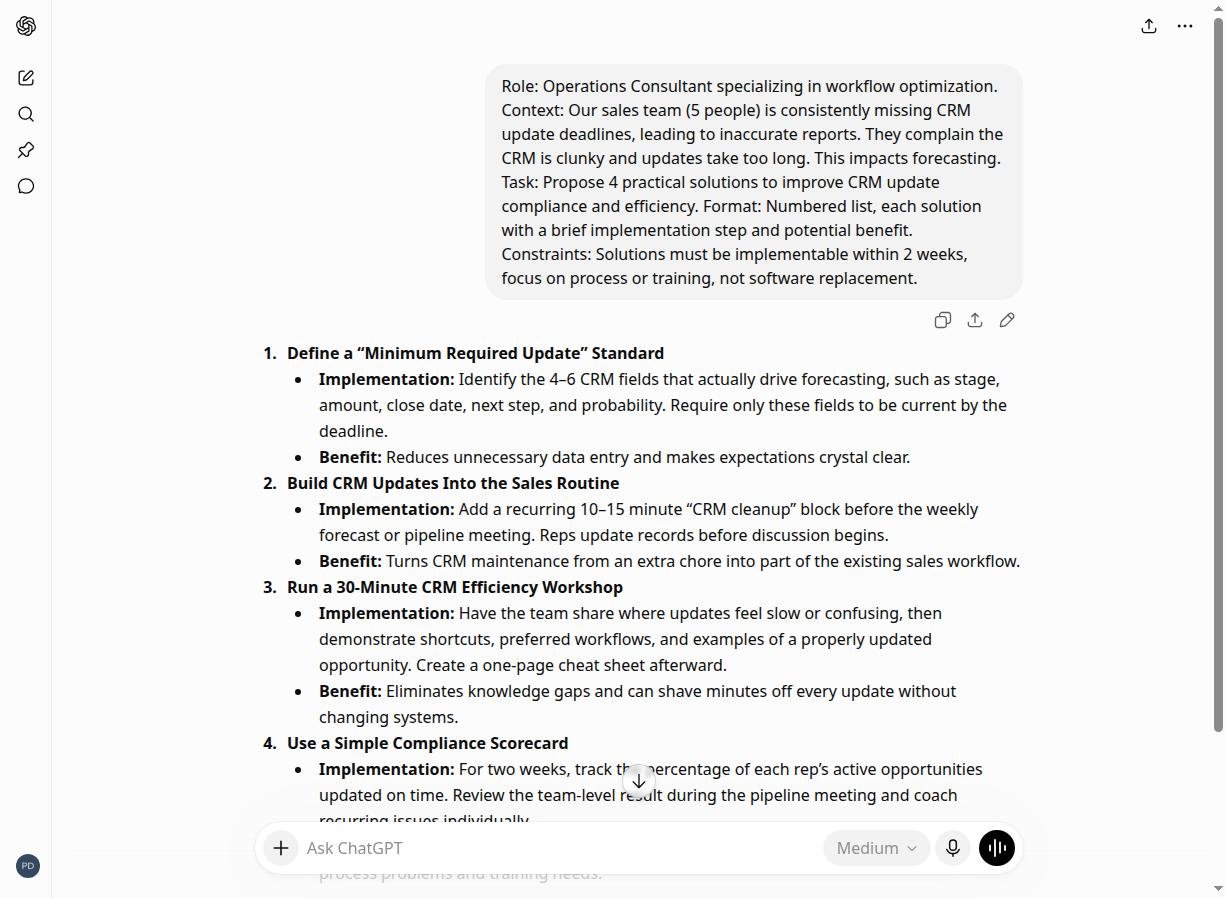
A sales operations challenge: a 5-person sales team consistently misses CRM update deadlines, creating inaccurate forecasting data. Team members cite a clunky interface and time-consuming processes. Using RCTFC: Role: 'You are an operations consultant specializing in workflow optimization.' Context: 'Sales team of 5 misses CRM deadline, affecting forecasts; team complains interface is clunky and updates take too long.' Task: 'Propose 4 practical solutions to improve CRM update compliance and efficiency.' Format: 'Numbered list, each solution with brief implementation step and potential benefit.' Constraints: 'Implementable within 2 weeks, focus on process or training, not software replacement.' ChatGPT might propose: (1) Create CRM update checklist at end-of-day; 10-minute daily discipline with manager spot-checks; benefit: builds habit, reduces decision friction. (2) Conduct workflow analysis to identify redundant or unclear steps in update process; streamline by 30-40%; benefit: lowers time investment, increases compliance. (3) Establish team 'why'—connect accurate CRM data to better forecasts, which protects team commission structures; benefit: intrinsic motivation. (4) Implement weekly 15-minute CRM training slot for ongoing tips and shortcut sharing; benefit: reduces friction over time. The manager reviews these suggestions against team capacity, past change initiatives, and feasibility. Some may be immediately implementable; others may require modification. The structured analysis has helped move beyond 'salespeople need to try harder' to concrete, multifaceted interventions addressing process, skill, and motivation simultaneously.
Summary
ChatGPT represents a powerful force multiplier for modern managers when deployed strategically across four critical leadership domains. The RCTFC framework provides the foundational structure for effective AI interaction, ensuring that prompts generate precisely targeted outputs rather than generic responses requiring extensive revision. Building on this foundation, managers can harness ChatGPT's capabilities to craft communications that genuinely resonate with teams, develop personalized growth and engagement approaches that move beyond cookie-cutter solutions, and engage in more comprehensive strategic analysis and problem-solving. Throughout all these applications, the central principle remains unchanged: ChatGPT is an augmentation of human leadership, not a replacement for it. The tool excels at expanding your thinking, generating options, stress-testing ideas, and drafting content. Your judgment, contextual understanding, emotional intelligence, and accountability remain irreplaceable. Success with ChatGPT requires both structured approach (RCTFC discipline) and experimental mindset. As you integrate this tool into your management practice, you'll discover applications and refinements specific to your team, your organization's culture, and your leadership style. The goal is not to become dependent on AI but to become a more effective, empathetic, and innovative leader—one who can tackle complex challenges, communicate with clarity and warmth, invest in genuine team development, and make informed strategic decisions with confidence.
Next Steps
Begin by selecting one management challenge your team currently faces—whether communication-related, development-focused, or strategic. Craft a RCTFC-structured prompt addressing this specific challenge. Observe the quality and relevance of ChatGPT's output. Experiment with refinements to your prompt structure, testing how changes in Context or Constraints affect response quality. As you experience firsthand how precise prompting yields immediately usable results, extend this practice to additional domains. Join a community of managers exploring AI-assisted leadership; share successes, failures, and creative applications. Remember that prompt engineering is a learnable skill that improves dramatically with intentional practice. Most importantly, maintain your role as the final decision-maker and keeper of team relationships—use ChatGPT to enhance that role, not diminish it.