Your Secret Weapon: 3 Prompts Every High School Guidance Counselor Should Master
Ever wish you had a super-powered assistant who could help you personalize advice, draft tricky emails, or even plan entire workshops in a flash? Well, buckle up, because today we’re unlocking that power with three game-changing AI prompts designed specifically for high school guidance counselors. Forget generic search results; we're talking tailor-made brilliance, right at your fingertips.
Overview
High school guidance counselors juggle multiple demanding responsibilities—from personalized career advising to sensitive parent communications to designing impactful workshops. This lesson introduces the RCTFC framework, a structured approach to crafting effective prompts for AI tools, enabling counselors to leverage artificial intelligence as a strategic partner rather than a generic search engine. By mastering three purpose-built prompts grounded in RCTFC principles, you can deliver more personalized, timely, and professionally polished guidance while reclaiming time and mental energy for the human elements of counseling that only you can provide.
What You'll Learn
- Understand the RCTFC framework (Role, Context, Task, Format, Constraints) and why each component elevates AI interactions
- Apply a structured prompt for generating personalized career exploration paths tailored to individual student profiles
- Construct an empathetic communication prompt to draft sensitive counselor-to-parent emails with professional tone and clarity
- Design a resource curation and workshop planning prompt to efficiently develop engaging, student-centered programs
- Recognize how strategic prompting transforms AI from a generic tool into a customized guidance counseling assistant
The RCTFC Framework: Your Prompting Blueprint
The RCTFC framework is a five-component structure that transforms vague requests into precise, actionable AI outputs. Rather than asking an AI tool a casual question and hoping for useful results, RCTFC gives you a proven blueprint for guiding the AI's intelligence toward exactly what you need. Think of it as the difference between asking a helpful colleague, "Can you brainstorm something?" versus giving them detailed context, specific expectations, and clear boundaries. Each letter represents a critical layer of instruction: Role establishes who the AI should pretend to be; Context provides the background information and specific situation the AI needs to understand; Task states exactly what you want the AI to produce; Format specifies how the output should be structured; and Constraints define any limitations or special requirements. Together, these five elements eliminate ambiguity and dramatically improve the relevance, quality, and usability of AI-generated content. Counselors often struggle with AI interactions because they approach them casually, asking open-ended questions without scaffolding. RCTFC reverses this by treating prompt engineering as a professional skill—one that yields predictable, high-quality results every single time. The framework works because it mirrors how you would brief a human team member on an important project: you'd explain their role, give them context about the situation, clarify what you're asking them to produce, show them the format you need, and outline any constraints. AI responds powerfully to this same structured communication.
- RCTFC stands for Role, Context, Task, Format, and Constraints—five essential components of an effective AI prompt
- Each component adds precision and prevents ambiguity that leads to disappointing or irrelevant AI outputs
- The framework is grounded in how we naturally brief other professionals, making it intuitive to apply
- Structured prompting separates frustrating AI interactions from genuinely productive ones
- Mastering RCTFC unlocks predictable, high-quality outputs you can trust and refine over time
Lab: Lab Exercise
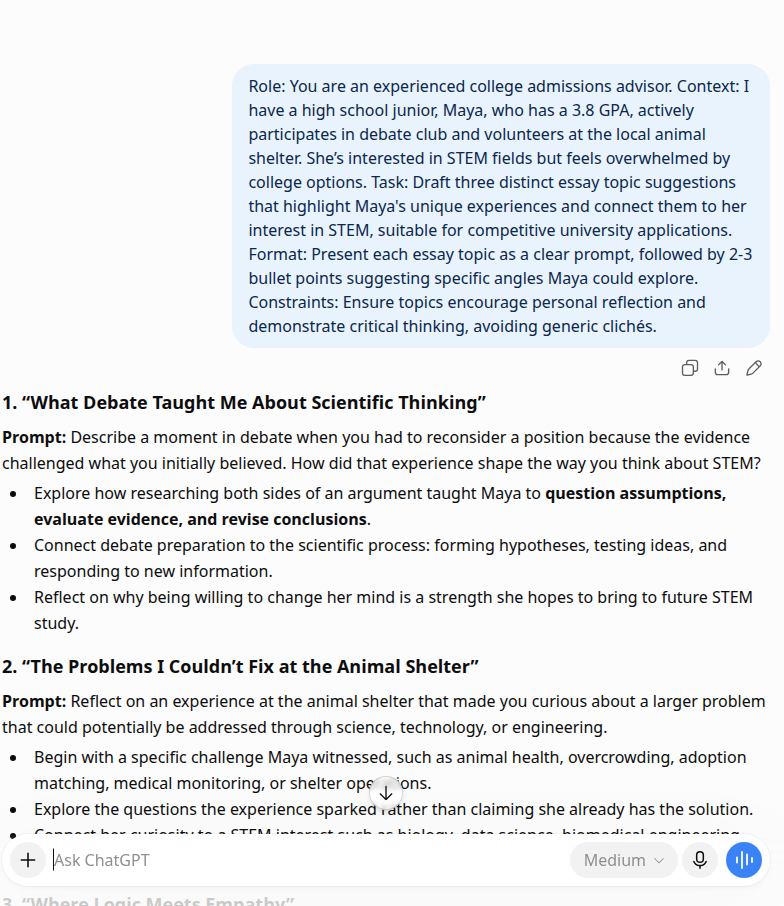
A guidance counselor needs to help a student named Maya with college essay topics. Rather than asking the AI "What are some good essay topics for Maya?" (vague and likely to produce generic results), the counselor uses RCTFC: Role: "You are an experienced college admissions advisor." Context: "I have a high school junior, Maya, who has a 3.8 GPA, actively participates in debate club and volunteers at the local animal shelter. She's interested in STEM fields but feels overwhelmed by college options." Task: "Draft three distinct essay topic suggestions that highlight Maya's unique experiences and connect them to her interest in STEM, suitable for competitive university applications." Format: "Present each essay topic as a clear prompt, followed by 2–3 bullet points suggesting specific angles Maya could explore." Constraints: "Ensure topics encourage personal reflection and demonstrate critical thinking, avoiding generic clichés." This structured prompt yields focused, personalized essay suggestions that reflect Maya's actual profile, interests, and strengths—far superior to generic topic lists. The AI understands not just what you want, but why, and who it's helping.
Prompt One: Personalized Career Exploration Paths
One of the most common challenges in guidance counseling is helping undecided or uncertain students envision realistic, fulfilling career futures. Generic advice—"follow your passion" or "choose a stable field"—often leaves students more confused than clarified. The first prompt harnesses AI to generate deeply personalized career exploration paths that weave together a student's specific interests, demonstrated skills, and legitimate concerns about their future. Rather than handing a student a printout of job titles, this approach uses AI to create a curated journey showing how their current profile connects to multiple career clusters, relevant roles within those clusters, and concrete high school activities they can pursue to test fit and build skills. This moves career guidance from abstract advice-giving into actionable exploration. The power of this prompt lies in its ability to hold multiple variables simultaneously. A student might have creative interests but worry about financial stability; the prompt asks AI to suggest career paths that blend both—creative roles within stable industries, or roles that combine creative and analytical thinking. It also connects high school experiences to career outcomes, helping students see that debate club or coding projects aren't random activities but strategic explorations of their professional future. By receiving three distinct pathways rather than one recommendation, students gain agency—they can explore different directions and discover what resonates most authentically.
- Personalized career guidance moves beyond generic advice by integrating specific interests, skills, and student concerns
- AI can rapidly synthesize student attributes (interests, talents, anxieties) into coherent career exploration pathways
- Offering multiple distinct pathways empowers students with choice and agency in their career planning
- Connecting high school activities and courses to specific career clusters makes exploration concrete and actionable
- This approach particularly helps students who feel torn between competing values (e.g., creativity versus stability)
Lab: Lab Exercise
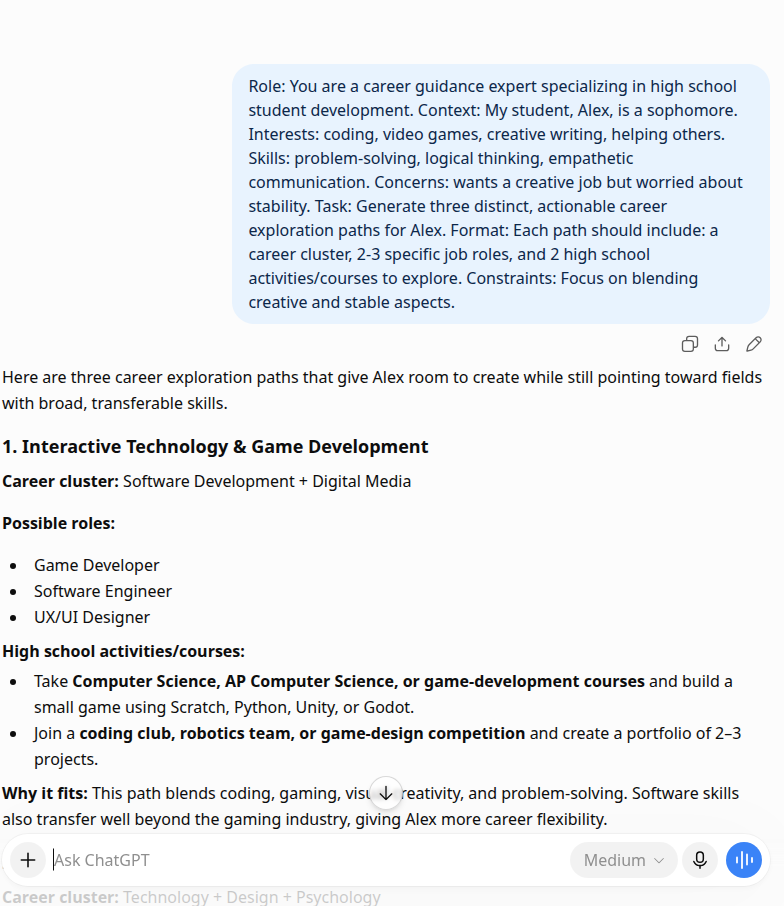
A counselor is working with Alex, a 10th grader interested in coding and video games but also creative writing and helping others. Alex worries about stability in creative fields. Using the RCTFC framework, the counselor crafts: Role: "You are a career guidance expert specializing in high school student development." Context: "My student, Alex, is a sophomore. Interests: coding, video games, creative writing, helping others. Skills: problem-solving, logical thinking, empathetic communication. Concerns: wants a creative job but worried about stability." Task: "Generate three distinct, actionable career exploration paths for Alex." Format: "Each path should include: a career cluster, 2–3 specific job roles, and 2 high school activities/courses to explore." Constraints: "Focus on blending creative and stable aspects." The AI might suggest: (1) Game Design & Development—roles like UX Designer or Educational Game Developer, paired with activities like joining a game development club or taking computer science courses; (2) Software Engineering with Creative Focus—roles like AR/VR Developer or Technical Director, with activities like internship shadowing or independent coding projects; (3) Tech for Social Good—roles like Health Tech Product Manager or EdTech Designer, with activities like volunteer coding for nonprofits or courses in both computer science and psychology. Each pathway directly addresses Alex's desire for creativity while showing how technical skills create stability and meaningful impact.
Prompt Two: Drafting Empathetic and Effective Communications
Guidance counselors regularly navigate emotionally charged conversations that require careful, compassionate communication. Whether reaching out to a parent about a struggling student, addressing attendance concerns, discussing sensitive personal issues, or updating families on academic progress, the stakes are high. These messages must balance honesty with empathy, professionalism with warmth, and clarity with tact. Crafting the right words in these moments is mentally taxing—it requires holding multiple considerations simultaneously and finding language that feels authentic to you while respecting the recipient's emotions and perspective. The second prompt leverages AI not to replace your judgment or voice, but to rapidly generate a solid draft that handles tone and structure, freeing you to focus on personalizing and refining the message. Rather than staring at a blank screen trying to find the right opening, you can work from a thoughtfully structured draft and adjust it to match your voice and the specific nuances of the situation. This is particularly valuable when you're managing high volumes of communication or when composing during stressful moments. AI can help ensure that even your quickest drafts maintain professional tone, avoid accusatory language, and communicate empathy and support. The prompt works by specifying the emotional intelligence required (compassion, respect for the parent's perspective) and constraining the output to avoid language that could be perceived as blame or dismissiveness.
- High-stakes communications require careful tone and structure; AI drafts can save time without sacrificing quality
- Using Role to establish emotional intelligence ("compassionate counselor") guides AI toward appropriate tone
- Context about the specific situation ensures the draft addresses actual concerns rather than generic issues
- Constraints that prohibit accusatory language or that emphasize empathy keep outputs aligned with your counseling values
- AI-generated drafts are starting points for personalization, not final products; you maintain voice and judgment
Lab: Lab Exercise
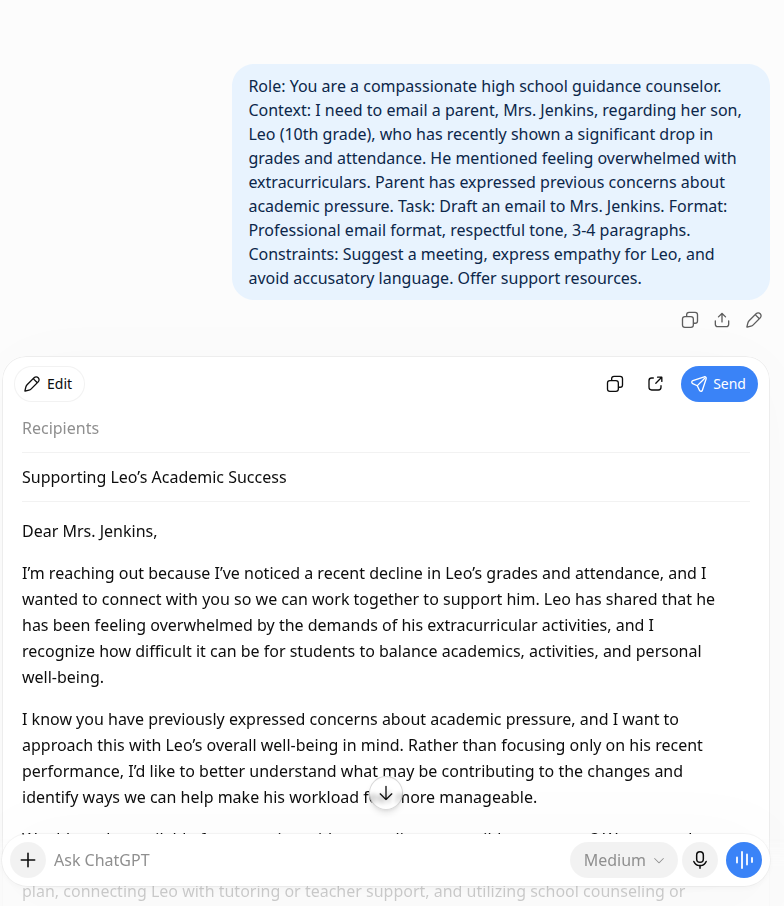
A counselor needs to contact Mrs. Jenkins about her son Leo, a 10th grader whose grades and attendance have dropped significantly and who mentioned feeling overwhelmed by extracurriculars. The counselor knows the parent has previously expressed concerns about academic pressure, so the conversation must acknowledge her perspective rather than adding to it. Using RCTFC: Role: "You are a compassionate high school guidance counselor." Context: "I need to email a parent, Mrs. Jenkins, regarding her son, Leo (10th grade), who has recently shown a significant drop in grades and attendance. He mentioned feeling overwhelmed with extracurriculars. Parent has expressed previous concerns about academic pressure." Task: "Draft an email to Mrs. Jenkins." Format: "Professional email format, respectful tone, 3–4 paragraphs." Constraints: "Suggest a meeting, express empathy for Leo, and avoid accusatory language. Offer support resources." The AI produces a draft like: "Dear Mrs. Jenkins, I wanted to reach out regarding Leo's recent academic and attendance patterns, as I know supporting his success is important to both of us. Over the past few weeks, I've noticed a shift in his engagement, and Leo himself shared that he's feeling stretched thin with his current commitments. Rather than viewing this as a concerning trend, I see it as an important signal that Leo might benefit from rethinking his schedule or finding better balance. I'd like to meet with you and Leo to understand what's happening and explore how we can work together to help him feel less overwhelmed. Our school has several resources that might help—from time-management support to conversations about realistic extracurricular loads. Would you be available to meet...?" This draft demonstrates empathy, validates the parent's existing concerns, reframes the issue as solvable, and invites collaboration—all while being specific enough to require minimal revision.
Prompt Three: Efficient Resource Curation & Workshop Planning
A significant portion of guidance counselor work involves staying current with scholarship opportunities, mental health resources, college program details, financial aid procedures, and other rapidly evolving information. Counselors then translate this information into engaging workshops, presentations, or individual guidance. The challenge is that research and program design are time-intensive, often happening alongside other responsibilities, and the quality of workshops often suffers if developed hastily. The third prompt uses AI to streamline both resource discovery and workshop design, turning the AI into a rapid-research assistant and event planner. Rather than spending hours researching and then separately designing a workshop structure, you can use this prompt to efficiently outline an entire program—including time blocks, interactive activities, discussion questions, and resource segments—tailored to specific student populations and needs. The prompt is particularly powerful when you specify constraints like "must be engaging," "include peer support," or "adapt for first-generation students," because these constraints guide the AI to create programs that actually resonate rather than generic slide-based presentations. This approach also enables you to design more workshops, more frequently, with less preparation burden, making your guidance services more responsive to emerging student needs.
- Resource curation and workshop design are time-intensive; AI can rapidly synthesize information and structure programs
- Specifying student demographic details (first-generation, diverse, high-stress) allows AI to tailor content and tone appropriately
- Time-blocked agendas with interactive activities create more engaging, memorable workshops than lecture-based formats
- Including practical resources (financial aid information, peer support strategies) makes workshops immediately actionable for students
- Constraints about engagement level and instructional approach guide AI toward student-centered design rather than information dumps
Lab: Lab Exercise
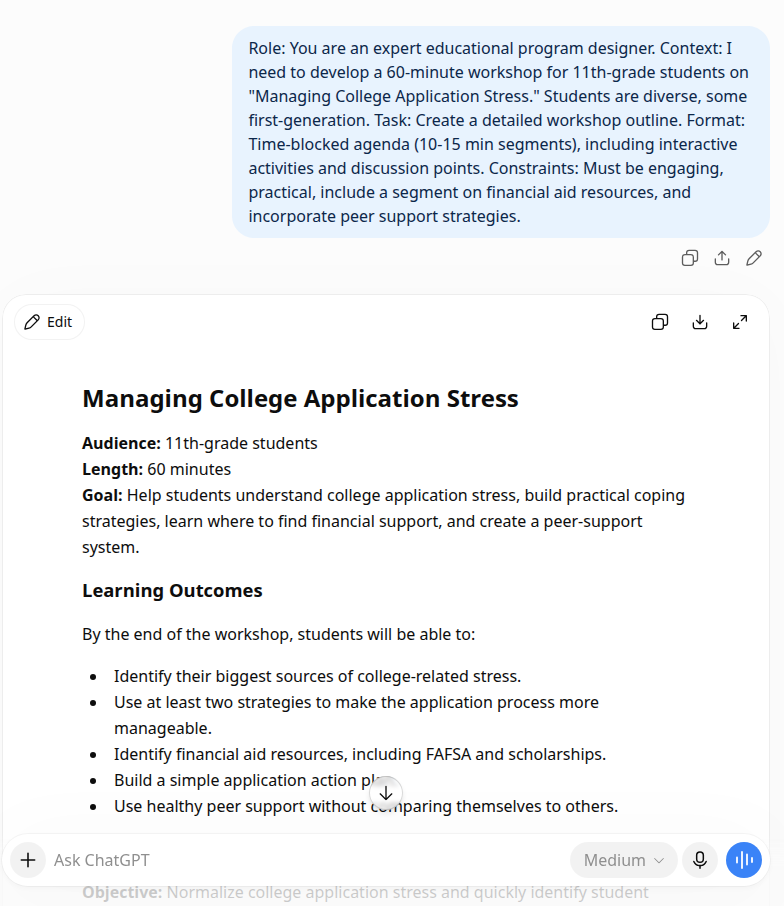
A counselor needs to design a 60-minute workshop on "Managing College Application Stress" for 11th graders, many of whom are first-generation college applicants. Rather than manually researching best practices and assembling slides, the counselor uses RCTFC: Role: "You are an expert educational program designer." Context: "I need to develop a 60-minute workshop for 11th-grade students on 'Managing College Application Stress.' Students are diverse, some first-generation." Task: "Create a detailed workshop outline." Format: "Time-blocked agenda (10–15 min segments), including interactive activities and discussion points." Constraints: "Must be engaging, practical, include a segment on financial aid resources, and incorporate peer support strategies." The AI generates an outline like: 0–5 min: Welcome & ice-breaker ("Share one word describing your college application feelings"); 5–15 min: Normalize stress (data on first-generation students, testimonial video); 15–25 min: Interactive activity (small groups brainstorm their biggest stressors, report back); 25–35 min: Practical stress-management strategies (breathing techniques demo, time-management templates); 35–45 min: Financial aid basics (FAFSA walkthrough, scholarship resources handout, Q&A); 45–55 min: Peer support panel (current college students, preferably first-generation, share their experiences); 55–60 min: Close with resources (counselor contact info, mental health services, college planning website). This structure ensures the workshop is interactive, addresses the specific anxieties of first-generation students, includes concrete resources, and leverages peer support—all developed in minutes rather than hours.
Summary
The RCTFC framework and these three prompts form an integrated toolkit for modernizing guidance counseling practice. By mastering RCTFC—Role, Context, Task, Format, Constraints—you transform AI from a frustrating, hit-or-miss tool into a reliable, personalized assistant. The first prompt harnesses AI to generate tailored career exploration pathways that speak to individual student profiles, moving beyond generic advice into actionable, agency-building guidance. The second prompt leverages AI's ability to draft emotionally intelligent communications, saving you time and mental load on sensitive conversations while maintaining your professional voice and values. The third prompt accelerates resource curation and workshop design, enabling you to deliver more frequent, more relevant programming with less preparation burden. Together, these three prompts address the core time-intensive and emotionally demanding aspects of counseling work—personalization, communication, and program development. The overarching message is that AI, when prompted strategically, amplifies rather than replaces human counseling expertise. These tools don't diminish the irreplaceable human elements of your work—the trust, empathy, and nuanced judgment you bring to student conversations. Instead, they handle the scaffolding and drafting, freeing you to do more of the genuine relational work that makes guidance counseling powerful. By investing time upfront in learning RCTFC and customizing these three prompts to your context, you create reusable templates that compound your efficiency and impact over time.
Next Steps
Start by selecting one of the three prompts that addresses your most pressing current challenge—whether that's helping undecided students with career planning, managing a difficult parent communication, or designing an upcoming workshop. Customize that prompt using the RCTFC framework and your specific context (student names, concerns, populations), then test it with your preferred AI tool. Take the output and refine it with your professional judgment and voice, noting what worked well and what you'd adjust next time. As you gain confidence with the first prompt, layer in the others. Consider saving your most effective customized prompts as templates in a shared document with counseling colleagues, multiplying the impact across your team. Finally, pay attention to what constraints and specifications yield the best results for your context—over time, you'll develop an intuitive sense of how to calibrate each element of RCTFC to your particular student population and counseling style.