Unlocking Your Brainpower: 3 ChatGPT Prompts Every College Student Should Master
Ever felt like your brain is a brilliant but sometimes chaotic library, and you just need a super-efficient librarian to find what you need? Welcome to the era of AI. Forget just asking ChatGPT "write me an essay" – we're diving into how to truly converse with this powerful tool to make your college life not just easier, but smarter and way more productive. Get ready to elevate your academic game!
Overview
ChatGPT has become an indispensable tool for college students, but its true power emerges only when you know how to communicate with it effectively. Rather than asking vague questions and hoping for useful answers, mastering strategic prompting techniques transforms ChatGPT from a simple search alternative into a personalized academic partner—a brainstorming collaborator, study guide generator, and learning accelerator all in one. This guide equips you with a proven framework and three essential prompt types that will fundamentally change how you approach essays, research, note-taking, and exam preparation, making your college experience not just easier, but genuinely smarter and more productive.
What You'll Learn
- Understand and apply the RCTFC prompting framework (Role, Context, Task, Format, Constraints) to craft precise, effective ChatGPT requests
- Master the Brainstorming Dynamo prompt to overcome writer's block and generate well-structured essay outlines and thesis statements
- Use the Academic Architect prompt to efficiently summarize dense reading material and transform lecture notes into actionable study materials
- Leverage the Study Buddy Sensei prompt to create personalized study guides, practice questions, and exam preparation tools tailored to your courses
The Foundation: Your RCTFC Playbook
The RCTFC framework is the cornerstone of effective AI communication. Rather than relying on hope when asking ChatGPT questions, RCTFC provides a structured recipe that ensures consistent, high-quality responses. Think of it as giving your AI assistant a complete job description: who they should be, what context they're working within, exactly what you need them to do, how you want the answer formatted, and what boundaries they should respect. Without this structure, you're essentially shouting into the void and hoping for the best. With it, you're orchestrating a symphony of helpfulness. Breaking down each component: Role Definition establishes who ChatGPT should pretend to be (an academic coach, a professional editor, a study guide creator), which shapes the expertise and tone of the response. Context Setting provides the background information ChatGPT needs to understand your situation and constraints, such as your academic level, subject background, or the specific challenge you're facing. Task Specification articulates your precise objective—what you actually want ChatGPT to produce or help you accomplish. Format Prescription dictates how the answer should be structured, whether that's a two-paragraph explanation, a numbered list, bullet points, or a table. Finally, Constraints Application sets guardrails around the response, such as word limits, language complexity, topics to avoid, or specific requirements your assignment demands. The power of RCTFC lies in its ability to eliminate ambiguity. When you provide all five elements, ChatGPT can deliver responses that are not just relevant but precisely tailored to your needs. This transforms prompting from a guessing game into a deliberate, effective communication strategy. You're no longer a passive recipient of whatever the AI decides to generate; you become the conductor, shaping both the content and the delivery.
- RCTFC stands for Role Definition, Context Setting, Task Specification, Format Prescription, and Constraints Application
- Each element serves a specific purpose in clarifying your request and guiding ChatGPT's response
- Structured prompting yields more relevant, tailored, and useful outputs than vague or casual requests
- Using RCTFC empowers you to be deliberate with AI, treating it as a tool you actively control rather than a magic answer generator
Lab: Lab Exercise
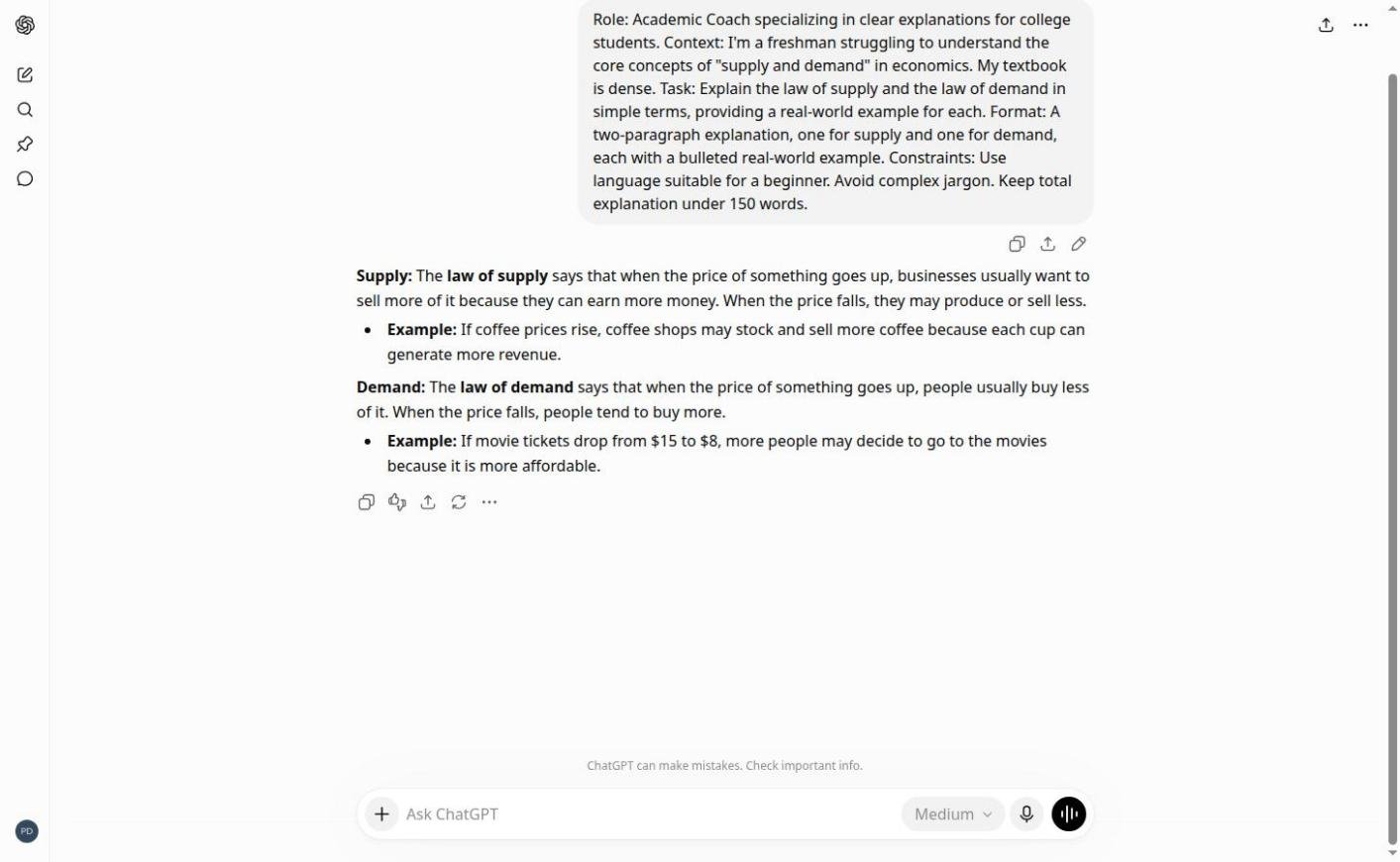
Consider a freshman struggling with supply-and-demand economics. Instead of asking ChatGPT "explain supply and demand," apply RCTFC: Set your Role as an Academic Coach specializing in clear explanations for college students. Provide Context that you're a freshman finding your textbook overwhelming. State your Task clearly: explain the law of supply and the law of demand in simple terms with a real-world example for each. Prescribe your Format as a two-paragraph explanation (one for supply, one for demand) with bulleted examples underneath. Apply Constraints by specifying beginner-level language, minimal jargon, and a 150-word maximum. When you submit this prompt to ChatGPT, you receive a focused, accessible explanation perfectly calibrated to your academic level and specific needs—far more useful than a generic textbook-style definition. This is the power of structure: it transforms a vague request into a precisely defined task that even an AI can execute flawlessly.
Prompt 1: The Brainstorming Dynamo
Writer's block is one of the most frustrating obstacles in college life. Whether you're facing a blank page before a major essay, trying to identify an angle for a research project, or attempting to develop a thesis statement that actually interests you, that initial moment of creative paralysis can derail your entire timeline. This is where the Brainstorming Dynamo prompt becomes invaluable. Rather than staring at a blinking cursor hoping inspiration strikes, you can leverage ChatGPT to generate diverse perspectives, potential essay outlines, and challenging research questions that spark genuine intellectual engagement. The Brainstorming Dynamo prompt works by asking ChatGPT to think expansively about your topic, offering multiple competing angles and arguments you might explore. This serves two critical functions: it breaks through the creative inertia of a blank page, and it forces you to consider your topic from various perspectives before committing to a single direction. The prompt generates raw material—multiple thesis statements, supporting arguments, and structural options—that you then evaluate, refine, and integrate into your own thinking. You're not accepting ChatGPT's suggestions wholesale; you're using them as a springboard for your own critical analysis and decision-making. This approach actually enhances your learning rather than circumventing it. By engaging with ChatGPT's suggestions and choosing which directions to develop, you're actively thinking through your assignment, weighing options, and developing your own intellectual position. The AI handles the cognitive load of generating possibilities while you exercise judgment and creativity in selecting and developing the most promising ideas.
- The Brainstorming Dynamo prompt transforms ChatGPT into a creative collaborator that generates multiple angles, thesis statements, and supporting arguments
- Using this prompt breaks through writer's block by providing raw material to react to rather than generating from nothing
- Multiple options force you to think critically about your topic and make deliberate choices about which direction to pursue
- This approach enhances learning by keeping you actively engaged in decision-making rather than passively accepting AI-generated content
Lab: Lab Exercise
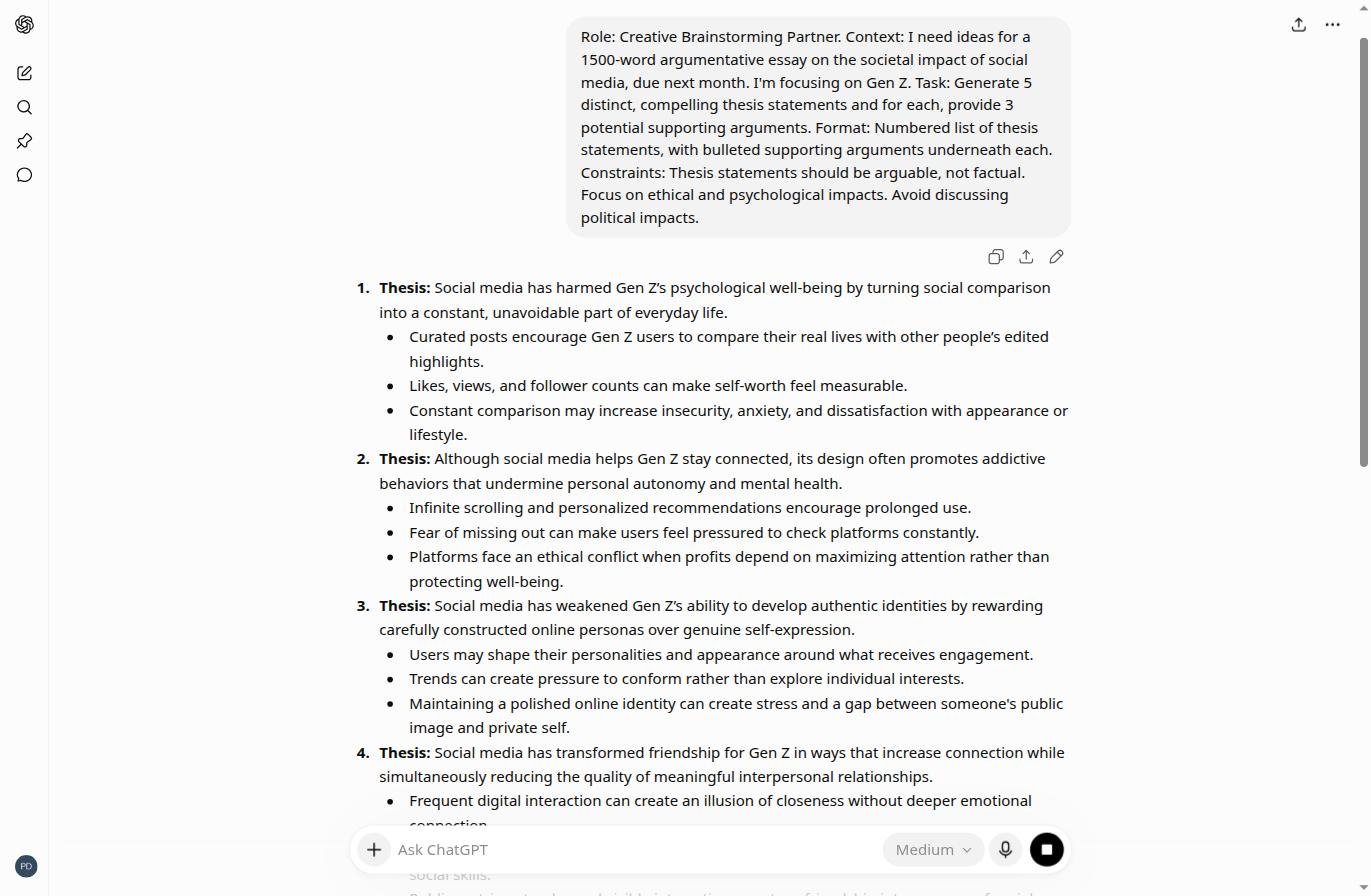
Imagine you need to write a 1500-word argumentative essay on the societal impact of social media for Gen Z, due in a month. Instead of spending hours staring at your blank document trying to formulate a thesis, you use the Brainstorming Dynamo prompt with these specifications: Role as a Creative Brainstorming Partner, Context that you need ideas for this specific essay with its deadline and audience focus, Task to generate 5 distinct and compelling thesis statements with 3 supporting arguments each, Format as a numbered list with bulleted arguments under each thesis, and Constraints that thesis statements must be arguable (not factual), focus on ethical and psychological impacts, and avoid political angles. ChatGPT delivers five well-developed thesis options—perhaps one focusing on dopamine-driven addiction mechanisms, another on parasocial relationships and mental health, another on identity fragmentation and authenticity—each with three potential supporting arguments already outlined. You review these options, find that the parasocial relationships angle resonates most with you, and use that thesis as your starting point, then develop your own supporting arguments based on your reading and thinking. You've now moved from paralysis to momentum, from a blank page to a structured plan, and you've done so while remaining intellectually engaged with the material.
Prompt 2: The Academic Architect
College inundates you with information: dense textbook chapters, rapid-fire lecture notes, long academic articles, research papers, and primary source documents. The sheer volume can feel overwhelming, and trying to absorb and retain everything in its original form is neither practical nor effective. This is where the Academic Architect prompt becomes crucial. It transforms ChatGPT into a personal summarization and note-taking specialist, capable of distilling vast amounts of complex information into concise, digestible, and truly useful study materials. The Academic Architect prompt addresses a fundamental challenge in academic learning: the difference between volume and value. You could read a hundred pages and retain almost nothing, or you could read twenty pages and then spend time transforming that information into a well-structured summary with key concepts highlighted, and retain significantly more. By asking ChatGPT to summarize dense material, extract core arguments, and reorganize information into study-friendly formats, you're not skipping the learning—you're optimizing it. You're moving from passive reading toward active engagement with the material. The summarization process itself becomes a learning tool because it forces you to identify what's actually essential versus what's supporting detail. This prompt is particularly powerful for three types of academic work: condensing dense research papers into their key findings and implications, transforming rambling lecture notes into clean, organized study materials, and breaking down complex concepts into their component parts. In each case, the output becomes raw material for genuine learning and retention. You're reclaiming study time by spending less time searching for important information and more time understanding and applying it.
- The Academic Architect prompt helps you condense complex information into actionable, study-friendly formats
- Efficient summarization and note-taking don't replace learning; they enhance it by focusing your effort on what's truly important
- Well-organized summaries with key bullet points are far more useful for retention and exam preparation than original dense texts
- This prompt transforms ChatGPT into a tool for optimizing study efficiency without sacrificing comprehension
Lab: Lab Exercise
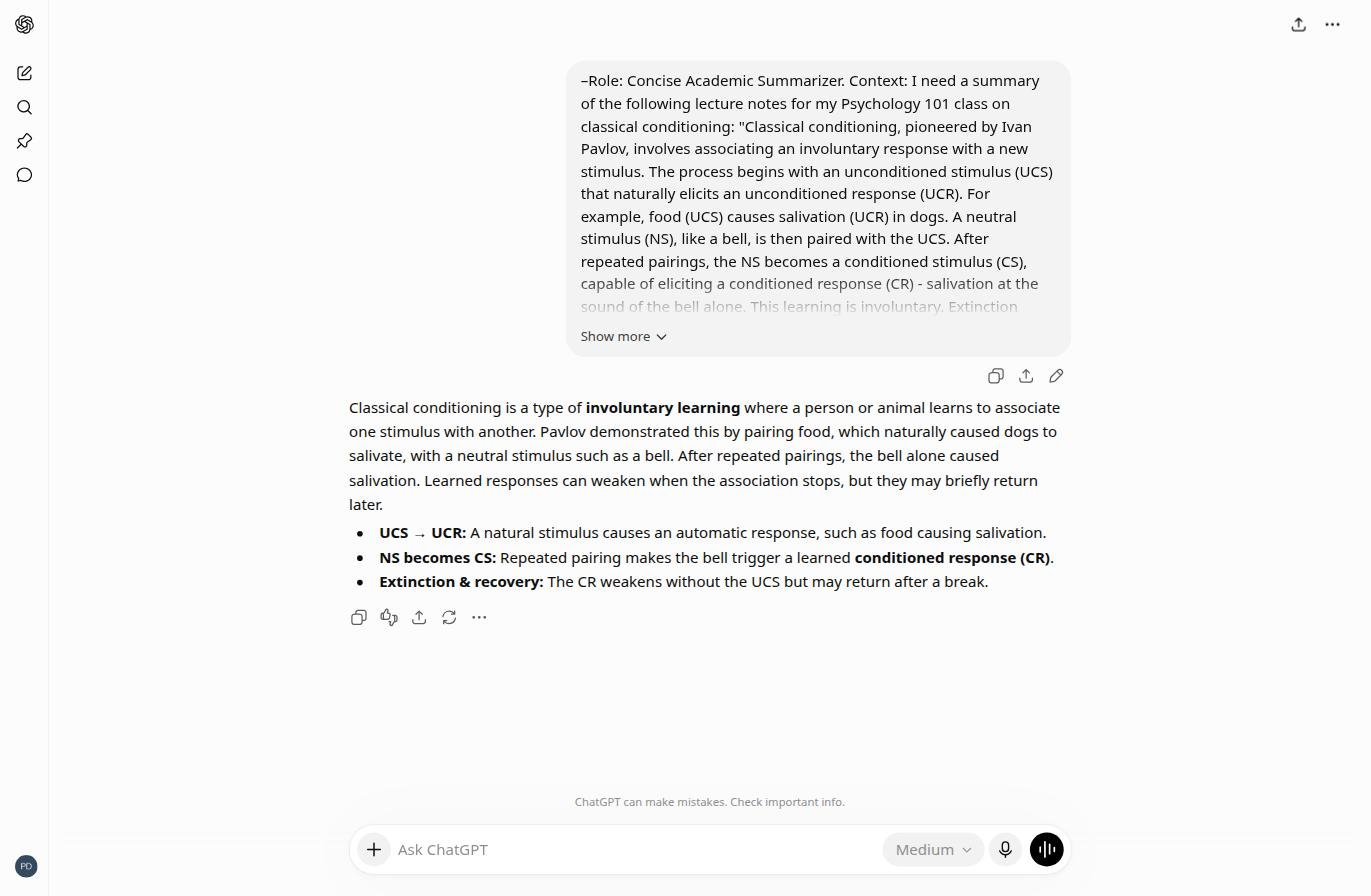
You're preparing for Psychology 101 and just received detailed lecture notes on classical conditioning. The notes include definitions of unconditioned stimuli, conditioned stimuli, unconditioned responses, conditioned responses, extinction, and spontaneous recovery—all explained in paragraph form with minimal structure. Rather than copying these notes verbatim and hoping they stick, you use the Academic Architect prompt: Role as a Concise Academic Summarizer, Context that this is for Psychology 101 and you're a beginner in the subject, Task to summarize the key concepts, Format as one paragraph (maximum 100 words) followed by 3 main bullet points, and Constraints of clear, simple language suitable for beginners. ChatGPT delivers something like: a focused paragraph explaining that classical conditioning involves pairing a new stimulus with an automatic response until the new stimulus alone triggers that response, followed by bullet points covering (1) the core mechanism—neutral stimulus paired with unconditioned stimulus becomes a conditioned stimulus, (2) the learning process through repeated pairing, and (3) extinction and spontaneous recovery as ways conditioned responses can diminish or reappear. This output is far more useful than your original notes because it's structured for learning: you immediately see what matters, the connections between concepts, and what you need to understand deeply versus what's supporting detail. When exam day arrives, these bullet points are your study anchor.
Prompt 3: The Study Buddy Sensei
Exam season introduces a particular kind of stress: the pressure to transform weeks of learning into reliable performance under time constraints. Generic online quizzes rarely match your course content precisely, and creating your own practice materials is time-consuming. The Study Buddy Sensei prompt solves this by transforming ChatGPT into a personalized exam preparation specialist who can instantly generate custom study guides and practice questions tailored to your specific courses and learning needs. Rather than hoping that random online resources align with what your professor emphasized, you're creating practice materials that directly target your course content. The power of this prompt lies in customization and active learning. When ChatGPT generates practice questions specifically about your course material at your specified difficulty level, you're engaging in the most effective form of exam preparation: retrieval practice. By attempting to answer targeted questions, getting feedback, and identifying knowledge gaps, you're building the neural pathways that will fire during the actual exam. The Sensei prompt goes further by creating study guides that organize course content strategically, helping you see how concepts connect and which areas need deeper study. You can request multiple rounds of questions at increasing difficulty, create guides focused on specific units or topics, and tailor everything to your professor's emphasis and your learning style. This approach transforms exam preparation from a passive, anxiety-filled review process into an active, strategic engagement with course material. You're not just reading notes and hoping you remember them; you're practicing retrieval, identifying gaps, filling them, and building confidence through successful repeated exposure to the material in question format.
- The Study Buddy Sensei prompt generates personalized study guides and practice questions tailored to your specific courses and exams
- Custom practice questions are more effective than generic online resources because they target your course content precisely
- Retrieval practice—attempting to answer targeted questions—is one of the most effective exam preparation strategies available
- This prompt allows you to identify knowledge gaps before the exam and address them strategically
Lab: Lab Exercise
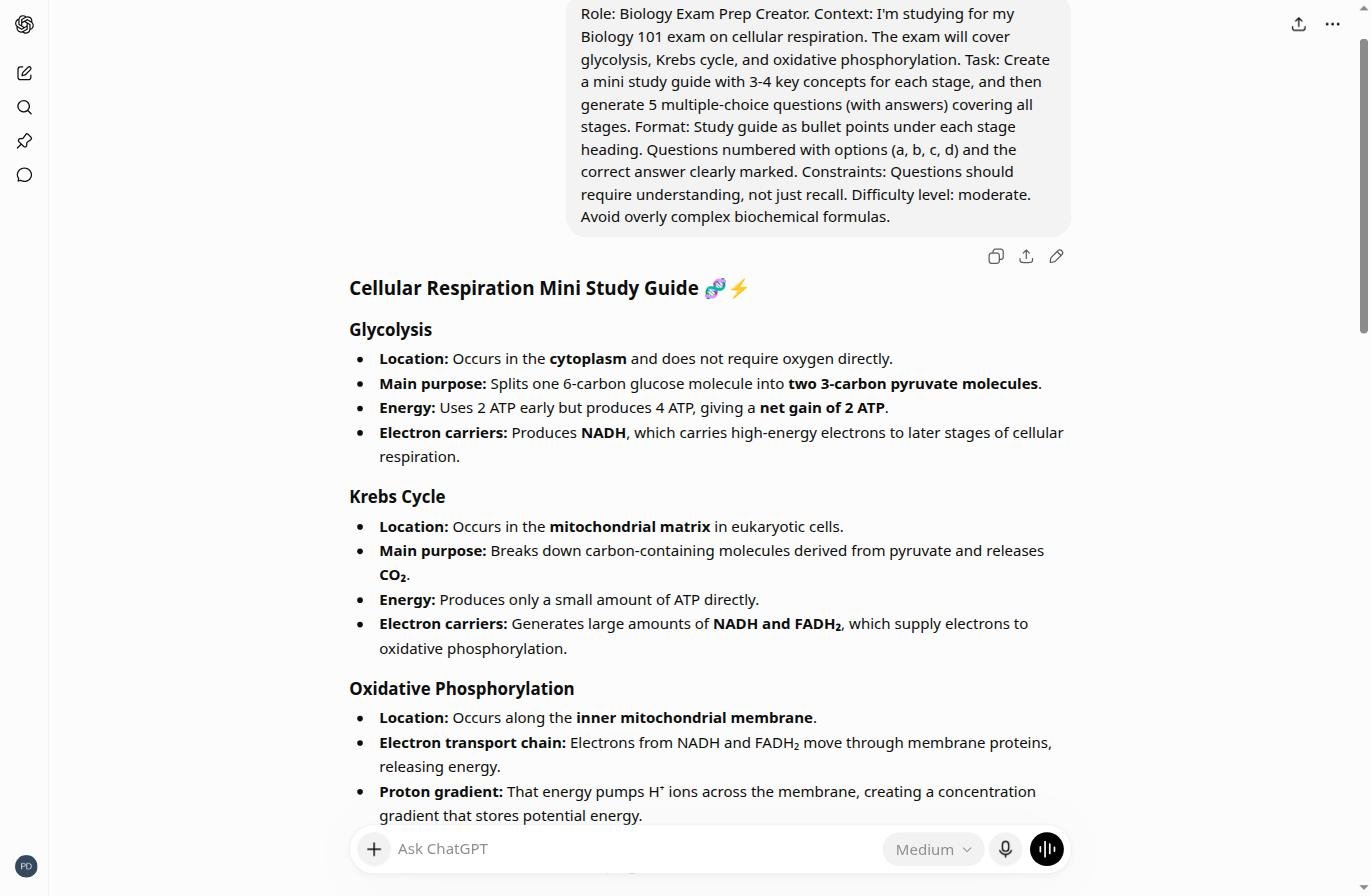
You're facing your Biology 101 exam on cellular respiration, which will cover glycolysis, the Krebs cycle, and oxidative phosphorylation. Rather than searching for generic biology practice questions that may not match your professor's focus, you use the Study Buddy Sensei prompt: Role as a Biology Exam Prep Creator, Context that you're studying for this specific exam covering these three stages, Task to create a mini study guide with 3-4 key concepts for each stage plus 5 multiple-choice questions covering all stages, Format as bulleted study guide followed by numbered multiple-choice questions with marked correct answers, and Constraints that questions should test understanding rather than mere recall, difficulty should be moderate, and overly complex biochemical formulas should be avoided. ChatGPT delivers a focused study guide highlighting that glycolysis breaks glucose into pyruvate and produces 2 ATP molecules and electron carriers, that the Krebs cycle (citric acid cycle) oxidizes pyruvate to extract electrons and generate ATP and electron carriers, and that oxidative phosphorylation uses electron carriers to generate the majority of ATP through chemiosmosis. Then you receive five carefully crafted multiple-choice questions—for example, one asking why the Krebs cycle is considered a cycle (testing conceptual understanding), another asking how many ATP molecules are produced in glycolysis (testing recall at moderate difficulty), another linking the outputs of one stage to inputs of the next (testing integration). You work through these questions, note which concepts you struggled with, review those areas, then request another set of questions to verify your improved understanding. By exam time, you've practiced retrieval in a format matching the actual test and built genuine confidence in your understanding.
Summary
Mastering ChatGPT for college success isn't about using AI to avoid learning—it's about using AI as a strategic tool to learn more effectively. The RCTFC framework provides the foundation, ensuring that every interaction with ChatGPT is precise, intentional, and tailored to your specific needs. The three essential prompts—Brainstorming Dynamo, Academic Architect, and Study Buddy Sensei—address the major academic challenges you'll face: overcoming creative paralysis and developing strong ideas, processing overwhelming amounts of information efficiently, and preparing for exams with confidence and targeted practice. When you combine these prompts with RCTFC's structured approach, ChatGPT transforms from a generic chatbot into your personal academic partner. The underlying principle unites all three prompts: you remain the active learner, the decision-maker, and the thinker. ChatGPT handles the cognitive labor of generating possibilities, summarizing information, or creating practice materials, while you exercise judgment, make choices, and engage deeply with your material. This division of labor doesn't diminish your learning—it enhances it by freeing you from busywork and allowing you to focus your intellectual energy where it matters most. Your college experience becomes not just manageable, but genuinely brilliant.
Next Steps
Start applying the RCTFC framework to your very next ChatGPT interaction—whether that's generating ideas for an upcoming assignment, summarizing readings for a class, or creating practice questions for an upcoming exam. Pay attention to which components of RCTFC have the most impact on the quality of ChatGPT's responses, and refine your prompting based on what you learn. As you become comfortable with these three essential prompts, experiment with combining them or adapting them to other academic challenges you encounter. Share what you discover with your classmates—your refinements to these prompts might spark even more effective strategies for everyone in your study groups.