The Hidden Way to Turn Goals Into Tasks
Ever stare at a brilliant goal, feeling it stare back, utterly un-task-ified and overwhelming? Today, we're unlocking the secret handshake to transform lofty aspirations into clear, actionable steps, turning that overwhelming feeling into "game on!"
Overview
Goals and tasks exist in fundamentally different domains: goals are aspirational destinations, while tasks are concrete, actionable steps. This lesson bridges what we call the "great goal-to-task divide"—the chasm between inspiring ambitions and the practical work required to achieve them. Most people excel at dreaming big but struggle to translate those dreams into a coherent action plan, leading to overwhelm and inaction. By combining strategic analysis with the RCTFC framework (Role, Context, Task, Format, Constraints) and leveraging AI as a thinking partner, you can systematically deconstruct any goal into a prioritized, executable task list that transforms "I want to do this" into "here's exactly what I do next."
What You'll Learn
- Understand why the gap between goals and tasks exists and how it creates paralysis
- Identify conceptual barriers blocking a goal and develop high-level task categories to overcome them
- Apply the RCTFC framework to decompose complex goals into structured, phased task lists
- Recognize task dependencies and prioritize tasks based on impact, urgency, and strategic sequence
- Use AI as an intelligent partner in goal-to-task conversion rather than a simple task generator
Understanding the Goal-to-Task Divide
The gap between aspiration and action is not a failure of motivation—it is a cognitive mismatch. Our brains are exceptionally good at conceptualizing grand visions: "launch a business," "write a book," "achieve financial independence." These statements feel energizing and clear in the moment. However, they remain abstract. They describe a destination but provide no map of the terrain, no waypoints, no sense of sequence or effort required. When you try to move from the inspirational statement to actual work, the scale becomes paralyzing. The sheer breadth of possible actions creates decision paralysis. Should you start with marketing? Product development? Financial planning? The vagueness doesn't just slow you down; it stops you entirely. This is not a personal failing. It reflects how human brains allocate cognitive resources. We are wired to think in narratives and big pictures. The granular, sequential, and specific thinking required to convert goals into tasks is a different cognitive mode—one that does not come naturally to most people. Without external structure or assistance, we either remain stuck in abstraction or we begin tackling tasks randomly, hoping something sticks. The solution is to bridge this divide intentionally by first clarifying the strategic landscape (what are the actual obstacles?), then systematically decomposing the goal into manageable, sequenced work.
- Goals are abstract aspirations; tasks are concrete, sequenced actions—they live in different cognitive modes
- The overwhelm we feel is not a lack of motivation but a lack of structure and clarity about the path forward
- Strategic analysis of barriers comes before task generation, providing the foundation for impactful work
- AI can serve as a clarity compass, helping you externalize and organize your thinking about the obstacles between you and your goal
Lab: Lab Exercise
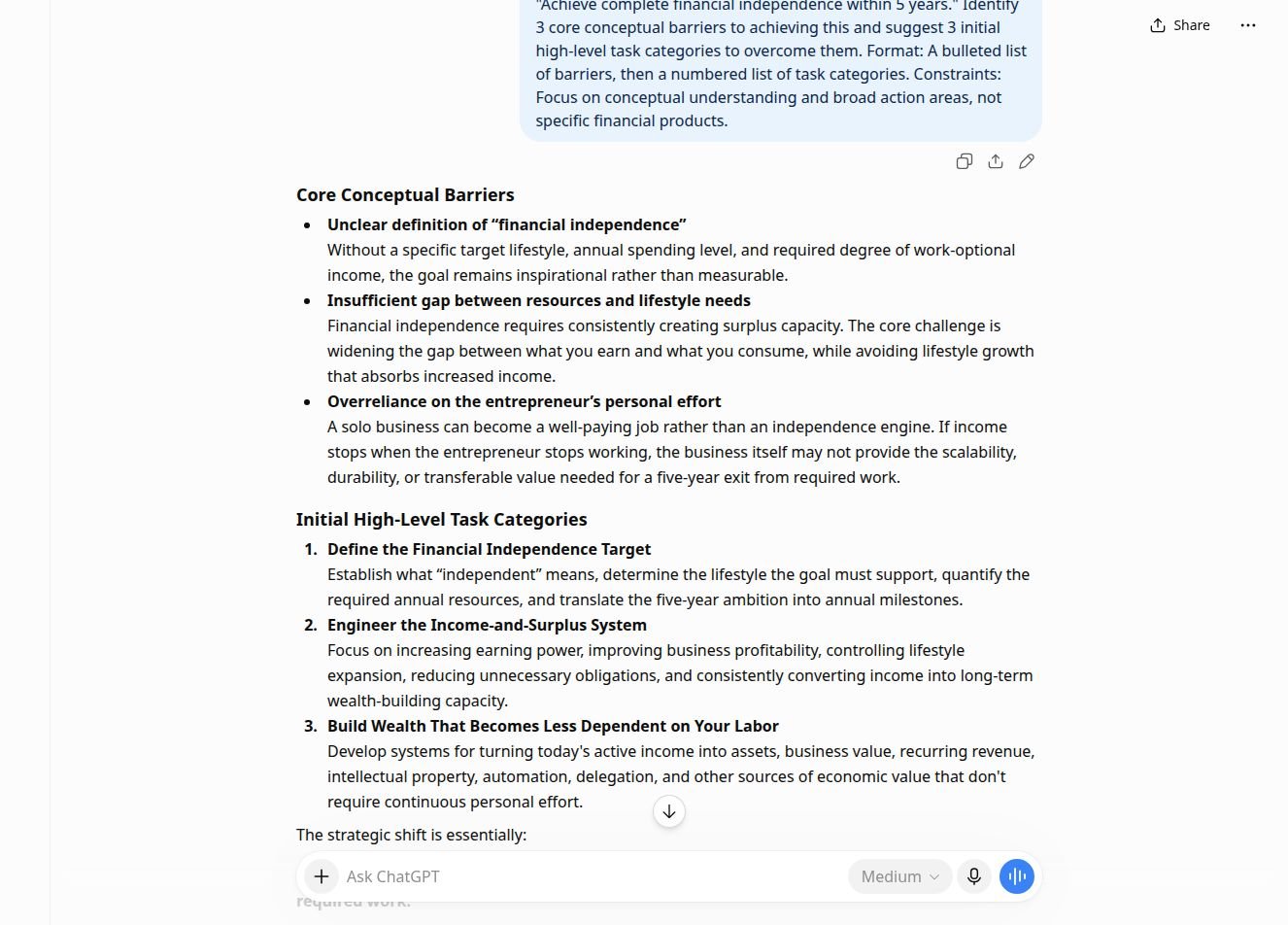
Consider the goal "Achieve complete financial independence within 5 years." At first glance, this feels like a clear destination. But what does it actually require? How much money? What income level? What expenses? What investments? What skills do you need to develop? What constraints exist? Rather than jumping to tasks like "open a savings account" or "research investments," the strategic first step is to identify the conceptual barriers: perhaps you lack a clear definition of "financial independence," you do not understand wealth-building strategies, or you have not assessed your current financial position. Once these barriers are surfaced, you can create high-level task categories to address them: (1) Define financial independence numerically and clarify your target timeline, (2) Research and learn wealth-building fundamentals (income growth, investing, asset allocation), (3) Conduct a comprehensive financial audit to establish your baseline and identify gaps. This approach transforms vague dread into focused, strategic clarity before any detailed task work begins.
The RCTFC Framework: Your Goal-Breaking Blueprint
With the strategic landscape clarified, the next phase requires precision. The RCTFC framework is a structured prompt engineering method that ensures your instructions to AI are crystal clear, eliminating vagueness and maximizing output quality. Each element serves a distinct function: Role defines who the AI should be (a project manager, a strategic consultant, a domain expert), creating a persona that shapes the AI's reasoning and vocabulary. Context provides the situational parameters—what constraints, deadlines, or resources are in play. Task states explicitly what you want the AI to produce. Format specifies exactly how you want that output structured (numbered lists, tables, phases with subtasks). Constraints add guardrails, ensuring the AI stays focused and does not propose solutions that are irrelevant or impossible given your circumstances. When applied to goal decomposition, RCTFC prevents the common failure mode of AI responses that are either too generic ("create a marketing plan") or too specific to wrong scenarios (suggesting enterprise-scale solutions for a solo operator). By specifying that you are a solo creator with existing expertise, you get tasks that respect your actual capacity. By specifying the output format (numbered phases with bulleted subtasks), you receive a structure you can immediately act upon rather than prose you must interpret. The framework is not bureaucratic overhead; it is precision engineering for thought partnership. Each dial (Role, Context, Task, Format, Constraints) allows you to fine-tune the AI's output to match your actual situation and needs.
- RCTFC stands for Role, Context, Task, Format, and Constraints—each element guides AI toward clearer, more useful output
- Role and Context ensure the AI understands who you are and what your situation actually entails, preventing irrelevant suggestions
- Task and Format transform abstract requests into specific deliverables with usable structure
- Constraints act as safety rails, preventing the AI from proposing solutions that do not fit your capacity or scenario
- Precision in prompt construction directly correlates with actionability of output—vague prompts yield vague results
Lab: Lab Exercise
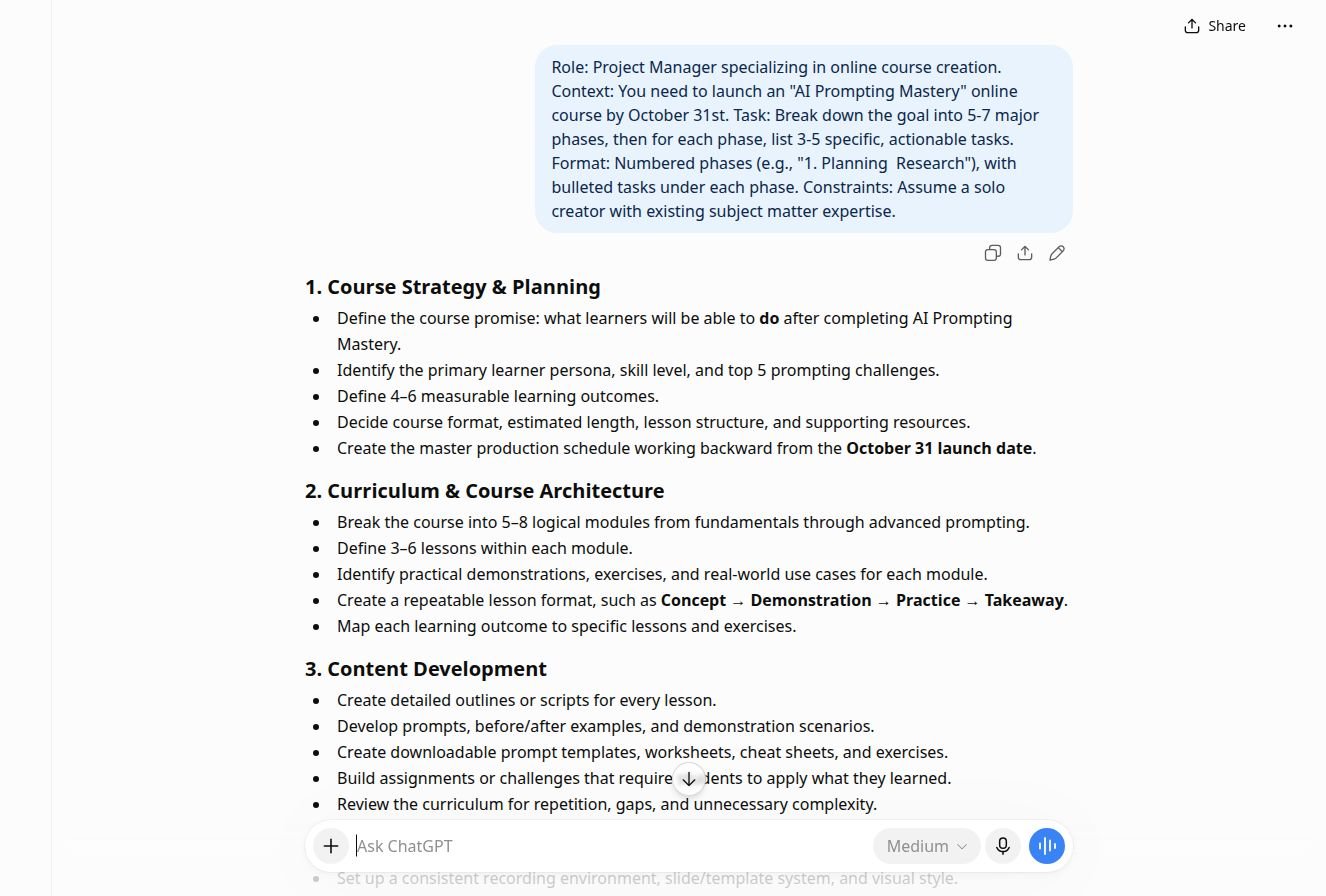
Imagine you want to launch an "AI Prompting Mastery" online course by October 31st as a solo creator with subject matter expertise. A vague prompt like "Help me launch a course" yields generic, broad suggestions. With RCTFC, you would frame it: Role: "You are a project manager specializing in online course creation."; Context: "I am a solo creator with existing subject matter expertise, launching by October 31st."; Task: "Break down the goal into 5-7 major phases. For each phase, list 3-5 specific, actionable tasks."; Format: "Numbered phases (e.g., '1. Planning & Research') with bulleted tasks under each."; Constraints: "Assume solo operation with existing expertise." The AI response you receive would be something like: "1. Planning & Research (2 weeks): Define course structure and modules; research competitor offerings; outline learning objectives. 2. Content Development (4 weeks): Write module scripts; create outline slides; develop supplementary materials. 3. Production (3 weeks): Record video modules; edit and format videos; create thumbnail graphics. 4. Technical Setup (2 weeks): Set up payment gateway; build landing page; configure email automation. 5. Marketing Launch (2 weeks): Finalize marketing copy; create promotional assets; execute pre-launch campaign." Notice the specificity: tasks are sequenced in phases, realistic timeframes are implied, and everything respects the solo-operator constraint. This structure is immediately actionable, whereas generic advice would require you to do the decomposition work yourself.
Refining and Prioritizing Tasks for Strategic Execution
Generating a comprehensive task list is a crucial step, but it introduces a new problem: without prioritization and dependency mapping, a long list can feel as paralyzing as the original goal. Not all tasks carry equal weight. Some are foundational—they must happen before other work can begin. Others are high-impact but low-urgency. Still others are busy work that gives the illusion of progress without moving you meaningfully forward. The refinement phase addresses this by asking three critical questions: What must happen before something else? (dependency mapping); What tasks drive the most progress toward the goal? (impact assessment); and What is blocking other work from starting? (bottleneck identification). Dependency mapping reveals the logical sequence of work. If you need to record videos but have not yet outlined modules, you have a blocker. If you cannot set up a payment gateway until your landing page exists (because you need the URL), there is a dependency. By surfacing these relationships, you can identify the critical path—the minimum sequence of work that unlocks everything else. Prioritization then layered atop this foundation. A task might be high-impact (without it, nothing else works well) but low-urgency (you could theoretically do it later). A task might be high-urgency (a deadline is approaching) but low-impact (it does not unlock subsequent work). Strategic prioritization favors tasks that are both high-impact and appropriately urgent, with special attention to tasks that unlock other work (reducing total cycle time). This is where solo operators gain enormous advantage by thinking like strategists rather than just task-checkers. By identifying which domino to push first, you create momentum and prevent the demoralizing experience of completing many tasks while the core work remains undone. AI is particularly valuable here because it can rapidly analyze a task list, surface dependencies you might miss, and propose prioritization that balances urgency with strategic sequencing.
- Task lists without prioritization remain overwhelming; prioritization converts lists into roadmaps
- Dependencies are constraints that determine the logical sequence of work—identify them early to prevent blockers
- High-impact tasks are those that unlock other work or directly move you toward the core goal; prioritize these
- Bottlenecks are tasks whose completion unblocks multiple downstream activities; these are prime candidates for early prioritization
- AI can rapidly identify dependencies and propose prioritization strategies that balance impact, urgency, and sequence
Lab: Lab Exercise
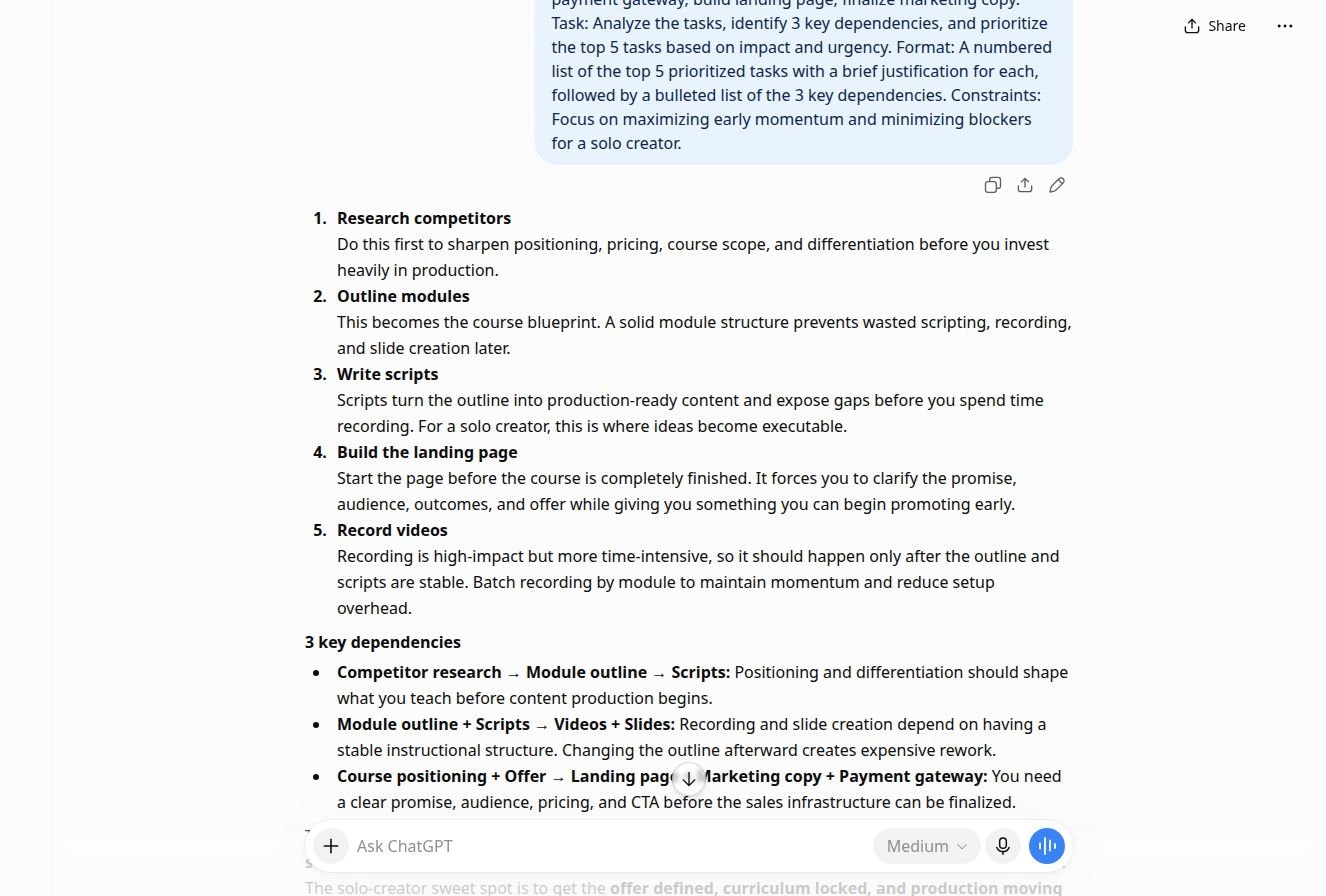
Suppose you have these course development tasks: research competitors, outline modules, write scripts, record videos, create slides, set up payment gateway, build landing page, finalize marketing copy. Without analysis, you might prioritize based on ease (maybe research competitors because it feels manageable) or based on urgency (maybe marketing copy because launch is soon). Strategic analysis reveals dependencies: you cannot write scripts until modules are outlined; you cannot record videos until scripts exist; you cannot set up payment gateway until the landing page exists (you need the URL); you cannot finalize marketing copy without knowing the course structure and features. From this, the critical path emerges: outline modules → write scripts → record videos forms one dependency chain. In parallel, design and build landing page, then set up payment gateway. Marketing copy depends on knowing course details from the outline phase. A strategic prioritization of the top 5 tasks might be: (1) Outline modules—foundational, unblocks scripts and marketing content; (2) Research competitors (in parallel with step 1)—informs positioning and ensures market viability; (3) Write scripts—required before recording, part of critical path; (4) Design and build landing page—must exist before payment setup, informs funnel; (5) Record videos—completes the core content creation. Notice that this sequence respects dependencies (scripts before recording), prioritizes tasks that unlock others (modules outline unblocks multiple paths), and respects the solo-operator reality (tasks can be done in parallel where possible, but core sequence is clear). Finalizing marketing copy and setting up payment gateway become subsequent tasks once these five are complete, but they do not block progress on the core deliverable.
Summary
The journey from goal to actionable execution is not mysterious or magical—it follows a repeatable process. First, understand the strategic landscape by identifying the conceptual barriers blocking your goal, transforming abstract dread into focused barriers-to-address. Second, apply the RCTFC framework to decompose the goal into structured, phased task lists that respect your actual situation and constraints. Third, refine and prioritize those tasks by mapping dependencies, assessing impact, and identifying which dominoes to push first. Throughout this process, AI serves not as a replacement for your thinking but as a powerful partner in clarifying, decomposing, and strategizing. The hidden way is not hidden at all—it is a systematic approach to translating aspiration into action. By embracing strategic analysis before task generation, precision in prompting, and intentional prioritization, you transform the overwhelming cliff face into a clear trail with visible next steps. This is not about being busy; it is about being strategic, focused, and genuinely moving toward your ambition with clarity and momentum.
Next Steps
Take one goal you are currently working toward and apply the three-phase process: (1) Use AI to identify the conceptual barriers blocking this goal and the high-level task categories needed to overcome them, (2) Use RCTFC to decompose the goal into a phased task list appropriate to your role and constraints, (3) Analyze the task list for dependencies and prioritize the top five tasks based on impact and urgency. Notice how much clearer your path forward becomes. For deeper mastery of AI prompting and how to structure instructions for maximum clarity, watch the full RCTFC video referenced in the lesson materials.