The Content Creator's ChatGPT Cheat Sheet: 3 Prompts You CANNOT Live Without!
Ever feel like you're playing a frustrating game of charades with ChatGPT, trying to get it to *get* what you actually need? Well, my friend, the secret isn't magic words, it's structure! We're about to unlock three game-changing prompts that will transform your AI interactions from a guessing game into a powerhouse partnership, making your content creation flow like a perfectly brewed artisanal coffee.
Overview
Effective communication with ChatGPT hinges not on magic words, but on structural clarity. This guide introduces three essential prompting strategies that transform ChatGPT from a generic chatbot into a powerful content creation partner. By mastering these three prompts—grounded in the RCTFC framework (Role, Context, Task, Format, Constraints)—content creators can reliably generate audience-resonant ideas, repurpose existing content across platforms, and build SEO-optimized outlines that drive both engagement and search visibility. The difference between frustrating, vague AI responses and brilliant, actionable outputs lies in how you structure your instructions.
What You'll Learn
- Understand the RCTFC framework as the foundation for all effective ChatGPT prompts
- Use persona-driven prompting to generate content ideas that deeply resonate with your target audience
- Repurpose existing content into new formats to maximize reach and platform presence without duplicating effort
- Build keyword-rich, SEO-optimized outlines that guide your writing and improve search visibility
- Apply these three essential prompts to transform your content creation workflow
The Secret Sauce: Understanding RCTFC
Before applying any of the three essential content creation prompts, you must first master RCTFC—the foundational framework that determines whether ChatGPT delivers generic responses or precisely targeted outputs. RCTFC is an acronym representing five critical components: Role, Context, Task, Format, and Constraints. Think of it as giving your AI assistant a complete job description, rather than a vague hint. Role defines who or what the AI should be—a marketing strategist, a copywriter, an SEO expert, or any other specialized identity that shapes its perspective and expertise. Context provides the situation or circumstances surrounding your request, helping ChatGPT understand the broader picture and nuances of what you're trying to accomplish. Task is the specific action or deliverable you need—whether that's brainstorming, analyzing, creating, or transforming. Format specifies exactly how you want the output structured—as a list, outline, short paragraphs, bullet points, or any other arrangement. Constraints establish boundaries, limitations, or specific requirements that keep the output focused and relevant. When you provide all five elements clearly, ChatGPT shifts from guessing what you want to executing a well-defined assignment. The result is outputs that are relevant, actionable, and aligned with your actual needs rather than generic placeholder content.
- RCTFC stands for Role, Context, Task, Format, and Constraints—the five pillars of clear AI instruction
- Each component serves a distinct purpose in guiding ChatGPT toward precise, useful outputs
- Specificity in all five areas dramatically reduces frustration and increases result quality
- RCTFC is the bedrock upon which all three essential content creation prompts are built
- Mastering this framework transforms ChatGPT into a specialized, predictable assistant rather than a generic chatbot
Lab: Lab Exercise
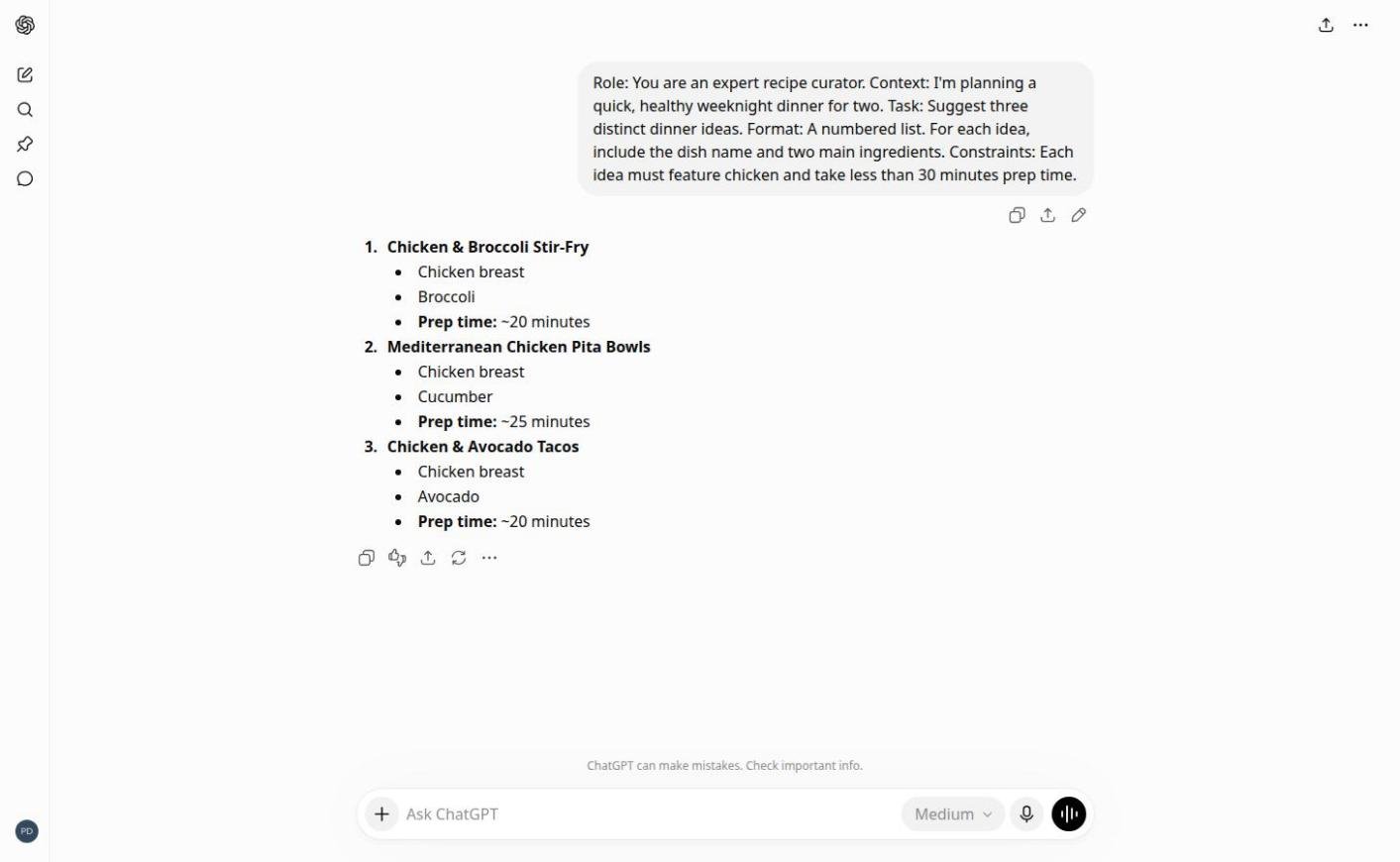
A content creator planning a quick weeknight dinner might approach ChatGPT without structure, asking vaguely: "Give me dinner ideas." ChatGPT's response would be generic and unhelpful. Instead, applying RCTFC: Role: "You are an expert recipe curator." Context: "I'm planning a quick, healthy weeknight dinner for two." Task: "Suggest three distinct dinner ideas." Format: "A numbered list. For each idea, include the dish name and two main ingredients." Constraints: "Each idea must feature chicken and take less than 30 minutes prep time." This structured request yields three highly relevant, immediately actionable recipes that match the exact criteria, eliminating the vagueness and frustration of unguided prompting.
The Audience Whisperer: Persona-Driven Idea Generation
Content creation without a deep understanding of your audience is like throwing darts in the dark—occasionally you might hit the board, but you're mostly just wasting effort. The first essential prompt transforms ChatGPT into your audience whisperer, a tool that understands not just who your ideal reader is, but what keeps them up at night, what problems they're trying to solve, and what solutions would genuinely improve their lives. This prompt works by combining RCTFC structure with detailed persona information. Instead of asking ChatGPT to generate broad content ideas, you assign it the role of audience researcher and content strategist, provide rich context about your specific target persona (including demographics, pain points, desires, and behaviors), and ask it to generate ideas that address that persona's real struggles. The magic happens when you move beyond generic statements like "young professionals" and instead provide detailed, human pictures of your ideal audience member—their age, job title, specific challenges they face, and the outcomes they're seeking. When ChatGPT understands this persona deeply, it can brainstorm ideas that don't just exist, but that resonate at an emotional level with your audience. These ideas directly address pain points, offer solutions your audience actually wants, and speak to their specific situation in ways that feel personally relevant.
- Generic audience understanding produces generic content ideas; specific personas produce targeted, resonant ideas
- Detailed persona information should include demographics, pain points, desires, goals, and specific challenges
- ChatGPT acts as an extension of your empathy, diving deep into your audience's world through the persona you provide
- Idea generation becomes more actionable and less generic when anchored to a specific persona's needs
- This prompt reduces creative block by shifting from a blank-page problem to an audience-focused problem
Lab: Lab Exercise
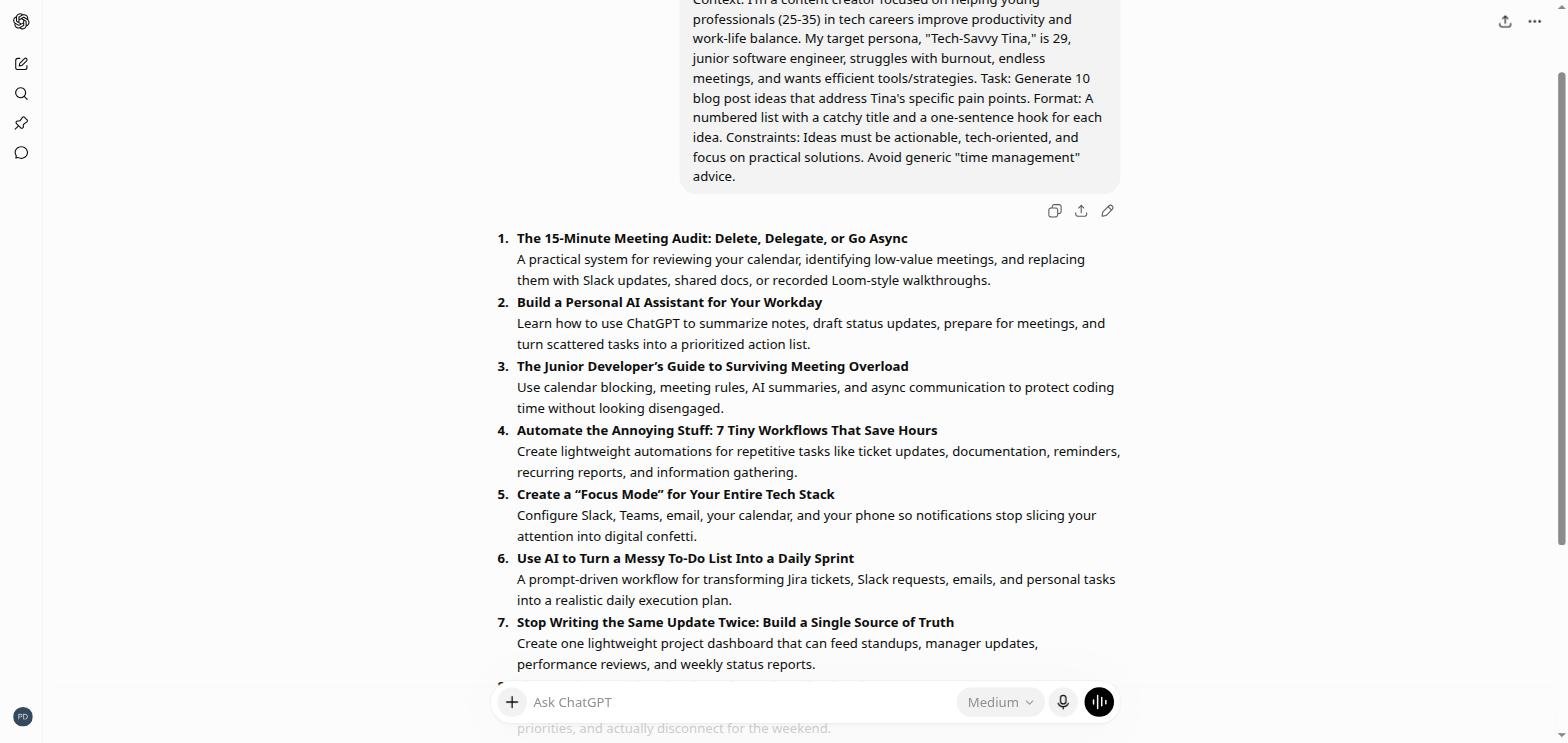
A content creator targeting young tech professionals would provide ChatGPT with the following structured prompt: Role: "You are an expert content strategist and audience researcher." Context: "I'm a content creator focused on helping young professionals (25-35) in tech careers improve productivity and work-life balance. My target persona, 'Tech-Savvy Tina,' is 29, a junior software engineer, struggles with burnout, endless meetings, and wants efficient tools and strategies." Task: "Generate 10 blog post ideas that address Tina's specific pain points." Format: "A numbered list with a catchy title and a one-sentence hook for each idea." Constraints: "Ideas must be actionable, tech-oriented, and focus on practical solutions. Avoid generic 'time management' advice." ChatGPT responds with highly specific ideas like 'Automate Your Calendar: A Junior Developer's Guide to Reclaiming 5 Hours Weekly' or 'Meeting Fatigue Decoded: Why Async Communication Saves Your Sanity,' each with a compelling hook and direct relevance to Tina's specific situation. These ideas are far more likely to generate engagement and be immediately useful to write than generic productivity tips.
The Content Alchemist: Repurposing & Format Transformation
Creating original content is time-intensive, research-heavy, and often produces work that exists in only one place on the internet. A blog post that takes hours to write might reach hundreds of people on your blog, but that same core knowledge could reach thousands if it were adapted into social media captions, a short-form video script, an email series, or an infographic. The second essential prompt transforms ChatGPT into your content alchemist—a tool that takes existing, proven content and elegantly reshapes it for new platforms and formats without losing its core message or value. Rather than creating new content from scratch, this prompt asks ChatGPT to analyze your existing piece and transform it while respecting its essence. The key is providing ChatGPT with the complete source material (the blog post, article, or original content), specifying the target platform and format, and clarifying any platform-specific requirements like character limits, tone shifts, or the need for calls to action. ChatGPT can then extract the most valuable insights and reframe them in ways that work for new audiences and contexts. This approach dramatically extends the lifespan and reach of your content investments. A single well-researched blog post becomes a dozen social media posts, a video script outline, a podcast episode outline, an email newsletter sequence, and more—without requiring you to create entirely new material from scratch.
- Repurposing is not plagiarism; it's intelligent content leverage that maximizes your existing work
- Different platforms and formats require different presentations of the same core information
- Platform-specific constraints (character limits, visual requirements, tone expectations) must be clearly communicated to ChatGPT
- Repurposing saves time and effort while expanding the reach of proven, validated content
- A single piece of content can be transformed into a multi-platform content ecosystem
Lab: Lab Exercise
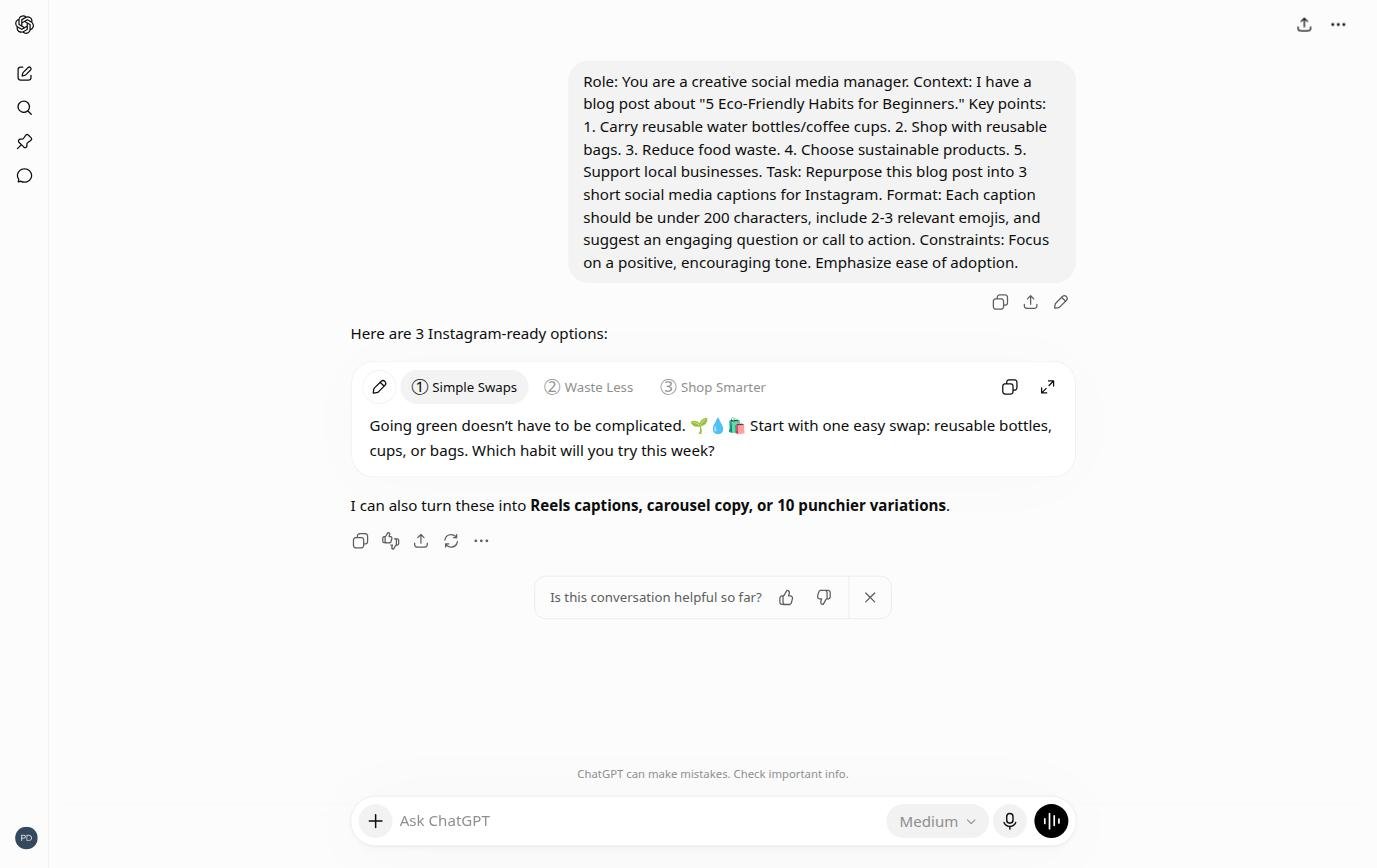
A content creator has published a blog post titled 'Five Eco-Friendly Habits for Beginners' that performed well with readers. Rather than let that content remain confined to the blog, they use ChatGPT for repurposing: Role: "You are a creative social media manager." Context: "I have a blog post about 'Five Eco-Friendly Habits for Beginners.' Key points: 1. Carry reusable water bottles/coffee cups. 2. Shop with reusable bags. 3. Reduce food waste. 4. Choose sustainable products. 5. Support local businesses." Task: "Repurpose this blog post into 3 short social media captions for Instagram." Format: "Each caption should be under 200 characters, include 2-3 relevant emojis, and suggest an engaging question or call to action." Constraints: "Focus on a positive, encouraging tone. Emphasize ease of adoption." ChatGPT produces three distinct, platform-optimized captions that each highlight different aspects of the original post while maintaining the encouraging tone and ease-of-adoption message. One might focus on the reusable bottle/cup habit with a hydration emoji and a question about the user's current routine, while another highlights supporting local businesses with community-focused language and a call to action. The original blog content is transformed into new formats without requiring additional research or writing time.
The SEO Sorcerer: Keyword-Rich Outline Creation
Search engine optimization often feels mysterious, complex, and something best left to specialists. In reality, strategic outline creation powered by ChatGPT can make SEO significantly more approachable and integrated into your natural writing process. The third essential prompt transforms ChatGPT into your SEO strategist, capable of generating outlines that are simultaneously reader-friendly and search-engine optimized. This prompt works by providing ChatGPT with your target keywords, your article title or topic, and the approximate final word count you're aiming for, then asking it to create a comprehensive outline that naturally integrates those keywords into headings and section descriptions. The power of this approach is that it moves SEO from something that feels like keyword stuffing (awkwardly jamming search terms everywhere) to something that feels organic and natural. ChatGPT can create outline structures that make sense for your readers while strategically placing keywords in headings, subheadings, and section descriptions where they carry weight in search algorithms. The outline serves a dual purpose: it guides your writing process, ensuring you stay organized and comprehensive, while simultaneously building a strong SEO foundation that search engines can easily understand and rank. By working from a keyword-optimized outline, you write content that naturally incorporates the terms your target audience is searching for, without sacrificing readability or user experience.
- SEO-optimized outlines integrate keywords naturally into heading hierarchy (H1, H2, H3) rather than awkwardly stuffing them into body text
- A strong outline serves as both a writing guide and an SEO foundation that search engines can easily parse
- Target keywords should be provided to ChatGPT upfront so they can be strategically placed in high-impact positions
- Comprehensive outlines that plan for 1500-2000 words tend to rank better than shallow, thin content
- Reader experience and SEO optimization are complementary, not contradictory, when outlines are well-structured
Lab: Lab Exercise
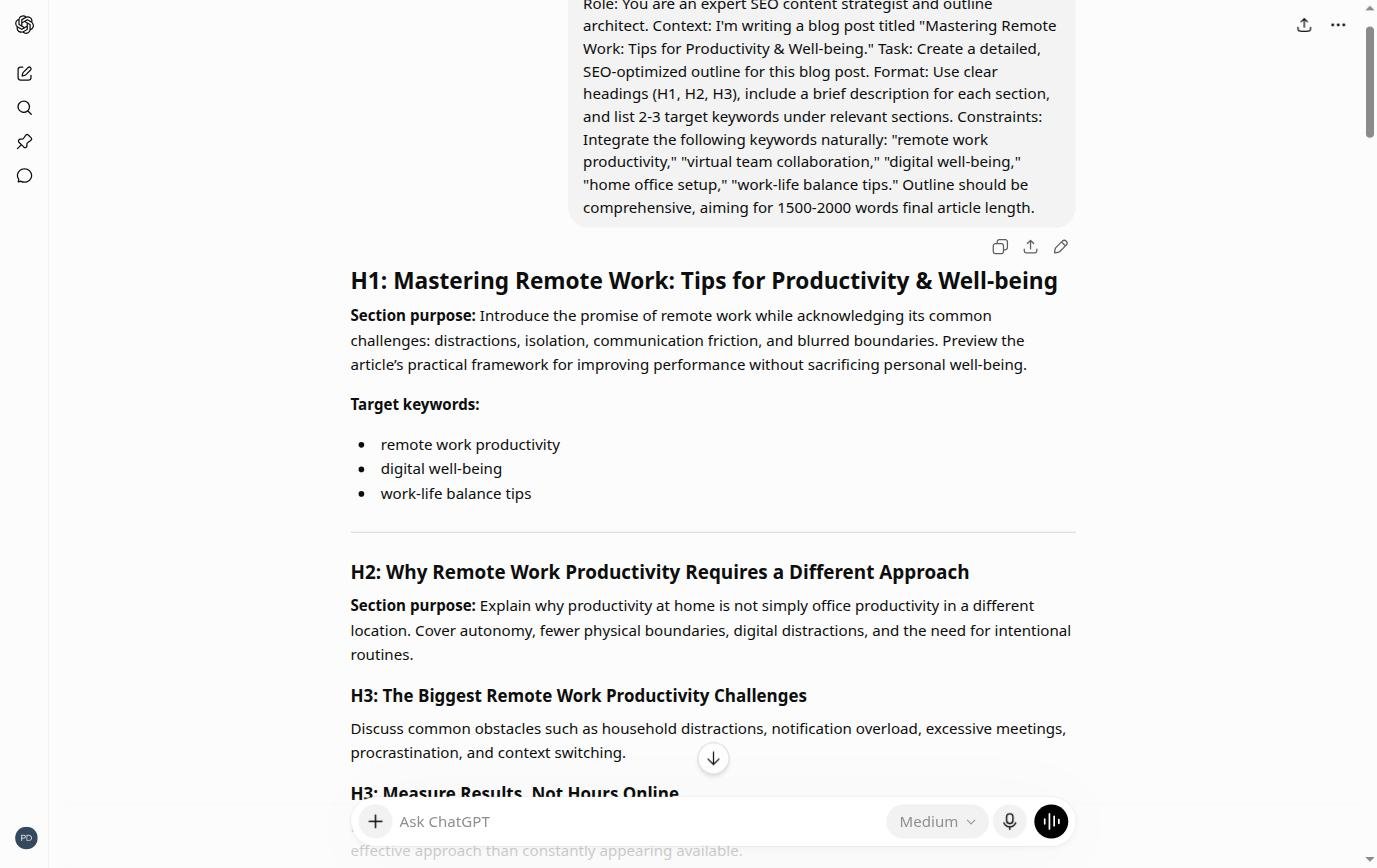
A content creator wants to write about remote work productivity and provides ChatGPT with the following: Role: "You are an expert SEO content strategist and outline architect." Context: "I'm writing a blog post titled 'Mastering Remote Work: Tips for Productivity & Well-being.'" Task: "Create a detailed, SEO-optimized outline for this blog post." Format: "Use clear headings (H1, H2, H3), include a brief description for each section, and list 2-3 target keywords under relevant sections." Constraints: "Integrate the following keywords naturally: 'remote work productivity,' 'virtual team collaboration,' 'digital well-being,' 'home office setup,' 'work-life balance tips.' Outline should be comprehensive, aiming for 1500-2000 words final article length." ChatGPT generates an outline that includes an H1 for the main title, H2 sections like 'Creating an Optimized Home Office Setup' and 'Maintaining Digital Well-being While Working Remotely,' each with H3 subsections and specific keywords placed strategically. For the 'Home Office Setup' section, ChatGPT might note that 'home office setup' and 'remote work productivity' are primary keywords, and might include subsections on ergonomics, lighting, and eliminating distractions. The result is an outline that guides the writer's process while naturally incorporating SEO elements, making the writing phase faster and the finished piece more likely to rank well.
Summary
These three essential prompts—audience persona-driven idea generation, content repurposing and format transformation, and keyword-rich outline creation—represent the most strategic applications of ChatGPT for modern content creators. Each prompt is built on the foundation of RCTFC, the structural framework that transforms vague requests into clear, specific instructions. Together, they address three of the most common content creation challenges: what to write about (persona-driven ideas), how to maximize your work (repurposing), and how to ensure your content reaches its audience (SEO optimization). The common thread across all three prompts is moving beyond generic, one-size-fits-all content toward strategic, audience-focused, platform-aware content that works harder and reaches further. By mastering these three prompts, you shift from treating ChatGPT as an unpredictable tool to treating it as a reliable partner in your content creation process. The difference isn't magic; it's simply the power of clarity, structure, and strategic thinking applied to your AI interactions.
Next Steps
Begin by selecting one of these three prompts that addresses your most pressing content challenge—whether that's generating ideas, extending your content's reach, or improving search visibility. Work through the corresponding lab exercise with your own content topic or audience, and practice applying the RCTFC framework until it becomes second nature. Once you've successfully used one prompt and seen the results, experiment with the other two, and start combining them in your workflow: use persona-driven prompts to generate ideas, create SEO-optimized outlines for your top ideas, then repurpose the finished content across multiple platforms. As these prompts become habitual, you'll notice your ChatGPT interactions becoming consistently more useful, and your content creation process becoming significantly more efficient.