Smart Selling: Real Estate Agents & ChatGPT – Your AI Co-Pilot!
Ever feel like you're juggling a dozen flaming chainsaws while trying to write a compelling property description, craft the perfect client email, and brainstorm social media ideas all before your morning coffee? What if I told you there’s an incredibly witty, always-on assistant ready to catch some of those chainsaws for you? Get ready to supercharge your real estate game with ChatGPT!
Overview
Real estate agents operate in an environment of constant demands: writing compelling property descriptions, maintaining personalized client communication, and developing engaging marketing content. ChatGPT offers a powerful solution to accelerate and enhance these core activities without sacrificing quality or authenticity. This guide introduces the RCTFC framework—a structured approach to prompting—that transforms ChatGPT from a generic chatbot into a specialized business tool. By mastering this framework and applying it to three critical agent workflows (property descriptions, client outreach, and content creation), you'll unlock significant time savings while strengthening client relationships and expanding your digital presence.
What You'll Learn
- Learn and apply the RCTFC framework to construct precise, effective ChatGPT prompts
- Draft compelling property descriptions that highlight key features and appeal to target buyers
- Generate personalized client follow-up emails that build relationships and maintain human connection
- Brainstorm and create social media content tailored to different platforms and audience segments
- Integrate ChatGPT into your daily workflow while maintaining your professional voice and expertise
Unlock Your AI Superpower: The RCTFC Framework
The RCTFC framework is a five-part structure designed to eliminate ambiguity and guide ChatGPT toward precisely the output you need. Rather than making vague requests and hoping for usable results, this framework ensures you provide your AI assistant with the equivalent of a fully briefed team member ready to execute a specific mission. The five components work together synergistically: Role establishes who or what ChatGPT should embody—whether that's an expert copywriter, a marketing strategist, or a lead generation specialist. This primes the AI to adopt the relevant expertise and tone. Context provides the situational background: Are you writing for a new listing? Following up after an open house? Launching a market analysis campaign? This grounds the response in real business reality. Task specifies the exact deliverable: "Write a property description," "Draft an email," or "Generate content ideas." Format defines the structural shape of the response: three paragraphs, bullet points, numbered list, or specific email structure. Constraints are the guardrails that ensure quality and relevance—word limits, tone requirements, specific elements to emphasize or exclude, or particular pain points to address. Together, these five elements transform vague requests into pinpoint instructions that consistently deliver professional-quality results tailored to your exact needs.
- The RCTFC framework consists of Role, Context, Task, Format, and Constraints
- Each component serves a specific purpose in clarifying your request to ChatGPT
- Well-crafted prompts using RCTFC produce more relevant, usable, and professional outputs
- This structured approach is applicable across all real estate communication and marketing tasks
- Strategic prompting saves time and improves quality compared to trial-and-error interactions
Lab: Lab Exercise
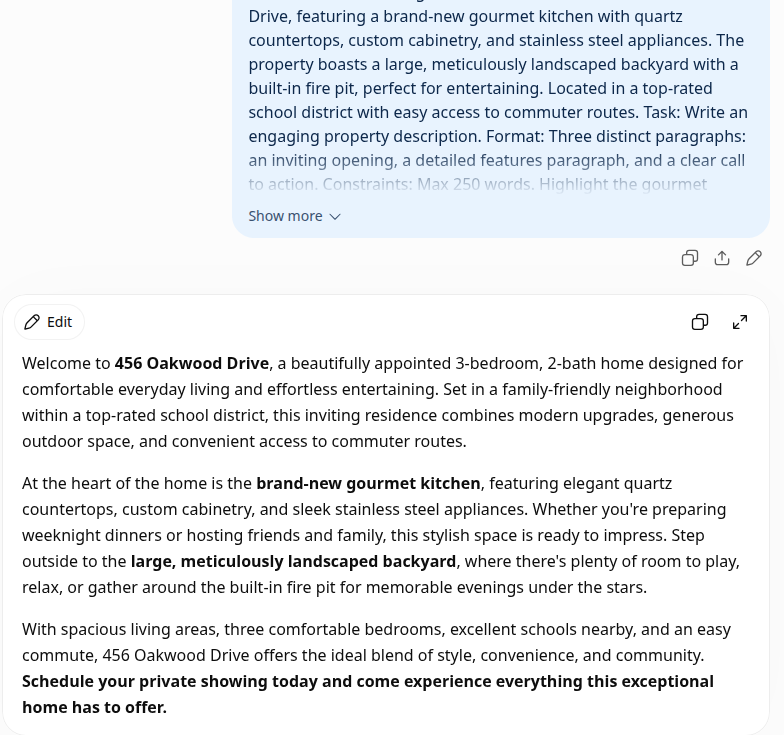
Consider a property listing that requires a compelling description. Using RCTFC: Your Role is "Expert Real Estate Copywriter known for creating captivating property descriptions." The Context is that you have a new residential listing at 456 Oakwood Drive—a 3-bed, 2-bath home with a brand-new gourmet kitchen (quartz countertops, custom cabinetry, stainless steel appliances), a large landscaped backyard with built-in fire pit, located in a top-rated school district with convenient commuter access. Your Task is to "Write an engaging property description." The Format specifies "Three distinct paragraphs: an inviting opening, a detailed features paragraph, and a clear call to action." Your Constraints are: maximum 250 words, must highlight the gourmet kitchen and spacious backyard, must emphasize family-friendly aspects and convenience, and must omit any mention of price. When you submit this complete prompt to ChatGPT, the AI understands not just what to write, but how to think about the property, what audience to appeal to, and what structural and stylistic guardrails to respect. The result is a polished, market-ready description that sounds professional and authentic to your voice—not generic or obviously AI-generated. This is the power of precision: the more specific your instructions, the more useful the output.
Client Communication Revolutionized: Personalized Outreach at Scale
Client communication forms the backbone of real estate success. Every interaction—whether an immediate follow-up after an open house, a thoughtful check-in with an interested buyer, or a congratulatory message to a newly closed client—contributes to relationship strength and referral potential. Yet the volume of communication required to maintain personalized, warm contact with dozens of prospects and clients simultaneously can consume enormous amounts of time. Real estate agents often face a difficult choice: either spend hours crafting individual emails to maintain authenticity, or resort to generic templates that fail to resonate. ChatGPT offers a third path: genuinely personalized communication created at scale. By using the RCTFC framework to provide ChatGPT with specific client details, interaction history, and personal observations from recent meetings, you can generate follow-up emails that feel individually crafted because they are—just dramatically faster. An agent who learned that a prospect named Sarah fell in love with a home's sun-drenched living room and mentioned her love of dogs can use ChatGPT to draft a warm follow-up that references both of these specifics, includes helpful local dog park information, and clearly invites the next step (a private showing). This level of personalization builds trust and keeps prospects engaged throughout their buying journey. The key is providing ChatGPT enough context about the client and the situation so that it can tailor the message accordingly. This transforms email outreach from a time sink into a relationship-strengthening tool.
- Personalized client communication at scale is achievable when using ChatGPT strategically
- Follow-up emails should acknowledge specific details from recent interactions to demonstrate genuine attention
- Client emails generated via ChatGPT should maintain a warm, professional tone without sounding templated
- Clear next steps and calls to action keep prospects moving through the sales pipeline
- Consistency in communication builds trust and reinforces your professional brand
Lab: Lab Exercise
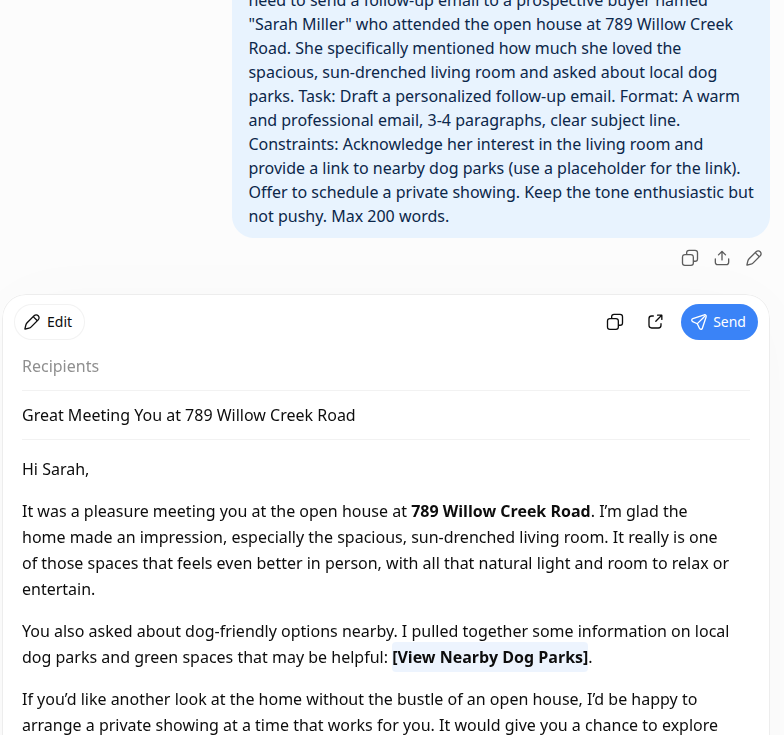
You've just hosted an open house at 789 Willow Creek Road. A prospect named Sarah Miller attended and specifically mentioned how much she loved the spacious, sun-drenched living room. She also asked about local dog parks. That evening, rather than spending 15 minutes writing a follow-up from scratch, you turn to ChatGPT with this prompt: Role: "Your friendly and professional Real Estate Agent." Context: "I need to send a follow-up email to a prospective buyer named 'Sarah Miller' who attended the open house at 789 Willow Creek Road. She specifically mentioned how much she loved the spacious, sun-drenched living room and asked about local dog parks." Task: "Draft a personalized follow-up email." Format: "A warm and professional email, 3-4 paragraphs, with a clear subject line." Constraints: "Acknowledge her interest in the living room and provide a link to nearby dog parks (use a placeholder for the link). Offer to schedule a private showing. Keep the tone enthusiastic but not pushy. Max 200 words." ChatGPT generates something like: a subject line that references her interest, an opening that thanks her for attending and recalls her enthusiasm about the living room, a paragraph that provides dog park information and connects it to neighborhood lifestyle, a paragraph offering to schedule a private showing at her convenience, and a warm closing. The result feels personalized, warm, and professional—exactly what Sarah needs to move forward in her buying journey. What might have taken 15 minutes of composition now takes 2 minutes, and you've freed up mental energy for higher-value activities like analyzing comparable sales, preparing market analyses, or meeting with additional clients.
Marketing & Content Creation Unleashed: Brainstorming Brilliant Ideas and Social Media Content
A strong online presence is no longer optional in real estate; it's essential. Agents who consistently produce engaging social media content, insightful blog posts, and timely market updates build visibility, attract leads, and establish authority in their local markets. However, generating fresh content ideas week after week can feel creatively exhausting. The blank screen syndrome is real: you sit down to brainstorm Instagram captions about market trends or neighborhood highlights, and 20 minutes later you've deleted three attempts and are no closer to posting something compelling. ChatGPT serves as your always-available brainstorming partner, capable of rapidly generating multiple content directions tailored to specific platforms, audiences, and objectives. When you're launching a social media campaign targeting first-time homebuyers in your market and want to leverage a current trend (such as softening interest rates and increased inventory diversity), ChatGPT can generate multiple post concepts complete with captions, hashtags, and calls to action. Each idea can be tailored to your target audience's concerns and aspirations, ensuring that your content doesn't just fill your feed—it resonates and drives engagement. The ability to quickly generate multiple directions means you can test different approaches, see what resonates with your audience, and refine your content strategy based on real data. This transforms marketing from a sporadic, effortful activity into a sustainable, data-informed practice.
- Content brainstorming at scale is possible when you provide ChatGPT with clear audience and platform context
- Different social media platforms require different tones and formats—ChatGPT can adapt to each
- Market trends and neighborhood highlights are compelling content topics that position you as knowledgeable
- First-time homebuyers benefit from encouraging, educational content that addresses their specific concerns
- Consistent, platform-appropriate content builds audience engagement and generates leads
Lab: Lab Exercise
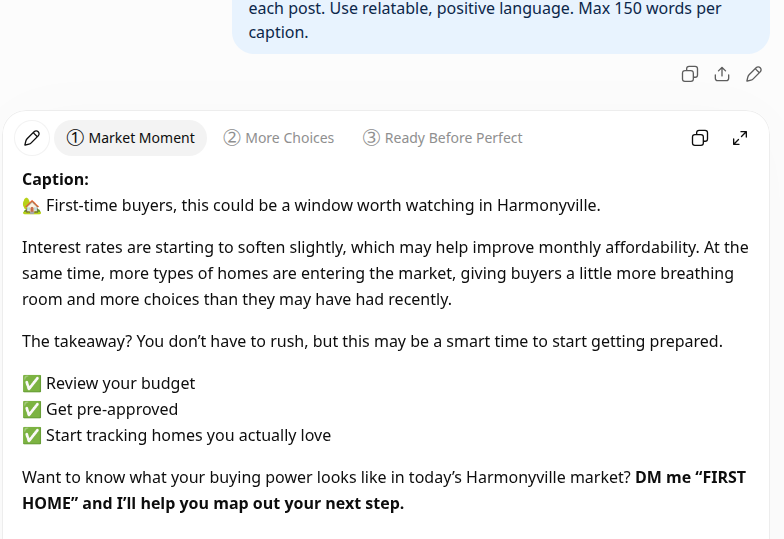
You want to launch a three-part Instagram campaign targeting first-time homebuyers in your area (Harmonyville) around the current market trend of softening interest rates and increased inventory diversity. You provide ChatGPT with this framework: Role: "Savvy Social Media Strategist specializing in real estate." Context: "I need content for my Instagram about current local real estate market trends, specifically targeting first-time homebuyers in 'Harmonyville.' Key trend: Interest rates are slightly softening, and more diverse inventory is entering the market." Task: "Generate 3 Instagram post ideas, including captions and relevant hashtags." Format: "Numbered list. Each idea should have a 'Caption:' and 'Hashtags:' section." Constraints: "Focus on encouragement and clear takeaways for first-time buyers. Include a call to action for each post. Use relatable, positive language. Max 150 words per caption." ChatGPT might generate something like: Post 1 focuses on the shift in interest rates with an encouraging message that now is a good time to explore homeownership, includes a call to action to DM for a free buyer consultation, and includes relevant hashtags like #FirstTimeHomeBuyer #HarmonyvilleHomes. Post 2 highlights the increased inventory diversity, emphasizing more options for different budgets and preferences, with a call to action to schedule a free market tour. Post 3 takes a broader perspective on what softening rates and new inventory mean for first-time buyers, with a call to action to attend an upcoming first-time buyer workshop. You now have three distinct directions, each with market-relevant content, appropriate calls to action, and platform-optimized hashtags. Rather than spending an hour staring at a blank screen, you've invested 5 minutes and received three immediately usable content pieces that you can adapt or post directly.
Summary
The RCTFC framework—Role, Context, Task, Format, and Constraints—is the foundational skill that transforms ChatGPT from a generic tool into your specialized real estate co-pilot. By consistently applying this five-part structure to your prompts, you move from unpredictable outputs to reliably professional results. This framework enables you to tackle three core agent challenges: writing compelling property descriptions that capture buyer attention and highlight key features, generating personalized client communications that maintain warmth and authenticity at scale, and brainstorming content that keeps your online presence fresh, engaging, and audience-focused. Across all three applications, the principle remains constant: clarity in your instructions produces clarity in the output. The agents who will thrive in the evolving real estate landscape are those who view AI not as a replacement for their expertise, but as a force multiplier—a tool that handles time-consuming mechanical writing tasks so that they can focus on what humans do best: building relationships, providing expert guidance, and closing deals. ChatGPT amplifies your professional capabilities without diluting your voice or authenticity.
Next Steps
Begin by selecting one of the three workflows presented in this guide—perhaps the one that currently consumes the most of your time or causes the most frustration. Experiment with the RCTFC framework on a real task: a property listing you need to describe, a client follow-up you need to write, or a batch of social media content you need to brainstorm. Craft your prompt carefully using the five-part structure, submit it to ChatGPT, review the output, and iterate if needed. Once you've seen how the framework works in practice on one task, the pattern becomes intuitive and you'll find yourself naturally applying it across your daily workflow. Track how much time you save and the quality of the results—you'll likely discover that the investment in learning this structured approach pays dividends across your entire business.