Power Prompts: Three AI Hacks Every High School Student Needs!
Ever feel like you're staring at a blank page, or a textbook that speaks an alien language? What if I told you there's a digital genius ready to be your ultimate study buddy, brainstorming partner, and essay architect? This isn't science fiction, it's smart prompting, and today we're unlocking three powerhouse prompts that will transform your academic game.
Overview
Artificial intelligence has become an increasingly accessible tool for high school students, but using it effectively requires more than simply typing a question. This lesson introduces the RCTFC framework—a structured approach to prompting that transforms generic AI responses into tailored, academic-grade results. By mastering three essential prompt types based on this framework, you'll unlock AI's potential as a personalized study partner, creative brainstorming engine, and essay architect. Rather than relying on luck or generic searches, you'll learn to communicate precisely with AI systems, getting exactly the help you need when you need it.
What You'll Learn
- Understand the five components of the RCTFC prompting framework (Role, Context, Task, Format, Constraints)
- Apply RCTFC to create a study-focused prompt that simplifies complex academic topics
- Use AI as a brainstorming partner to generate creative ideas and overcome writer's block
- Construct detailed essay outlines and project structures using AI guidance
The RCTFC Framework: Your AI Communication Blueprint
The RCTFC framework is a five-component structure that transforms vague requests into precise AI instructions. Rather than hoping an AI system will understand what you need, RCTFC ensures you provide all the context an AI requires to deliver exactly what you're asking for. Think of it as the difference between telling a substitute teacher "teach us" versus giving them a complete lesson plan with learning objectives, materials, and assessment methods. The framework consists of five distinct elements: Role describes who or what the AI should pretend to be (a biology tutor, a creative writing coach, etc.). Context explains the situation you're in and why you need help (you're a high school student struggling with a specific topic). Task is the exact action you want the AI to perform (explain a concept, generate ideas, create an outline). Format specifies how you want the information presented (bullet points, a numbered list, a narrative paragraph). Constraints are the boundaries you set (word limits, complexity levels, topics to avoid or include). When you include all five components, AI systems can calibrate their responses specifically for your needs rather than offering generic, one-size-fits-all answers.
- RCTFC stands for Role, Context, Task, Format, and Constraints
- Each component serves a specific purpose in guiding AI toward your desired outcome
- A well-structured prompt eliminates vague results and saves revision time
- The framework works because it mimics how you would brief a human expert
Lab: Lab Exercise
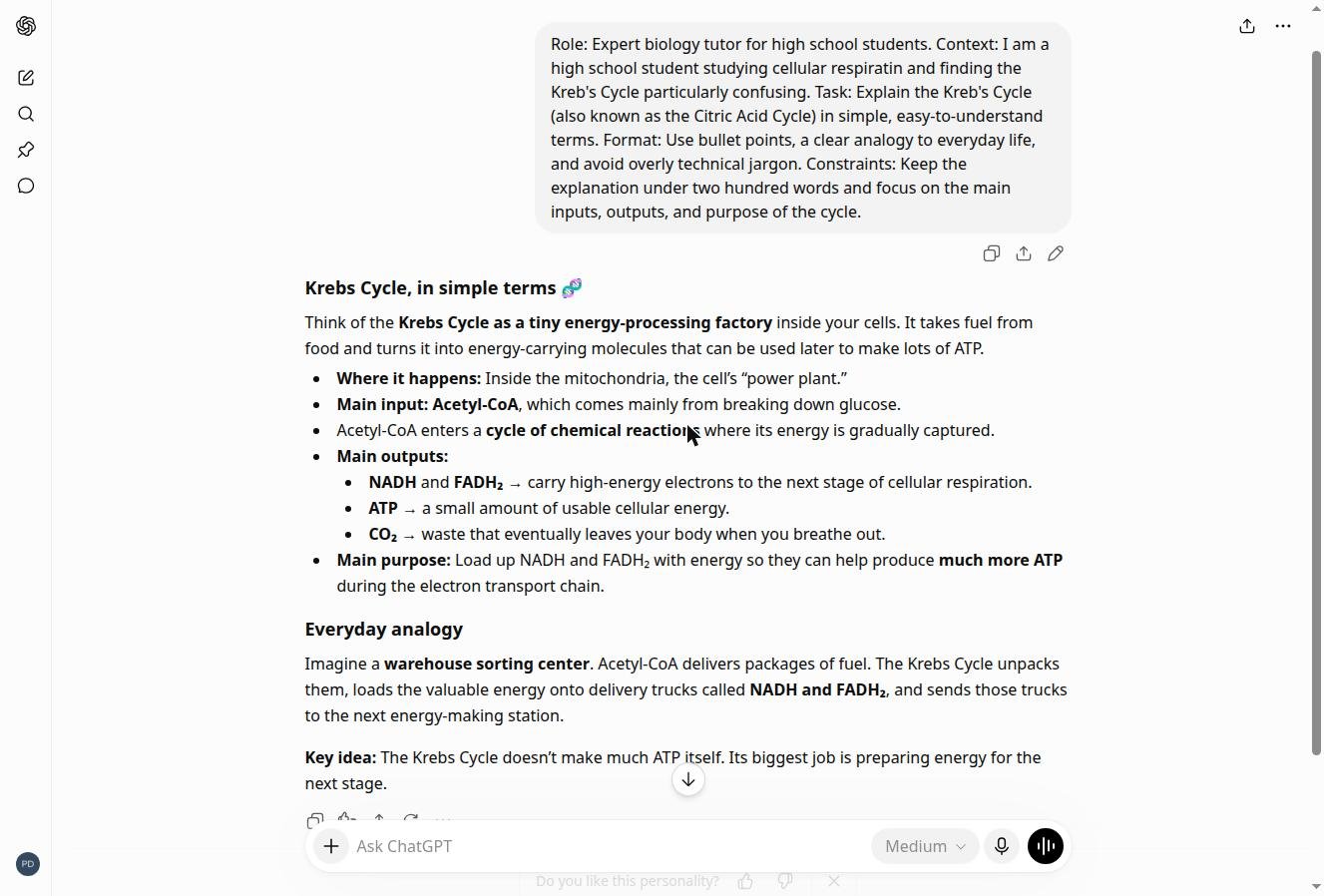
Consider the difference between these two requests. The first: "Explain the Kreb's Cycle." This is vague and might result in a highly technical, college-level explanation that overwhelms rather than clarifies. Using RCTFC, your prompt becomes: Role—Expert biology tutor for high school students. Context—I am a high school student studying cellular respiration and finding the Kreb's Cycle particularly confusing. Task—Explain the Kreb's Cycle (also known as the Citric Acid Cycle) in simple, easy-to-understand terms. Format—Use bullet points, a clear analogy to everyday life, and avoid overly technical jargon. Constraints—Keep the explanation under two hundred words and focus on the main inputs, outputs, and purpose of the cycle. With this structured prompt, the AI understands your knowledge level, what you're struggling with, how you learn best, and what depth is appropriate. The result is a focused, accessible explanation that actually helps you study rather than confusing you further. This same pattern applies whether you're explaining photosynthesis, historical events, or mathematical concepts.
Prompt One: The Study Buddy—Simplifying Complex Topics
Mastering complex academic content is one of the biggest challenges high school students face. Textbooks often assume prior knowledge you don't have, or use technical language that obscures rather than clarifies ideas. When you structure an RCTFC prompt designed specifically for learning, you create an AI that functions as a personalized tutor available whenever you need it. This approach is particularly powerful because it combats one of the main reasons students struggle: not understanding the material isn't a reflection of your intelligence, but often a reflection of how the material was explained to you. Using your Study Buddy prompt, you can request explanations that match your learning style, knowledge level, and specific confusion points. The AI adjusts complexity, uses analogies, provides examples, and can even re-explain points in different ways until concepts click. Unlike asking a teacher during class (where time is limited and you might feel self-conscious), this approach gives you unlimited, judgment-free explanation. Additionally, because you've specified constraints like word limits and jargon avoidance, you get focused explanations rather than encyclopedic overviews. You can use this prompt for any subject—biology, history, literature, mathematics—simply by swapping in different topics.
- The Study Buddy prompt leverages AI as a personalized tutor available 24/7
- Specifying your role as a student and your particular confusion points improves explanation quality
- Requesting simple language and everyday analogies makes abstract concepts concrete
- Using word limits and format preferences keeps explanations focused and digestible
Lab: Lab Exercise
The hands-on exercise demonstrates this in action. The prompt established that you're a high school student struggling specifically with the Kreb's Cycle, requested a simple explanation with analogies and minimal jargon, set a 200-word limit to keep information manageable, and asked the AI to focus on inputs, outputs, and purpose rather than every single detail. An AI responding to this prompt might explain the Kreb's Cycle like this: imagine cellular respiration as a multi-stage process of extracting energy, similar to how a factory breaks down raw materials into usable products and waste. The Kreb's Cycle is the second major stage where acetyl-CoA enters and is broken down further, releasing electrons that power the final energy-generation step. The main inputs are acetyl-CoA (from broken-down glucose) and water. The main outputs are carbon dioxide (which you exhale), electron carriers (NADH and FADH2) that store energy, and ATP (a small amount). The cycle's purpose is to prepare electrons and energy carriers for the final stage of cellular respiration. This explanation is far more useful to a high school student than a technical description of each enzymatic step. Compare what you'd get from "explain the Kreb's Cycle" to what you get from a properly structured RCTFC prompt, and you'll immediately see why framework matters.
Prompt Two: The Idea Generator—Brainstorming and Beating Writer's Block
Writer's block is a nearly universal experience, whether you're facing a blank essay assignment or trying to brainstorm a presentation topic. The problem intensifies when the assignment is broad (like "write about technology's impact on society") or when you've simply lost motivation or direction. The Idea Generator prompt uses AI to do what brainstorming partners do: offer multiple perspectives, make unexpected connections, and generate options you might not have considered alone. Unlike a human brainstorming partner, AI doesn't get tired, doesn't judge your half-formed ideas, and can generate a dozen distinct concepts in seconds. The key to making this prompt work is specificity: the more constraints you provide (length requirements, topic inclusions, audience level), the more relevant the ideas will be. Asking for five specific topics is better than asking for "ideas about technology." Specifying that you want debatable topics for a five-paragraph essay prevents the AI from suggesting topics that are either too narrow to research or too broad to cover. Including constraints about avoiding overly common topics ensures you're not simply recycling the thousandth essay about social media. This approach also combats academic procrastination by breaking the paralysis of the blank page—once you have five strong topic options from which to choose, the decision becomes manageable rather than overwhelming.
- AI brainstorming partners generate multiple options quickly without fatigue or judgment
- Specifying constraints (topic requirements, format, exclusions) dramatically improves idea relevance
- The Idea Generator prompt works for essays, projects, presentations, and any creative assignment
- Starting with AI-generated options often triggers your own ideas and breaks writer's block
Lab: Lab Exercise
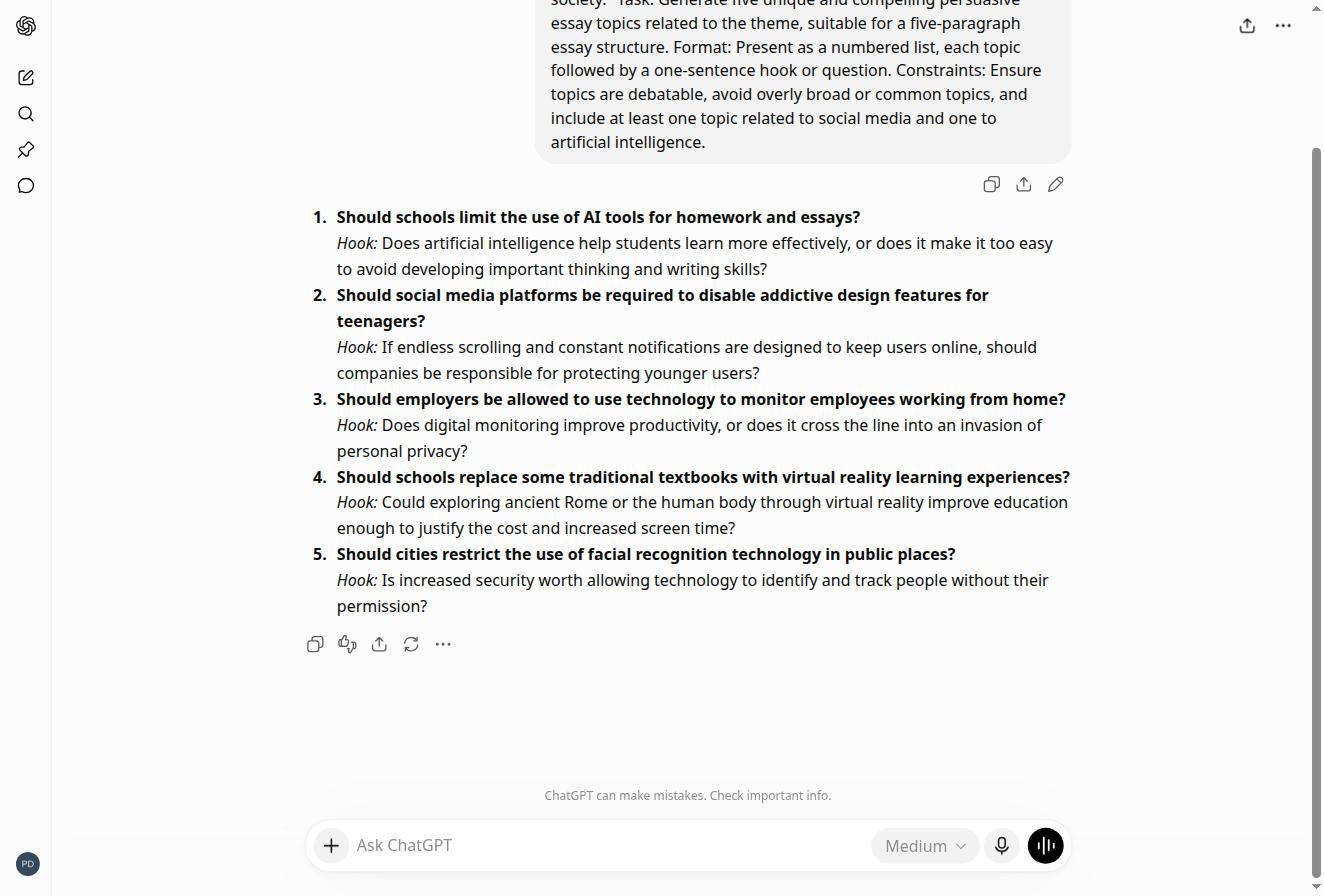
The hands-on exercise requested five unique persuasive essay topics related to technology's impact on society, suitable for a five-paragraph essay, presented as a numbered list with one-sentence hooks, while avoiding overly broad or common topics and including at least one about social media and one about artificial intelligence. An AI responding to this prompt might generate topics like: 1) "Should social media algorithms be regulated to protect teenage mental health?" (explores the specific harm of recommendation systems); 2) "Does artificial intelligence in education enhance or diminish critical thinking skills?" (directly relevant to your experience as a student); 3) "Should companies be required to disclose how they use collected personal data?" (addresses privacy concerns); 4) "Does remote work technology improve work-life balance, or does it blur necessary boundaries?" (explores unexpected downsides); 5) "Should AI-generated content require disclosure, or is the technology becoming indistinguishable from human work?" (asks a forward-looking question). Each topic includes a debatable question rather than a statement, suggesting there's legitimate argument on multiple sides. Each can be covered thoroughly in five paragraphs because it's specific but not so narrow that research becomes impossible. Notice that the AI didn't suggest the hundredth essay about "how social media is bad" or "technology is everywhere." Instead, it generated topics that honor the assignment parameters while offering genuine points of debate. You'd then select whichever topic genuinely interests you most and proceed with research and outlining.
Summary
The RCTFC framework transforms AI from a tool that provides generic answers into a sophisticated system that delivers personalized, academic-grade assistance. By mastering three prompt types—the Study Buddy for learning complex topics, the Idea Generator for creative brainstorming, and the Essay Architect for structural planning—you've equipped yourself with practical strategies that apply across every class and assignment. The common thread uniting these prompts is precision: the more specifically you communicate your role, context, task, format requirements, and constraints, the better the AI can serve you. These aren't tricks or shortcuts that bypass learning; they're tools that accelerate your learning by removing common friction points like confusion over complex material, paralysis from blank pages, and structural uncertainty when writing. Used thoughtfully, AI becomes a personalized tutor available whenever you need it, a brainstorming partner that never runs out of ideas, and an editor who helps you plan before you write. The skills you've learned here extend beyond high school: as AI becomes more prevalent in higher education, careers, and everyday problem-solving, the ability to communicate clearly and precisely with intelligent systems will remain valuable.
Next Steps
Start by applying one of these three prompts to an assignment you're currently working on or planning to start. If you have a class coming up where you're struggling with material, use the Study Buddy prompt to get a personalized explanation. If you have a written assignment without a topic, deploy the Idea Generator prompt. If you've chosen a topic and want to outline before writing, use the Essay Architect prompt. After you've tried one prompt and seen the results, experiment with the others and notice how your efficiency improves. As you grow comfortable with RCTFC, you can adapt it to other situations: presentations, research papers, lab reports, or even non-academic projects. The framework is flexible because it's based on how humans naturally communicate complex instructions. Consider sharing these prompts with classmates; collectively discovering how to refine and improve them will deepen everyone's understanding of how to work effectively with AI systems.