I Gave ChatGPT a Terrible Email. Here’s What It Did.
Ever stare at a rambling, confusing email you just drafted, knowing it's going to fall flat? Today, we're taking that mess and transforming it into a clear, compelling message that actually gets results, all thanks to a little AI magic and a powerful prompting framework.
Overview
Email communication is one of the most critical professional skills, yet many people struggle to articulate their thoughts clearly in written form. This guide introduces the RCTFC framework—a structured prompting methodology that transforms ChatGPT into a powerful email refinement tool. By learning to decompose your communication challenges into Role, Context, Task, Format, and Constraints, you'll move beyond vague requests to ChatGPT and instead issue precise instructions that generate professional, actionable emails. Whether you're starting with a rambling first draft or refining a message for a specific audience, this framework ensures you maintain control over AI outputs while dramatically improving your communication effectiveness.
What You'll Learn
- Understand the five components of the RCTFC prompting framework and why each element matters
- Apply RCTFC to restructure informal, unclear emails into professional, actionable communications
- Adapt emails for different audiences and tones using ChatGPT while maintaining your core message
- Craft compelling calls to action and subject lines that drive engagement and response
- Develop a systematic follow-up strategy to extend the impact of your email communications
The RCTFC Framework: Your Prompting Superpower
The RCTFC framework is a five-component structure that transforms vague requests into crystal-clear instructions for ChatGPT. Rather than asking the AI to "make this better" or "fix this email," RCTFC ensures you provide all the information the model needs to understand not just what you want, but why you want it and what success looks like. Think of it as replacing a vague wish with a detailed instruction manual. Each component serves a distinct purpose in shaping ChatGPT's response. Role establishes the perspective and expertise the AI should adopt—whether you need a marketing strategist, a careful editor, or a compassionate HR professional. This shapes not just the content but the underlying approach. Context provides the backstory: what's the situation, what led to this moment, what constraints or circumstances exist? This transforms a generic response into one grounded in your specific reality. Task defines the concrete action you're requesting—not just "improve this," but "rewrite this email to be no longer than 150 words with bulleted action items." Format specifies exactly how the output should be structured and presented. Constraints set the boundaries and rules that cannot be violated, ensuring the output respects your values, tone requirements, or other non-negotiable parameters. When you provide all five elements, you're not simply prompting ChatGPT; you're engineering a response. This level of precision dramatically reduces the need for revisions, minimizes misalignment between what you want and what you receive, and ultimately frees you to focus on strategic thinking rather than endless iterations. The power of RCTFC lies in its ability to remove ambiguity from both sides of the conversation—ChatGPT understands exactly what you need, and you understand exactly what to ask for.
- Role defines the AI's perspective and expertise; it shapes how the AI approaches the problem
- Context provides essential backstory and environmental information that grounds the response in your reality
- Task specifies the concrete action, moving from vague improvement to measurable, specific requests
- Format describes the exact structure, length, and presentation of the output
- Constraints establish non-negotiable rules, tone requirements, and boundaries for the response
- Together, these five elements eliminate ambiguity and transform generic outputs into precise, relevant results
Lab: Lab Exercise
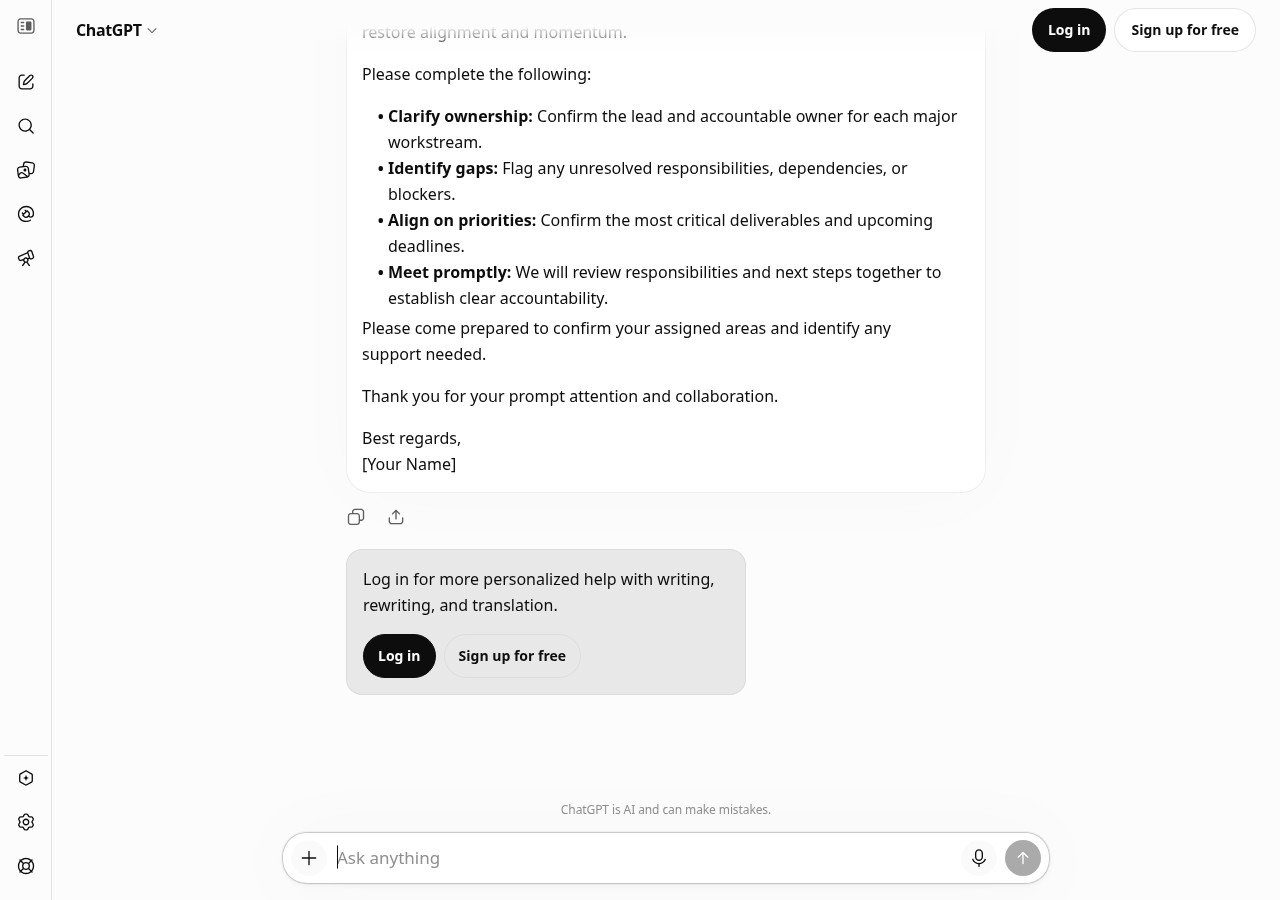
Consider an initial email that reads: "Hey team, just wanted to check in about that project thing, you know, the Quantum Leap Initiative with all the moving parts. I think we need to maybe get everyone on the same page? It's kind of a mess right now and I don't really know what's happening. Can someone, like, fix it? We should probably talk about it soon." This email is informal, vague about the problem, lacks direction, and contains no clear next steps. Using RCTFC, you would construct a prompt like: "Role: You are a professional business communication specialist and meticulous editor. Context: I have drafted an initial email to my team about a project status update. It is currently informal, vague, and lacks clear direction. The project, 'Quantum Leap Initiative,' is behind schedule due to unclear responsibilities. Task: Rewrite the following email to be clear, concise, professional, and actionable. Identify core issues and propose next steps. Format: A formal email no longer than 150 words, with a clear subject line, bulleted action items, and a professional closing. Constraints: Maintain a constructive and solution-oriented tone. The revised email must explicitly state the project name and the need for immediate clarification of responsibilities." With this structured input, ChatGPT understands not only that you want the email improved, but precisely how to improve it, what tone to use, what length to target, and what specific elements to include. The resulting email is transformed from a rambling message into something like: "Subject: Quantum Leap Initiative—Urgent Clarification of Roles Required. Team, the Quantum Leap Initiative is experiencing delays due to unclear role assignments. To restore momentum, we must immediately clarify individual responsibilities. Please review your assignments and come prepared to discuss during Thursday's 10 AM meeting. Action items: (1) Confirm your assigned tasks by Wednesday end-of-day, (2) Flag any resource gaps or dependencies, (3) Be ready to commit to revised timelines. Your prompt attention is essential to project success. Thank you, [Your Name]." Notice how the output is now direct, actionable, and professional—a dramatic improvement achieved through precise prompting rather than multiple revision rounds.
The Art of Adaptation: Audience and Tone Mastery
An excellent email to one audience can fall completely flat with another. Your CEO needs brevity and impact; your project team might appreciate collaboration and empathy; a new client requires professionalism and trust-building. This is where audience and tone adaptation becomes critical. ChatGPT can serve as your personal communications chameleon, shifting perspective and language to resonate with different recipients—but only if you tell it exactly who you're speaking to and how you want to sound. Audience adaptation goes beyond swapping out a few words. It requires understanding the psychological landscape of your recipient: what they value (speed, detail, innovation, certainty), what concerns them (risk, timelines, cost, team morale), and what will motivate them to engage and act. An executive audience wants the headline and the decision point; they're optimizing for speed and impact. A peer audience often values transparency and collaborative problem-solving. A client audience needs assurance of competence and commitment. When you use RCTFC to specify audience and tone, you're telling ChatGPT not just what message to deliver, but how to frame it psychologically. Tone is equally critical. A message that sounds confident and solution-focused to one reader might sound dismissive to another. A message heavy on data and detail might inspire confidence in an engineer but overwhelm a senior executive. By explicitly stating your desired tone—confident, empathetic, urgent, collaborative, data-driven—within the RCTFC framework, you ensure the output resonates emotionally as well as intellectually. This precision transforms a one-size-fits-all communication into something tailored, genuine, and far more likely to achieve the outcome you're seeking.
- Different audiences have different priorities, communication preferences, and psychological motivations
- Audience adaptation requires understanding not just who they are, but what they value and what will move them to action
- Tone is a vehicle for psychological resonance; the right tone makes a message more persuasive and trustworthy
- RCTFC allows you to specify both audience and tone, ensuring the output matches recipient expectations
- Failing to adapt for audience and tone risks alienation, misinterpretation, or inaction—even when the core message is sound
Lab: Lab Exercise
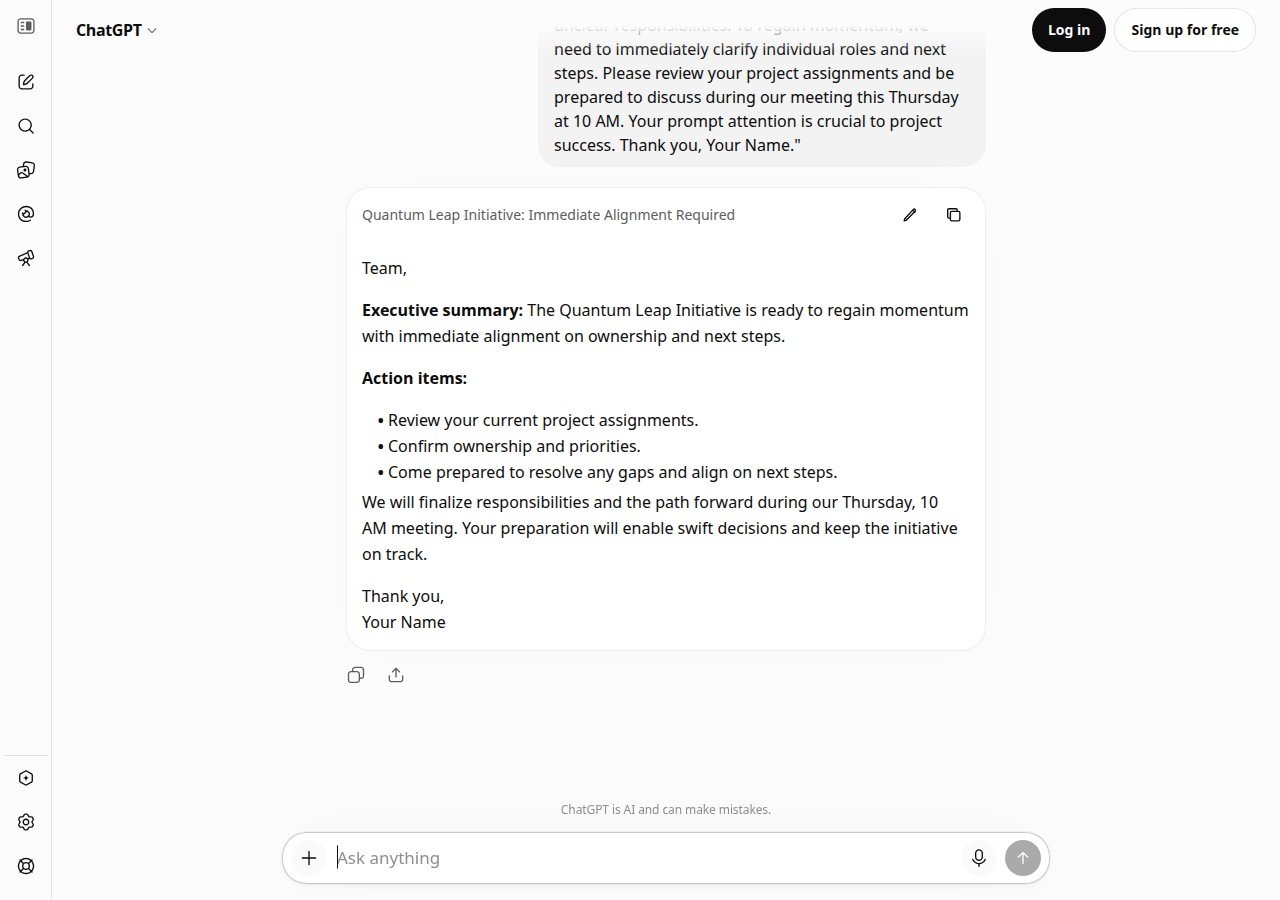
Starting with a clear, concise email about the Quantum Leap Initiative: "Subject: Urgent: Quantum Leap Initiative Status and Responsibility Clarification. Team, the Quantum Leap Initiative is experiencing delays due to unclear responsibilities. To regain momentum, we need to immediately clarify individual roles and next steps. Please review your project assignments and be prepared to discuss during our meeting this Thursday at 10 AM. Your prompt attention is crucial to project success. Thank you, [Your Name]." This email works for a general team. However, if you need to send this to senior leadership, you would use RCTFC to specify: "Role: Executive communication expert specializing in internal corporate messaging. Context: I have a clear, concise email about the 'Quantum Leap Initiative' status. We need to communicate this to a senior leadership team who values high-level overviews, quick action points, and a confident, results-oriented tone. Task: Rewrite the provided email for a senior leadership audience. Format: A brief, high-impact email no more than 100 words, starting with an executive summary, followed by essential action items or a clear call to address the issue. Constraints: The tone must be confident, proactive, and focused on solutions, not problems. Avoid excessive detail." The adapted output for executives might read: "Subject: Quantum Leap Initiative—Immediate Action Required. Our senior leadership team has identified role clarity as critical to restoring Quantum Leap Initiative momentum. We're implementing immediate responsibility assignments and expect full clarity by end of week. Your participation in Thursday's 10 AM leadership sync is essential. We're confident this intervention will put us back on track. [Your Name]." Notice the shift: less detail about the problem, more confidence about the solution, and a direct appeal to leadership action rather than team coordination. The same core information is reframed for maximum impact with this specific audience.
Driving Action: Crafting Potent Calls to Action and Strategic Follow-ups
A well-written, audience-appropriate email can still fail if it lacks a clear call to action or plan for follow-up. Many emails end with passive language like "let me know what you think" or trail off without clarity on what the recipient should actually do. A powerful call to action (CTA) transforms passive reading into active engagement. It's the difference between someone finishing your email and thinking "that's nice" versus "I need to do something about this." A compelling CTA is direct, specific, and measurable. Rather than "please address this issue," it says "confirm your project assignments by Wednesday end-of-day." Rather than "we should discuss this," it says "join the Thursday 10 AM meeting with your team's priority list." The specificity removes ambiguity for the recipient; they know exactly what action is expected and by when. Additionally, your subject line functions as the gatekeeper of attention—if the subject line doesn't capture attention or communicate urgency and relevance, many recipients won't open the email at all. An effective subject line is concise, specific, and honest about what's inside. Beyond the email itself, proactive follow-up planning extends your communication's impact. One email, no matter how well-crafted, rarely creates lasting momentum. ChatGPT can help you brainstorm follow-up tactics: reminder messages, progress check-ins, escalation paths if action isn't taken, and additional touchpoints that reinforce accountability. These follow-ups transform a one-off message into an ongoing conversation that maintains urgency and keeps your initiative visible. Strategic follow-up planning, informed by ChatGPT's suggestions, turns email from a discrete communication act into part of a coordinated influence strategy.
- A clear, compelling call to action transforms passive reading into active engagement by specifying exactly what the recipient should do
- Effective CTAs are direct, specific, and include clear deadlines or conditions for completion
- Subject lines are your email's first impression and determine whether the email gets opened; they should be concise and communicate urgency or relevance
- Strategic follow-up planning extends the email's impact beyond the initial send, maintaining momentum and accountability
- Proactive follow-ups can include reminders, progress checks, escalation paths, and reinforcement touchpoints
Lab: Lab Exercise
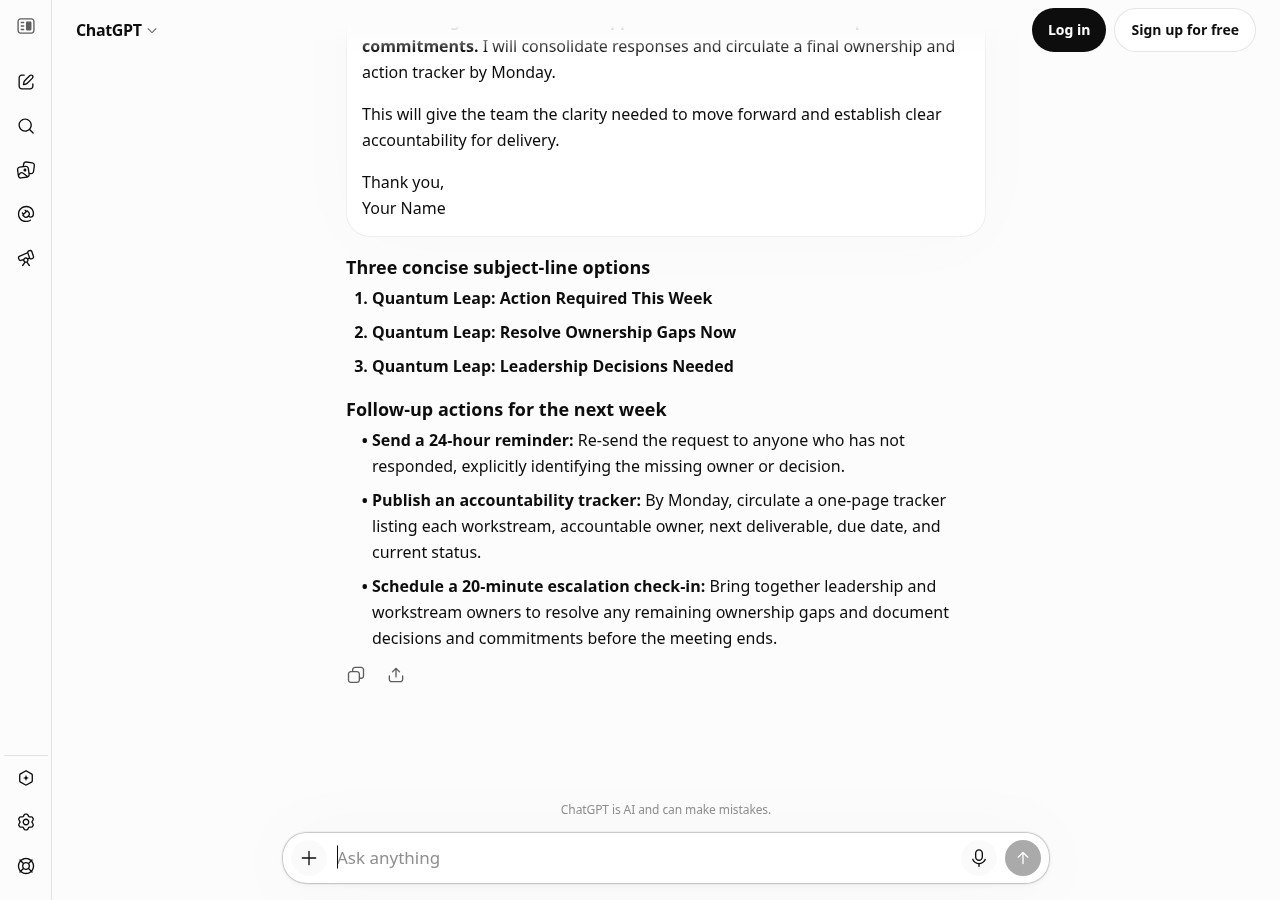
Starting with an email to senior leadership: "Subject: Quantum Leap Initiative: Urgent Status Update. Senior Leadership Team, the Quantum Leap Initiative faces critical delays due to unclear responsibilities. Immediate clarity is vital to restore momentum. Please address this issue promptly to ensure project success. Thank you, [Your Name]." Using RCTFC to enhance this email, you would specify: "Role: Strategic communications consultant and email marketing specialist. Context: I have an email for senior leadership regarding the 'Quantum Leap Initiative' that needs a stronger, more explicit Call to Action (CTA). It also needs an impactful subject line and ideas for next-step follow-ups to ensure engagement. Task: Refine the email to include a clear, compelling CTA. Generate three distinct, highly effective subject line options. Brainstorm three proactive follow-up actions for me to implement in the next week. Format: Provide the revised email, followed by the subject line options, then the follow-up actions in a bulleted list. Constraints: Subject lines should be concise and urgent. The CTA must be direct and measurable. Follow-up actions should be practical and reinforce project accountability." The resulting output might include: Three subject line options such as "Quantum Leap Initiative—Leadership Decision Required by Friday"; "Critical: Role Clarification for Quantum Leap Initiative"; and "Quantum Leap Initiative Status—Immediate Executive Input Needed." A revised email with a concrete CTA like "Please confirm your role clarity recommendations by 5 PM Friday. We will implement assignments Monday morning." And follow-up actions such as: "(1) Send a brief 48-hour reminder to any non-responders with a clear escalation note; (2) Schedule a 15-minute Friday leadership huddle to finalize role assignments and timelines; (3) Send a Monday morning confirmation email with the new role structure and the first week's deliverable milestones." This multi-layered approach ensures the email doesn't just land—it drives measurable action and maintains accountability.
Summary
Mastering email communication with ChatGPT hinges on three interconnected competencies: using RCTFC to eliminate ambiguity and precision-engineer your requests; adapting your message for specific audiences and tones to ensure psychological resonance; and crafting strategic calls to action and follow-up plans that drive tangible results. Each competency builds on the previous one: you start by clarifying what you want to say, then you shape it for who you're saying it to, and finally you ensure it moves people to action. Together, these skills transform ChatGPT from a tool that generates mediocre generic responses into a strategic partner that amplifies your communication effectiveness. You're no longer hoping the AI understands you; you're architecting precise inputs that guarantee relevant, impactful outputs. This shift from passive to active prompting is where the real power of AI for communication emerges—not because the AI is smarter, but because you're asking smarter questions.
Next Steps
Take a recent email you've sent that felt unclear or ineffective, and run it through the RCTFC framework. Experiment with ChatGPT using different audience and tone specifications for the same core message. Pay close attention to how precise prompting changes the output quality. Once you're comfortable with the framework, practice brainstorming subject lines and follow-up strategies for emails you're working on. Over time, internalizing RCTFC will make you a more strategic communicator even when you're not using AI, because you'll habitually think in terms of role, context, task, format, and constraints. Share your most effective prompts with colleagues and build a library of RCTFC templates tailored to the different communication scenarios you encounter regularly.