How Real Estate Agents Sell Smarter with ChatGPT: Your AI Co-Pilot for Success!
Ever wish you had a witty, lightning-fast assistant who could draft emails, craft compelling listings, and summarize market trends in a blink? Well, good news, agents! That super-smart sidekick isn't just a dream, it's ChatGPT, and it's ready to help you ditch the busywork and truly sell smarter. Let's unlock your AI superpowers!
Overview
ChatGPT represents a transformative tool for real estate professionals seeking to streamline operations, enhance client communication, and differentiate their services in a competitive market. By leveraging AI effectively, agents can reclaim time spent on repetitive administrative tasks—drafting follow-ups, writing listings, explaining market trends—and redirect that energy toward relationship-building and strategic selling. This guide explores three core applications: mastering the prompt framework that unlocks ChatGPT's potential, generating compelling property descriptions that resonate with buyers, and translating complex market data into client-friendly insights that establish your expertise.
What You'll Learn
- Understand the RCTFC prompting framework and apply it to real estate workflows
- Use ChatGPT to draft personalized client follow-up emails efficiently
- Generate engaging, targeted property descriptions that appeal to specific buyer demographics
- Translate market data and trends into clear, actionable client communications
- Identify time-saving opportunities by automating routine real estate tasks with AI
Your New AI Co-Pilot: Getting Started Smart
The foundation of effective AI usage lies not in the tool itself, but in how you communicate with it. ChatGPT, like any skilled assistant, performs best when given clear, structured direction. Vague requests yield generic results; precise instructions yield gold-standard outputs tailored to your specific needs. The RCTFC framework—Role, Context, Task, Format, and Constraints—provides a proven structure for crafting prompts that consistently deliver exceptional results. This framework mirrors the clarity you would bring to any professional instruction. Just as you wouldn't send a client a vague email about an open house, you shouldn't send ChatGPT ambiguous requests. Each component of RCTFC serves a distinct purpose: Role establishes who ChatGPT should embody and what expertise it should draw upon; Context provides the specific situation, property details, or client circumstances; Task explicitly states what you need accomplished; Format specifies the structure and tone of the output; and Constraints set boundaries on length, style, or specific requirements. Together, these elements transform ChatGPT from a general-purpose chatbot into a specialized agent aligned with your real estate business objectives. Implementing RCTFC doesn't require complex syntax or technical knowledge. It simply means taking thirty seconds to think through these five dimensions before hitting send. The investment pays immediate dividends: less time refining AI outputs, fewer follow-up prompts needed, and consistently professional results you can deploy directly or with minimal editing.
- Precise prompting is the foundation of effective AI usage in real estate
- RCTFC provides a five-part framework: Role, Context, Task, Format, and Constraints
- Clear communication with ChatGPT mirrors professional communication with clients and prospects
- Structured prompts dramatically reduce iteration time and improve output quality
Lab: Lab Exercise
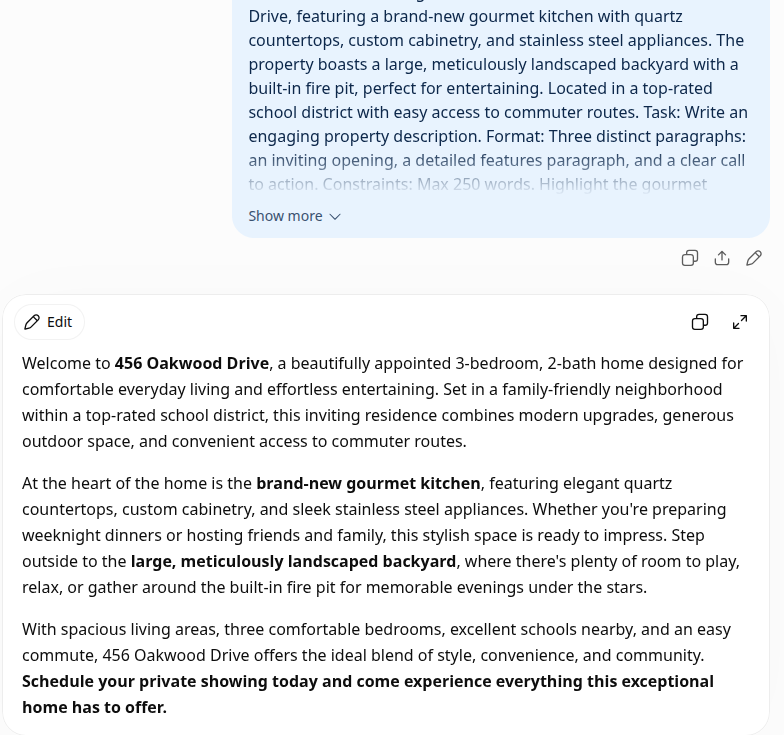
Consider an agent who has just hosted an open house at 123 Maple Drive and met three prospects: Sarah and Tom, who showed strong interest in the chef's kitchen and emphasized remote work compatibility; and David, who asked detailed questions about yard size and nearby schools. Using RCTFC, the agent would construct the prompt as follows: Role: 'You are an experienced real estate agent specializing in lead nurturing.' Context: 'I hosted an open house at 123 Maple Dr yesterday. I met Sarah & Tom, who loved the kitchen and specifically mentioned that remote work flexibility was important to them. I also met David, who asked several questions about the yard size and which schools are in the neighborhood.' Task: 'Draft personalized follow-up emails for each prospect that reference the features they showed interest in and invite them to schedule a private showing.' Format: 'Professional email with a friendly, warm tone.' Constraints: 'Keep each email to 3-4 sentences maximum and include a clear call to action to schedule a private showing.' This structure ensures ChatGPT generates three distinct, relevant emails tailored to each prospect's stated interests—Sarah and Tom's email would highlight remote work spaces and the kitchen, while David's would emphasize the yard and school proximity—rather than a generic template email sent to all three. The agent saves time on drafting while delivering messaging that demonstrates genuine attention and increases the likelihood of securing showings.
Crafting Compelling Listings That Sell
Property descriptions are one of the highest-leverage marketing assets in real estate. A compelling description—one that paints a vivid picture and speaks directly to a buyer's aspirations—can be the difference between a showing and a scroll-past. Yet agents often find themselves struggling to generate fresh, evocative descriptions for listing after listing, particularly when managing a large portfolio. ChatGPT transforms this challenge by functioning as a personal wordsmith, capable of generating multiple descriptions with different tones, emphases, and target audience angles. The key to generating listings that truly sell is combining property specifics with a clear understanding of the target buyer and the unique selling points that matter most to them. A luxury beachfront property appeals to a different set of desires than a family home in the suburbs. ChatGPT, when prompted with sufficient context about both the property and the intended buyer, can craft descriptions that resonate emotionally while accurately representing the property's features. This isn't about embellishment; it's about strategic emphasis—highlighting the sunlit morning room to the remote-work professional, emphasizing neighborhood schools and safety to the young family, focusing on luxury finishes and privacy to the affluent couple seeking an exclusive retreat. Beyond individual descriptions, ChatGPT can generate multiple versions of the same listing optimized for different platforms (a Zillow description differs from a luxury broker site description), different buyer personas, or even different seasonal angles. This capability means agents can A/B test descriptions, repurpose content across platforms, and maintain marketing momentum without the creative exhaustion that typically accompanies this work.
- Property descriptions are high-impact marketing assets that drive showing requests
- Targeted descriptions speak directly to specific buyer personas and their priorities
- ChatGPT can generate multiple description versions for different platforms and audiences
- Effective descriptions combine specific property features with emotional resonance and lifestyle appeal
- AI-generated descriptions save hours while elevating marketing consistency and quality
Lab: Lab Exercise
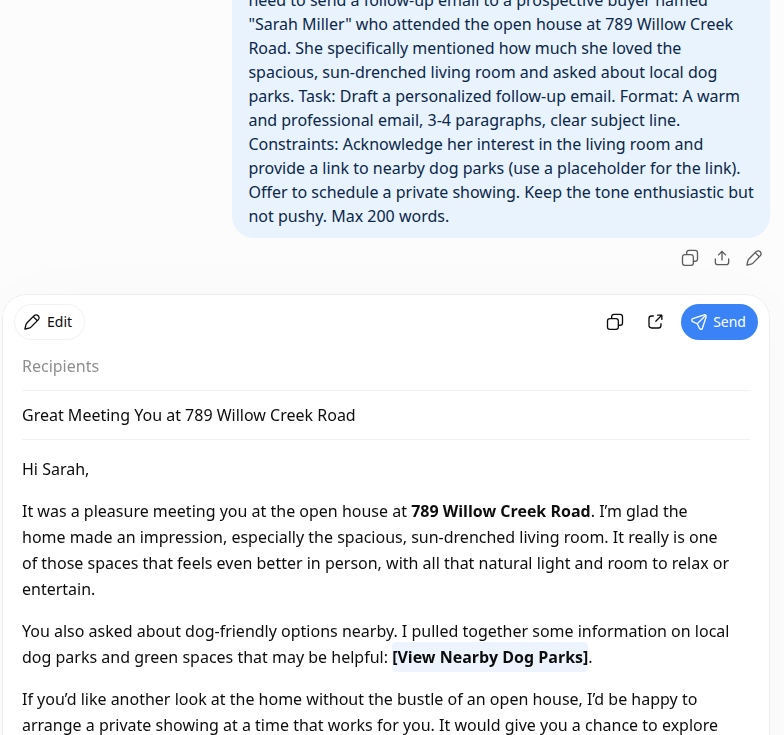
Imagine an agent representing a luxury oceanfront property at 789 Ocean View Terrace: 4 bedrooms, 3.5 bathrooms, newly renovated chef's kitchen, private ocean-facing balcony, community beach access, located in the desirable 'Sunset Shores' neighborhood, built in 1998, listed at $1.8 million. The target audience is affluent families or retirees seeking coastal luxury living. Using RCTFC, the agent crafts this prompt: Role: 'You are a creative real estate marketer specializing in luxury properties.' Context: 'I'm marketing a property at 789 Ocean View Terrace in Sunset Shores. It features 4 bedrooms, 3.5 bathrooms, and was recently renovated with a chef's kitchen as the centerpiece. The property includes a private ocean-facing balcony and residents have access to a private community beach. The home was built in 1998 but fully updated. The asking price is $1.8M. My target buyers are affluent families or retirees who value coastal luxury and a refined lifestyle.' Task: 'Write a captivating listing description that will appeal to this demographic.' Format: '4-paragraph web description suitable for Zillow or similar platforms.' Constraints: 'Emphasize luxury, tranquility, and coastal living. Include a strong call to action inviting potential buyers to schedule a viewing.' ChatGPT would generate something substantially more compelling than 'Ocean view property with 4 beds, 3.5 baths, renovated kitchen.' The output would evoke the experience of morning coffee on the private balcony overlooking the ocean, the sophisticated entertaining potential of a chef's kitchen, the peace of coastal living, and the exclusive community access—all written in language that appeals to the affluent buyer's aspirations rather than merely listing features. The agent can then deploy this description directly to Zillow, email marketing, social media, or the agency website, multiplying its value across channels.
Mastering Market Insights and Client Education
Market data—days on market, inventory levels, price trends, interest rate fluctuations—is crucial information that informed buyers need to understand. Yet translating dense market reports into language that resonates with and empowers first-time homebuyers, nervous sellers, or anxious clients is an art that few agents have time to perfect. When clients encounter terms like 'seller's market' or 'inventory contraction' without clear explanation, confusion and anxiety often follow. This is where ChatGPT excels as a market analyst and educator. By providing ChatGPT with specific market data relevant to a client's situation—neighborhood-specific statistics, regional trends, recent rate changes—and the client's particular concerns or questions, you can generate clear, empathetic explanations that build confidence and position you as the trusted expert. This capability is especially valuable when markets shift rapidly or when a client's timeline creates urgency. Rather than sending a generic market update email that clients may not even open, you can create personalized communications that directly address a client's stated worries and offer concrete, actionable strategies. The secondary benefit extends to your own education. Market complexity can be overwhelming, particularly when managing multiple markets or tracking rapid changes. ChatGPT can help you quickly synthesize market information, understand implications, and identify patterns—freeing your cognitive load so you can focus on client strategy rather than data interpretation. This means you spend less time in analysis paralysis and more time executing winning strategies.
- Market data is overwhelming for most clients and requires translation into accessible language
- Personalized market education builds client confidence and trust
- Clear market explanations position you as the authoritative expert clients rely on
- ChatGPT can generate empathetic, actionable client communications addressing specific concerns
- Translating data for clients also reinforces your own market understanding and strategy development
Lab: Lab Exercise
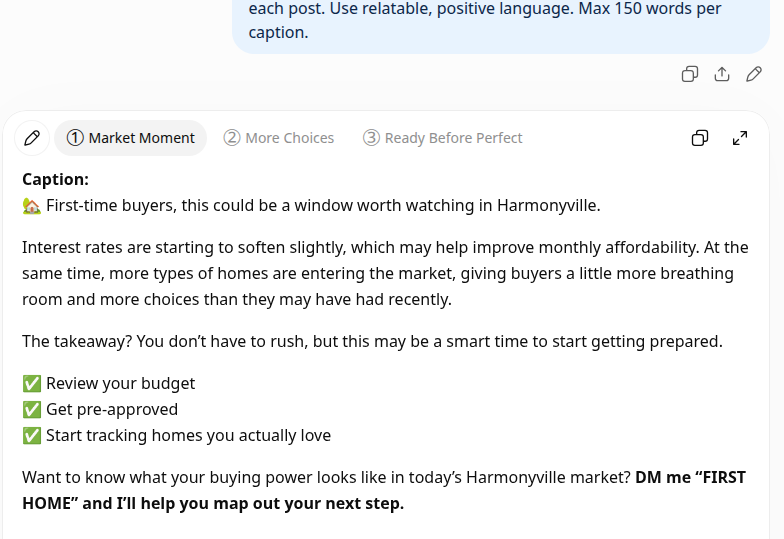
Consider a first-time homebuyer named Emily who is becoming nervous about rising interest rates and limited inventory in the Riverwood neighborhood. Current market conditions show: average sale price $410,000 (up 5% over the past six months), days on market at 45 days, inventory down 10% year-over-year, and interest rates that have recently jumped from 6.5% to 7.2%. Using RCTFC, the agent constructs a prompt: Role: 'You are an expert real estate consultant specializing in first-time homebuyer education and guidance.' Context: 'My client Emily is a first-time homebuyer looking in the Riverwood neighborhood. She's expressed anxiety about the rising interest rates and what she's heard about limited inventory. Current market data for Riverwood: average sale price $410k (up 5% in the past 6 months), days on market 45, inventory down 10% year-over-year. Interest rates jumped from 6.5% to 7.2% recently. Emily is worried these trends mean she's priced out or missing opportunities.' Task: 'Write an email to Emily explaining what these market trends mean for her situation, addressing her specific concerns, and suggesting concrete strategies to move forward.' Format: 'Empathetic, encouraging email that acknowledges her concerns while remaining realistic.' Constraints: 'Keep a positive but honest tone. Address her concerns directly without dismissing them. Suggest actionable strategies like getting pre-approved and understanding the importance of quick decision-making in a competitive market.' ChatGPT would generate an email that might read something like: 'Hi Emily, I want to address your concerns about the current market head-on. Yes, prices are up and inventory is tighter than a year ago—these are real factors to understand. However, rising rates actually shift psychology in the market, often creating urgency among sellers, and slower sales typically mean less competition for serious, prepared buyers. Here's what I recommend: First, getting pre-approved with a concrete rate lock shows sellers you're a serious buyer, which is even more valuable when inventory is limited. Second, while the market is selective, it rewards buyers who are ready to move quickly. Let's focus on finding homes that truly fit your needs and making your offer count. I'm confident that with the right strategy, we can find your home in Riverwood.' This response transforms raw market data into reassurance backed by concrete action items, directly addresses Emily's emotional concerns, and positions the agent as both knowledgeable and supportive—dramatically more effective than a generic market update.
Summary
ChatGPT represents far more than a novelty tool for real estate professionals; it is a genuine co-pilot that amplifies your capacity to deliver personalized, professional service at scale. The three core applications explored in this guide—mastering the RCTFC prompting framework, generating compelling property descriptions, and translating market insights into client education—collectively address the highest-value, most time-consuming tasks in real estate work. By delegating these functions to AI with smart prompting, agents reclaim hours previously spent on busywork and redeploy that time toward genuine relationship-building, strategic selling, and market-leading service. The path forward is not about replacing your expertise with AI, but amplifying it. You remain the trusted advisor, the market expert, the client advocate—what changes is the efficiency with which you deliver these services. Every personalized follow-up email, every compelling listing description, every clear market education piece strengthens client relationships and increases conversion. The agents who embrace these tools thoughtfully, using structured prompting to maintain quality while scaling output, will find themselves selling smarter and building practices that are more sustainable, profitable, and fulfilling.
Next Steps
Begin with one high-volume task in your current workflow—whether that's crafting follow-up emails, writing listing descriptions, or creating client market updates. Draft a prompt using the RCTFC framework for that task, test ChatGPT's output, and refine your prompt based on results. Once you've found a prompt structure that consistently produces work you're proud of, save it as a template for future use. As you grow comfortable with one application, expand to additional workflow areas. Consider joining a peer group of agents exploring AI to share successful prompts, results, and strategies for your local market and client base.