How Nutrition Coaches are Using ChatGPT
Ever feel like you’re an expert chef trapped in a never-ending menu-planning loop for all your clients? You're about to discover how to whip up bespoke meal plans in minutes, not hours, leaving more time for what you do best: coaching.
Overview
As a nutrition coach, you juggle countless demands: creating personalized meal plans, explaining complex nutritional concepts, and marketing your services—all while maintaining the expert, empathetic guidance your clients need. ChatGPT can become a powerful assistant that automates routine but time-consuming tasks, freeing you to focus on what you do best: coaching. This guide explores three high-impact applications of AI in nutrition coaching: automating personalized meal plan creation, translating scientific concepts into digestible client education, and generating fresh marketing content that attracts and engages your ideal clients.
What You'll Learn
- Use ChatGPT to create detailed, personalized meal plans that respect client constraints, preferences, and nutritional goals
- Leverage AI to transform complex nutritional science into clear, relatable explanations that clients understand and act on
- Generate engaging social media and marketing content that positions you as an expert while connecting authentically with your audience
- Apply prompt-crafting best practices to unlock consistent, high-quality AI outputs
- Maintain your professional authority and personalization while incorporating AI tools into your coaching workflow
Meal Plan Maestro: Crafting Custom Culinary Journeys
Personalized meal planning is one of the most valuable—and most time-intensive—services nutrition coaches provide. Each client arrives with a unique constellation of needs: dietary restrictions (gluten-free, vegetarian, vegan, keto), medical considerations (diabetes, hypertension), preferences (dislikes mushrooms, avocado), lifestyle constraints (busy professional, trains regularly), and specific goals (weight loss, muscle gain, energy optimization). Manually brainstorming meal combinations, cross-referencing nutritional data, and ensuring variety across days is genuinely a mental marathon that can consume hours per client per week. ChatGPT can serve as your sous chef, dramatically accelerating this process while preserving your expert judgment. By providing clear context about a client's requirements, preferences, and caloric targets, you can generate a first draft of a complete meal plan in minutes. The AI produces daily breakdowns with specific meal names, ingredient lists, and caloric estimates—all formatted and ready to refine. This doesn't replace your nutritional expertise; rather, it handles the mechanical heavy lifting of brainstorming and assembly, leaving you free to review, adjust, and personalize based on your professional knowledge and your client's feedback. The key to exceptional results is specificity. Rather than asking ChatGPT for "a meal plan for a vegetarian client," you'll provide detailed constraints: age, weight loss target, training frequency, food dislikes, caloric limit, and macronutrient preferences. This focused information enables the AI to generate suggestions that actually fit your client's life, making implementation more likely and client satisfaction higher.
- Each client's needs are unique; ChatGPT can rapidly synthesize multiple constraints into cohesive meal plans
- Detailed prompts unlock more relevant and usable AI output
- AI-generated meal plans serve as a strong first draft that you refine with your professional expertise
- Automating meal plan creation reclaims hours per week that can be reinvested in coaching and client relationships
Lab: Lab Exercise
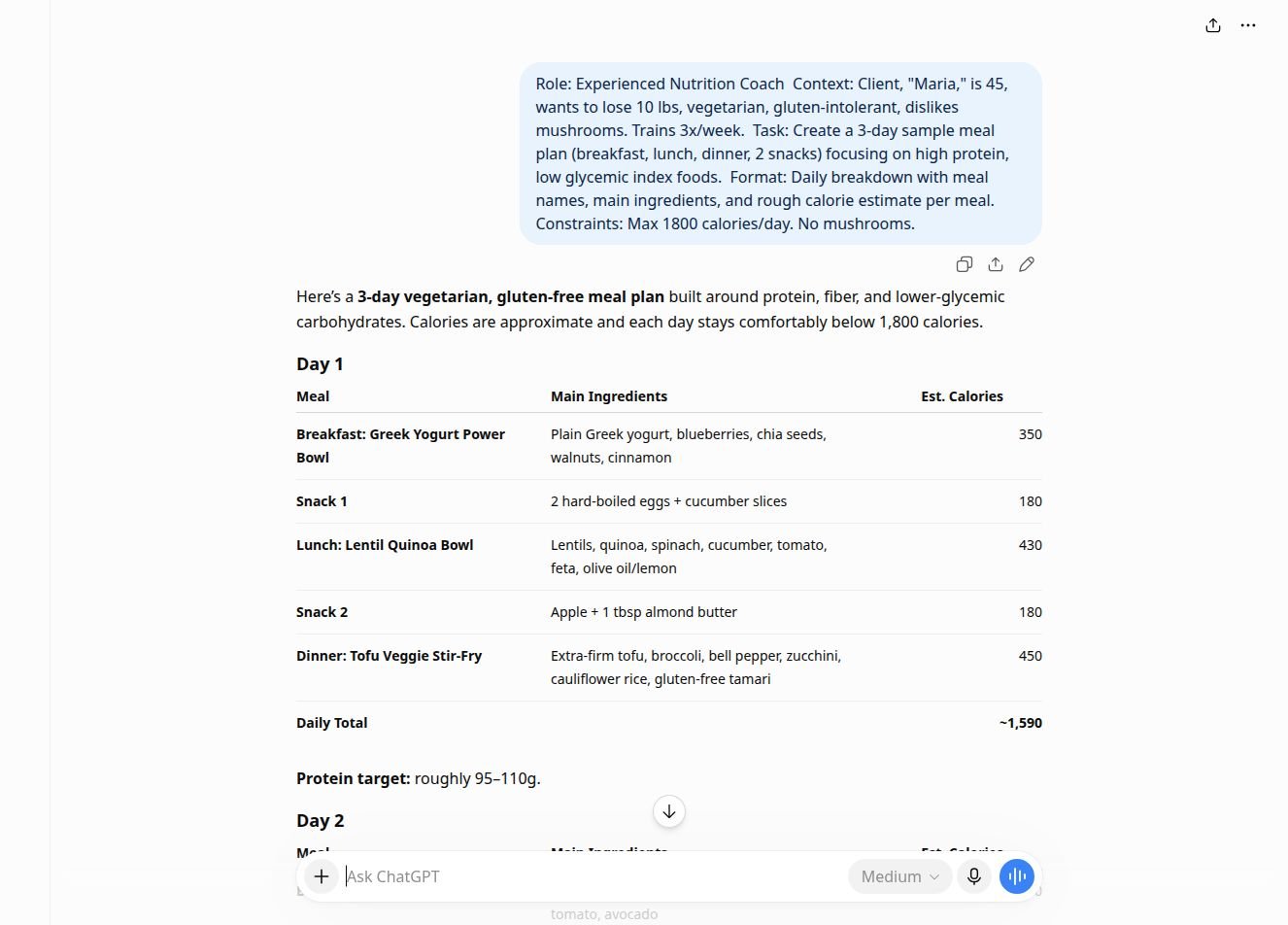
Consider Maria: a 45-year-old woman aiming to lose 10 pounds, who is vegetarian and gluten-intolerant, dislikes mushrooms, trains three times weekly, and needs to stay within 1,800 calories per day. Rather than spending an hour manually brainstorming, you provide ChatGPT with this specific brief: "Create a 3-day sample meal plan for a 45-year-old vegetarian female client who is gluten-intolerant, dislikes mushrooms, trains 3x/week, and wants to lose 10 lbs. Focus on high protein and low glycemic index foods. Maximum 1,800 calories/day. Include breakfast, lunch, dinner, and 2 snacks each day. For each meal, list the name, main ingredients, and approximate calorie count." ChatGPT responds with a structured plan—for example, Day 1 might feature quinoa-chickpea bowls, Greek yogurt parfaits with berries, and lentil soup—all respecting the constraints. You review the output, ensure nutritional balance, confirm it aligns with Maria's preferences, and share it with her. The entire process takes 10 minutes instead of 60, and Maria receives a genuinely personalized plan that demonstrates you understand her needs.
Clarity Commander: Simplifying Complex Concepts
Nutrition science is dense. Glycemic index, metabolic flexibility, macronutrient ratios, hormonal regulation—these concepts are fascinating and important, but they often mystify clients. You've experienced the phenomenon: you explain something you know deeply, and the client's eyes begin to glaze. This disconnect isn't because clients lack intelligence; it's because the gap between scientific language and everyday experience is wide. A coach's real gift is bridging that gap, translating rigor into relatability. Translating complex concepts into accessible language is part art, part craft—and it takes time. Finding the right analogy, choosing the precise tone, and structuring information for maximum clarity all require creative thinking. ChatGPT can accelerate this process significantly. When you feed the AI a concept and your client's profile (age, background, learning style, skepticism level), it can generate clear, engaging explanations tailored to that specific person. The output might use a relatable metaphor, break down ideas into bite-sized steps, and include concrete examples from daily life. This approach serves multiple purposes. First, clients who actually understand the "why" behind recommendations are far more likely to comply. Second, your communication becomes more efficient—instead of spending 20 minutes crafting an explanation, you iterate on an AI draft. Third, you maintain your authority: you review, edit, and personalize every explanation before sharing, ensuring it reflects your voice and professional standards.
- Complex nutritional concepts often fail to resonate with clients because of language barriers, not lack of intelligence
- Relatable analogies, practical examples, and simple language dramatically increase client comprehension and buy-in
- ChatGPT can generate clear educational content quickly, which you then refine to match your voice and expertise
- Clients who understand the rationale behind recommendations are more engaged and more likely to succeed
Lab: Lab Exercise
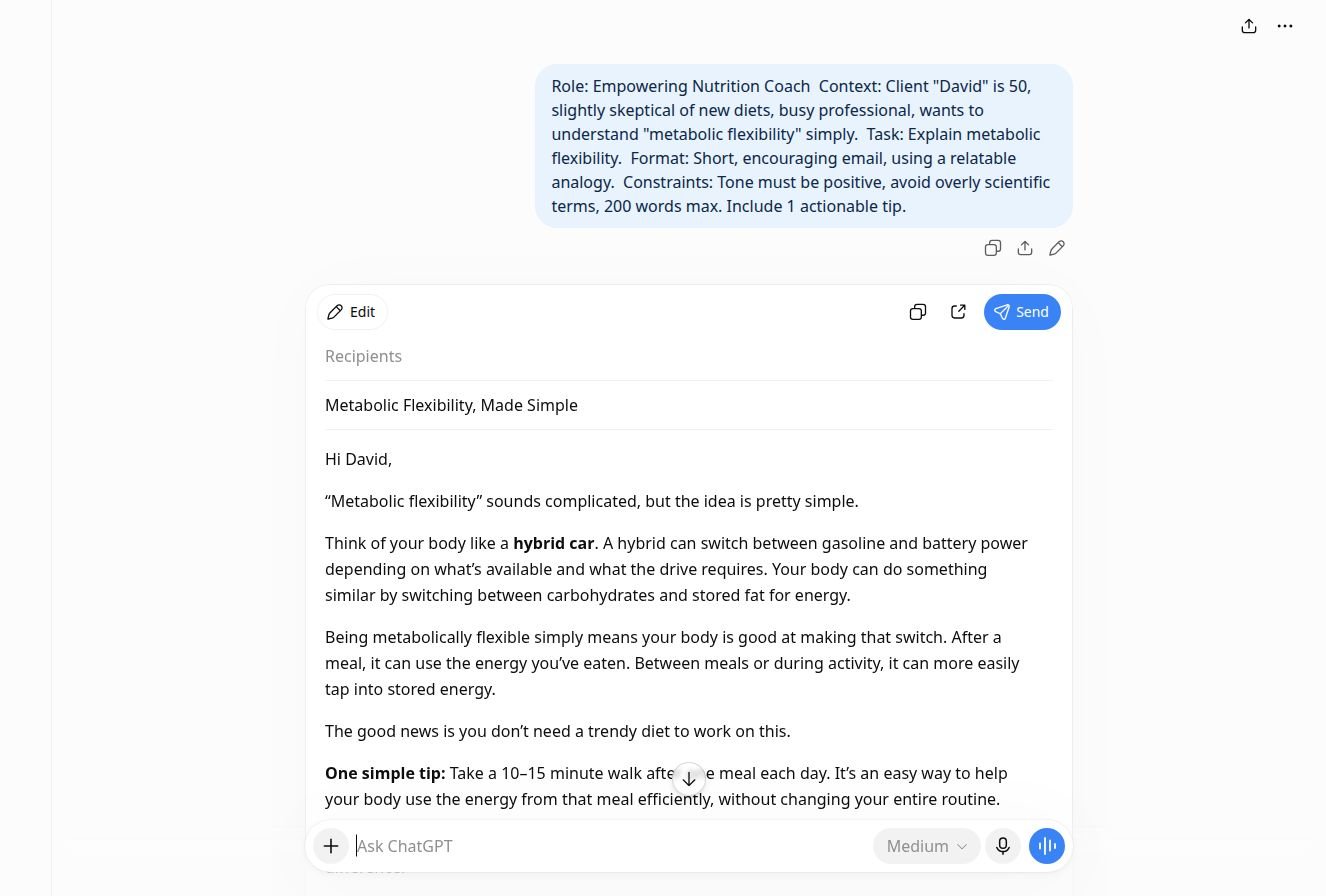
David is a 50-year-old busy professional, slightly skeptical of trendy diet approaches, and curious about "metabolic flexibility" but intimidated by scientific explanations. Instead of sending him a textbook definition, you use ChatGPT: "Write a short, encouraging email to a 50-year-old skeptical professional, David, explaining metabolic flexibility using a relatable analogy. Use simple language, avoid overly scientific terms, keep it to 200 words max, include 1 actionable tip, and maintain a positive, supportive tone." ChatGPT might respond with an email that opens: "Think of your body like a hybrid car that can run on either gas or electricity—metabolic flexibility is your body's ability to switch between burning carbs and fats for fuel, depending on what's available. This is actually great news for you..." The email continues with a clear, jargon-light explanation and concludes with a practical first step, like "Try eating protein at every meal—it helps your body practice this fuel-switching skill." You review, perhaps adjust a phrase or two to match your personal style, and send it to David. He reads something clear and encouraging, not intimidating; his skepticism softens; he feels seen and understood.
Content Creator Catalyst: Sparking Marketing Brilliance
Marketing is essential for nutrition coaches, yet it's often the hardest task to prioritize. Building an audience, generating leads, and maintaining consistent visibility require fresh ideas, clear messaging, and regular output—social media posts, newsletters, blogs, testimonials. Many coaches struggle with writer's block, lack of marketing strategy, or simply insufficient time to produce content consistently. The result: visibility suffers, potential clients never hear about you, and your impact remains limited to a small circle. ChatGPT can be your marketing catalyst. It excels at brainstorming multiple angles on a single topic, generating compelling headlines, drafting social media captions, and even structuring marketing strategies. By providing context about your niche (e.g., women's hormonal health for busy professionals), your target audience demographics, and your coaching philosophy, you can prompt the AI to generate a week's worth of social media ideas in minutes. Each suggestion includes a post topic, caption draft, and relevant hashtags—all written in a supportive, expert tone that attracts your ideal clients. The critical distinction: ChatGPT generates scaffolding, not final copy. You review each idea, edit for authenticity, ensure it aligns with your brand voice, and verify that claims are accurate. Some posts you'll use nearly as-is; others you'll significantly revise or reject. The outcome is that you've radically accelerated your content pipeline while maintaining full control over your message and reputation. You also reduce the psychological friction that often prevents coaches from marketing at all—facing a blank page is daunting; refining AI suggestions is manageable.
- Consistent, engaging marketing content attracts ideal clients and builds authority, yet it's often pushed aside by coaches
- ChatGPT can brainstorm multiple content angles, generate captions, and structure marketing strategies in minutes
- Your final content should always be reviewed, edited, and personalized to match your authentic voice and professional standards
- Marketing content that is specific, relatable, and empowering resonates far more than generic wellness messaging
Lab: Lab Exercise
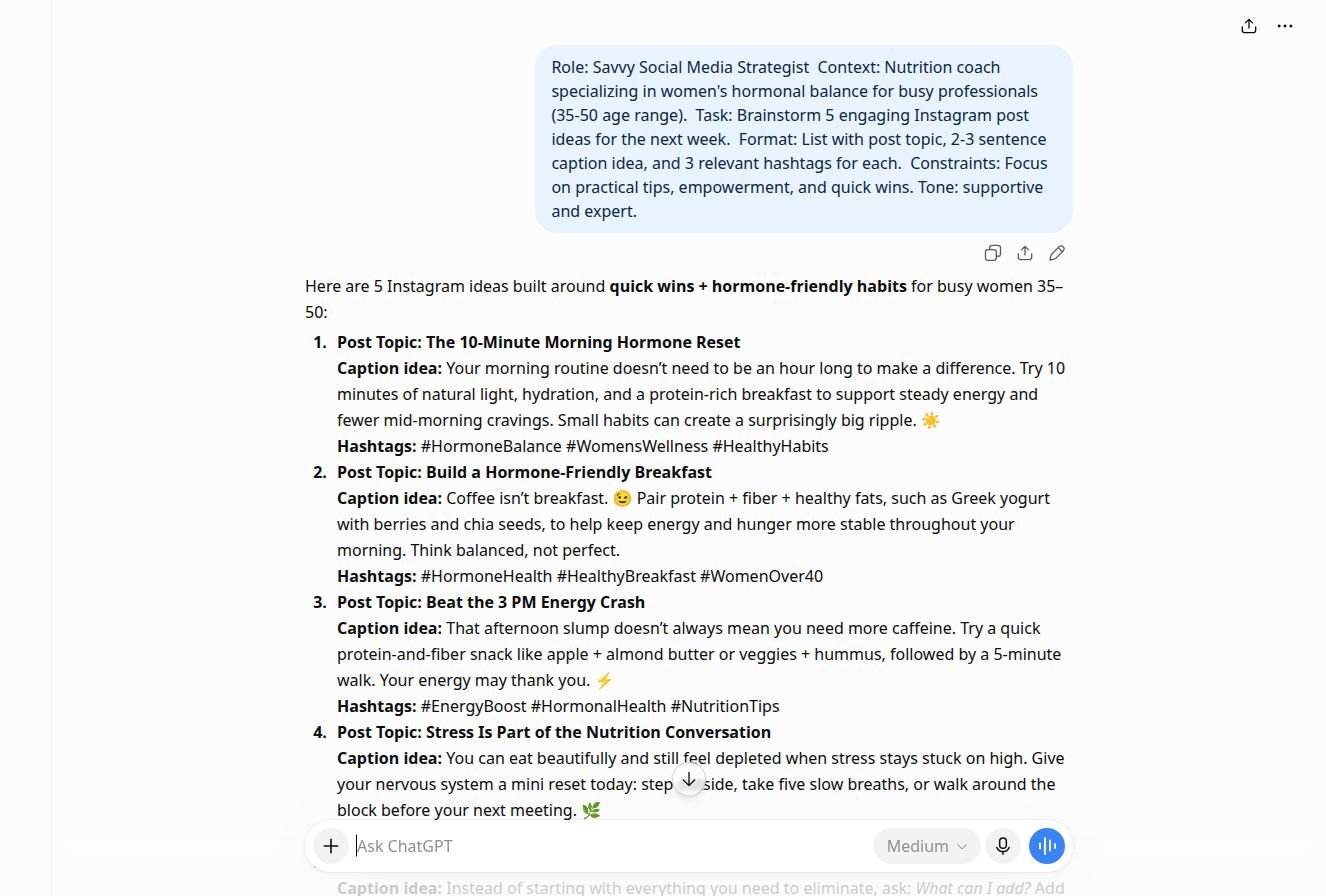
You specialize in hormonal health coaching for busy professional women aged 35–50. Instead of staring at a blank social media calendar, you prompt ChatGPT: "Brainstorm 5 engaging Instagram post ideas for a nutrition coach specializing in women's hormonal balance for busy professionals aged 35–50. For each idea, provide: the post topic, a 2–3 sentence caption idea, and 3 relevant hashtags. Focus on practical tips, empowerment, and quick wins. Keep the tone supportive and expert." ChatGPT responds with five ideas, such as: Post 1 topic: "Cortisol and Coffee Timing"—Caption: "Here's a small shift with big impact: If you're a caffeine lover, try waiting 90 minutes after waking before your first coffee. This gives your natural cortisol rhythm space to work its magic and prevents the jittery afternoon crash. Small timing change, major energy transformation!"—Hashtags: #HormoneHealth #BusyProfessionalWomen #WellnessHacks. You review this suggestion, think "This is great, but I'd slightly reword the caption to include my philosophy about working with your body, not against it," make that edit, and post it. Repeat for the remaining four ideas, and you've just created a week of engaging, strategic content in 15 minutes instead of several hours.
Summary
ChatGPT offers nutrition coaches three transformative applications that reclaim hours of work each week: automating personalized meal plan creation, translating complex nutrition science into clear client education, and generating fresh, engaging marketing content. In each domain, the tool handles the mechanical and creative heavy lifting—brainstorming meal combinations, finding the right analogy, drafting captions—while you maintain expert oversight and apply your professional judgment. The common thread across all three applications is specificity: the more detailed and clear your instructions to ChatGPT, the more useful and aligned the output. This isn't about replacing your expertise or removing the human element from coaching; it's about leveraging AI to amplify your impact. You remain the architect and editor of every client interaction and piece of content, but you do so far more efficiently, with more consistency, and with genuine joy instead of burnout. The result is that you can serve more clients, provide deeper coaching, and scale your impact without adding hours to your workday—freeing you to focus on what makes you a great coach: human connection, insight, and empathy.
Next Steps
Begin by identifying your most time-consuming task: meal planning, content creation, or client education. Pick one, craft a detailed prompt for ChatGPT based on the principles outlined above, and generate your first output. Spend time reviewing and refining it until it matches your standards. Once you've completed that iteration, experiment with the other two domains. As you build confidence and familiarity with the tool, develop a library of successful prompts you can reuse and adapt. Most importantly, share what you learn—discuss your favorite prompt-crafting tips with fellow coaches, compare results, and collaboratively discover workflows that work best for your specialty and coaching style.