How Managers Are Using ChatGPT to Save Time and Lead Better Teams
Ever feel like your inbox is a bottomless pit, sucking away precious hours you could be spending leading your team? Imagine reclaiming that time, while simultaneously leveling up your communication game.
Overview
Managers face constant pressure to handle communication, strategic planning, and team development—tasks that consume valuable hours without adding strategic value. ChatGPT offers a practical solution by functioning as an AI co-pilot that amplifies managerial effectiveness without replacing human judgment. This guide shows how to leverage ChatGPT across three critical management functions: drafting clear, empathetic communications; generating strategic ideas through rapid brainstorming; and creating personalized coaching experiences at scale. The goal is not to automate management but to reclaim time and mental energy so you can focus on what only you can do—provide vision, build relationships, and develop your team.
What You'll Learn
- Use ChatGPT to draft professional, empathetic communications and feedback messages more efficiently
- Leverage AI-assisted brainstorming to generate diverse strategic solutions to team challenges
- Create personalized coaching questions and development plans that empower team members
- Understand how to structure prompts effectively to get useful, actionable outputs from ChatGPT
- Maintain your authentic voice and leadership judgment while using AI as a productivity tool
Supercharging Communication & Feedback
Clear, well-crafted communication is one of a manager's most powerful tools, yet it often gets shortchanged when competing priorities pile up. The challenge is that effective communication requires both substance (what you're saying) and form (how you're saying it). When you're managing multiple projects, team crises, and administrative demands, finding the right words for delicate conversations—like performance feedback—can feel overwhelming. ChatGPT serves as a communication co-pilot that helps you separate these two components: you focus on the substance and intent of your message, while ChatGPT helps you sculpt that into professional, clear, and empathetic language. This is not about replacing your voice; it's about amplifying it. When you provide ChatGPT with context, tone requirements, and your core message, it can help transform rough notes into polished prose that lands the way you intend. The result is better-received feedback, faster message composition, and more consistent communication quality across your team interactions. Moreover, by removing the friction of finding the right words, you free up mental energy to focus on the deeper work of leadership—understanding your team members' needs and crafting messages that genuinely support their growth.
- ChatGPT helps you turn rough notes and ideas into professional, polished messages without losing your authentic voice
- Effective feedback requires both clarity on what needs improvement and assurance that the person is valued—ChatGPT can help balance both
- Providing rich context and explicit tone guidance to ChatGPT yields better, more personalized results
- The time saved on drafting allows you to focus on the strategic aspects of communication: why you're saying it and how it serves your team member's growth
- Maintaining a supportive, developmental tone in feedback reinforces that feedback is a gift, not a punishment
Lab: Lab Exercise
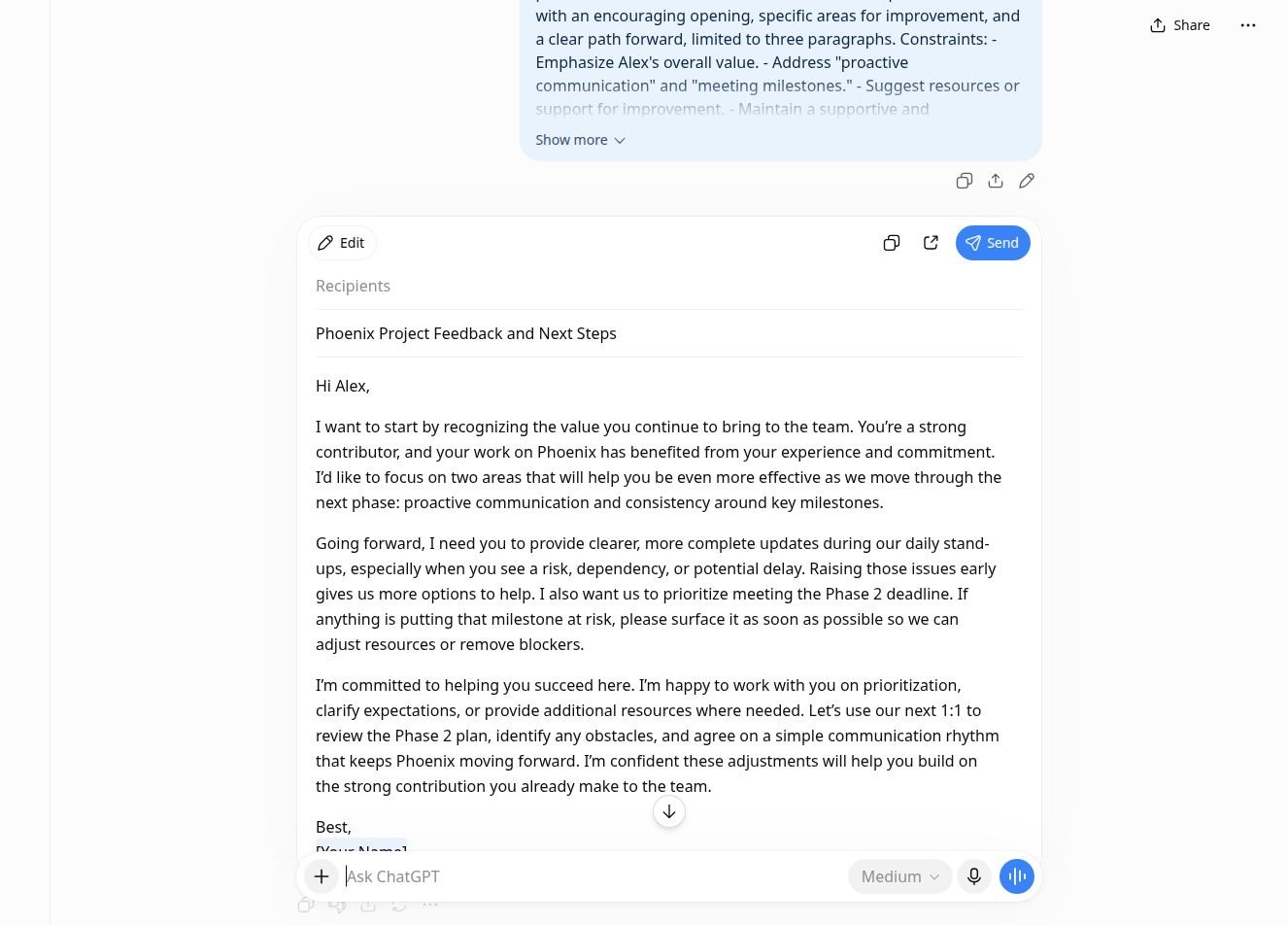
Imagine you need to give performance feedback to a team member named Alex regarding the Phoenix project. Alex is generally strong but has recently struggled with proactive communication and meeting key milestones. You might start with rough notes: 'Alex is good but not updating us daily and missing the Phase 2 deadline. Need to fix this.' You'd feel frustrated trying to word this in a way that feels both honest and supportive. By providing ChatGPT with these details as a manager, you could prompt: 'I need to draft a performance feedback email for my team member Alex who is a strong performer but has struggled with proactive communication and meeting the Phase 2 deadline for the Phoenix project. I want the email to be encouraging, acknowledge Alex's value, address specific areas for improvement (daily standup updates and the Phase 2 deadline), suggest support or resources, and maintain a developmental tone. Format as a professional three-paragraph email.' ChatGPT would generate something like: An opening paragraph that acknowledges Alex's strengths and overall value to the team; a middle section that specifically addresses the communication and deadline gaps without blame, framing them as growth areas; and a closing that outlines concrete next steps (like daily standup participation) and offers support (mentoring, resources, check-ins). The result is an email that Alex is more likely to receive as constructive rather than punitive, because it combines clarity about expectations with genuine support. You've saved time on drafting, but more importantly, you've ensured your feedback lands with the empathy and specificity that drives actual improvement.
Streamlining Strategic Planning & Brainstorming
Strategic thinking is where managers add unique value, yet many find themselves stuck in the initial brainstorming phase. Whether you're facing a concrete problem—like a team productivity dip—or trying to innovate around a process, the blank-page problem is real. You know something needs to change, but generating truly diverse, creative solutions when you're mentally fatigued is nearly impossible. ChatGPT excels at rapidly generating multiple solution angles, helping you escape the gravitational pull of obvious answers. It acts as a tireless thought partner that won't run out of ideas, get impatient, or push a single perspective. By describing your challenge in detail to ChatGPT and asking for structured brainstorming, you get a springboard of diverse ideas that you can evaluate, refine, and prioritize with your own judgment. This speeds up the ideation phase significantly, allowing you to move faster from 'we have a problem' to 'here's how we solve it.' The key is that ChatGPT isn't making strategic decisions for you; it's expanding the solution space you consider. You apply your deep knowledge of your team, organization, and context to evaluate which ideas fit. The result is more dynamic, proactive leadership because you're spending less time stuck and more time executing.
- ChatGPT can generate 5-10 diverse solution angles in seconds, whereas brainstorming alone often yields repetitive ideas
- Remote-first and empowerment-focused solutions tend to resonate better with modern teams than punitive or surveillance-based approaches
- Mixing short-term quick wins with long-term structural changes creates momentum while building sustainable improvements
- Framing your brainstorm request with clear constraints (e.g., 'avoid micro-management') helps ChatGPT generate more thoughtful, contextually appropriate ideas
- The best strategic moves often come from fresh perspectives—ChatGPT reliably provides these, even if some ideas are outside your typical thinking
Lab: Lab Exercise
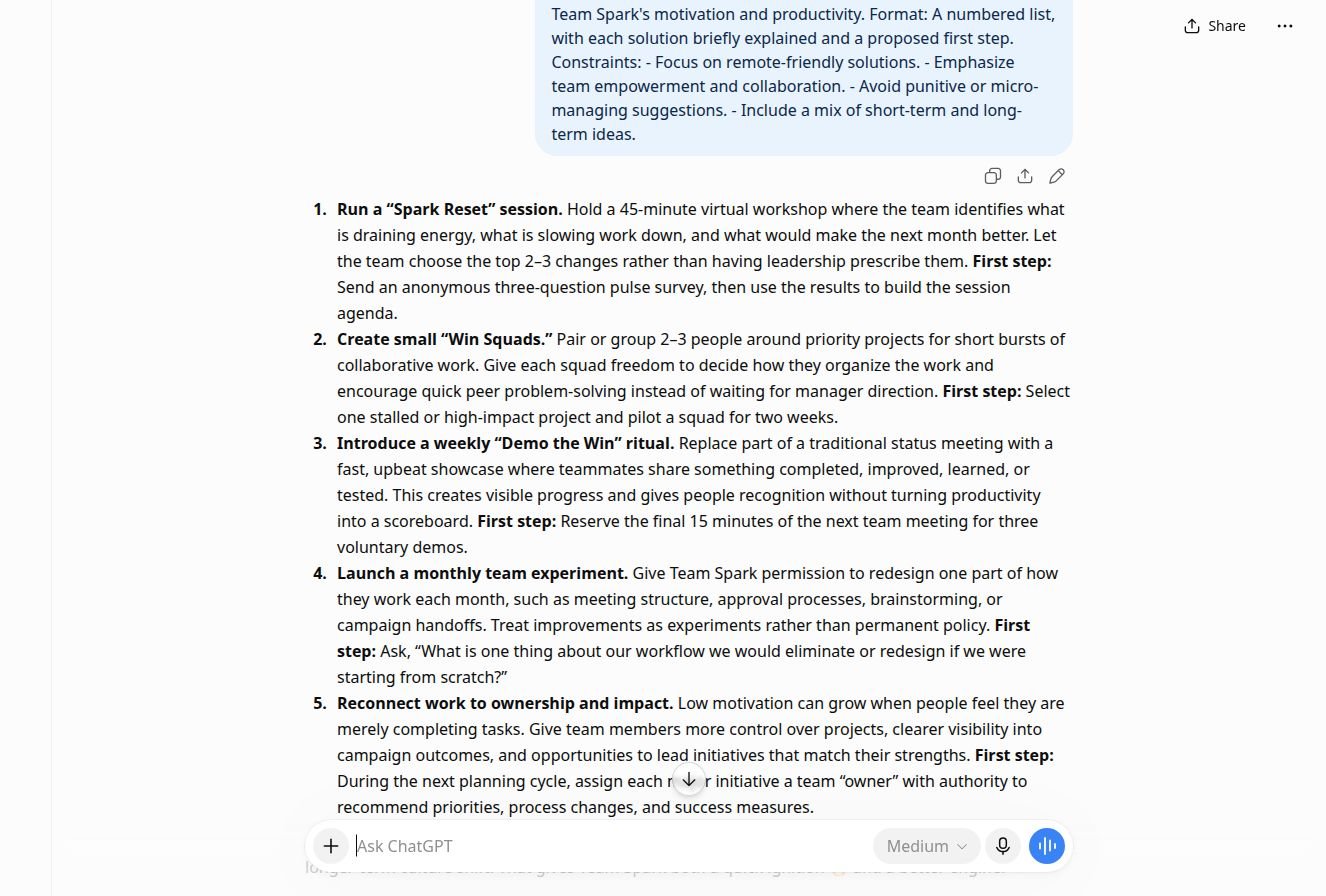
Suppose your remote marketing team, 'Team Spark,' has experienced a 15% drop in project completion rates and low motivation over the past month, with technical issues ruled out. You could prompt ChatGPT: 'I'm an innovative consultant specializing in team dynamics. My remote marketing team has seen a 15% drop in project completion and low motivation. I've ruled out technical issues. Please brainstorm 5 actionable, creative solutions to boost motivation and productivity. Focus on remote-friendly approaches, team empowerment and collaboration, and avoid punitive ideas. Include a mix of short-term wins and long-term changes. Format as a numbered list with brief explanations and a first step for each.' ChatGPT might generate ideas like: (1) A short-term 'reverse standup' where team members highlight wins and breakthroughs they've had—first step: schedule this for next week; (2) A peer-to-peer mentoring pairing program tied to specific skill development—first step: survey the team on development interests; (3) A 'theme week' series where each week the team focuses on one project type or skill, with dedicated collaboration time—first step: propose themes and get feedback; (4) A monthly team retro specifically focused on what energized them and what drained them—first step: design the first retro agenda; (5) A 'learning stipend' where individuals can choose a skill-building resource or course—first step: outline options and the selection process. Each of these ideas comes from a different angle (recognition, skill-building, focus, reflection, investment in growth), giving you multiple levers to pull. You evaluate which ones fit your team's culture and constraints, then execute. The brainstorm that might have taken you 90 minutes of solo thinking takes 10 minutes and yields better, more diverse ideas.
Developing Your Team with Personalized Coaching
Individual development is where great managers create lasting impact, yet it's often the first thing to get squeezed out by daily demands. Crafting personalized coaching plans, generating development questions, and creating growth conversations for each team member from scratch is genuinely time-intensive. Many managers know this work matters but struggle to make it a consistent practice. ChatGPT changes the equation by helping you generate thoughtful, probing coaching questions and tailored development guidance quickly. The coaching philosophy here is important: the best coaching doesn't give answers; it asks questions that help people discover their own answers. This approach builds ownership and confidence because people own solutions they develop themselves. ChatGPT can help you generate these kinds of questions at scale, personalized to each team member's specific challenge. Rather than every team member getting generic development advice, you can now spend time with each person describing their goal and challenge, and ChatGPT helps you generate targeted questions that will guide their thinking. You then use these questions in your one-on-ones, spending your time listening and reflecting rather than figuring out what to ask. This transforms coaching from an occasional, ad-hoc activity into something sustainable and deeply personalized.
- Open-ended, reflective questions empower team members to own their development rather than following prescribed solutions
- Coaching questions work best when they target both the concrete skill (e.g., clarity in presentations) and the underlying mindset (e.g., managing nervousness)
- Personalized coaching at scale is possible when you use ChatGPT to generate targeted questions, then bring your human presence and listening to the conversation
- The most impactful coaching questions encourage self-discovery—they make people say 'I hadn't thought of it that way' rather than 'they told me to do X'
- Development conversations are relationship-building moments; using ChatGPT to handle the initial question generation frees you to be fully present and engaged
Lab: Lab Exercise
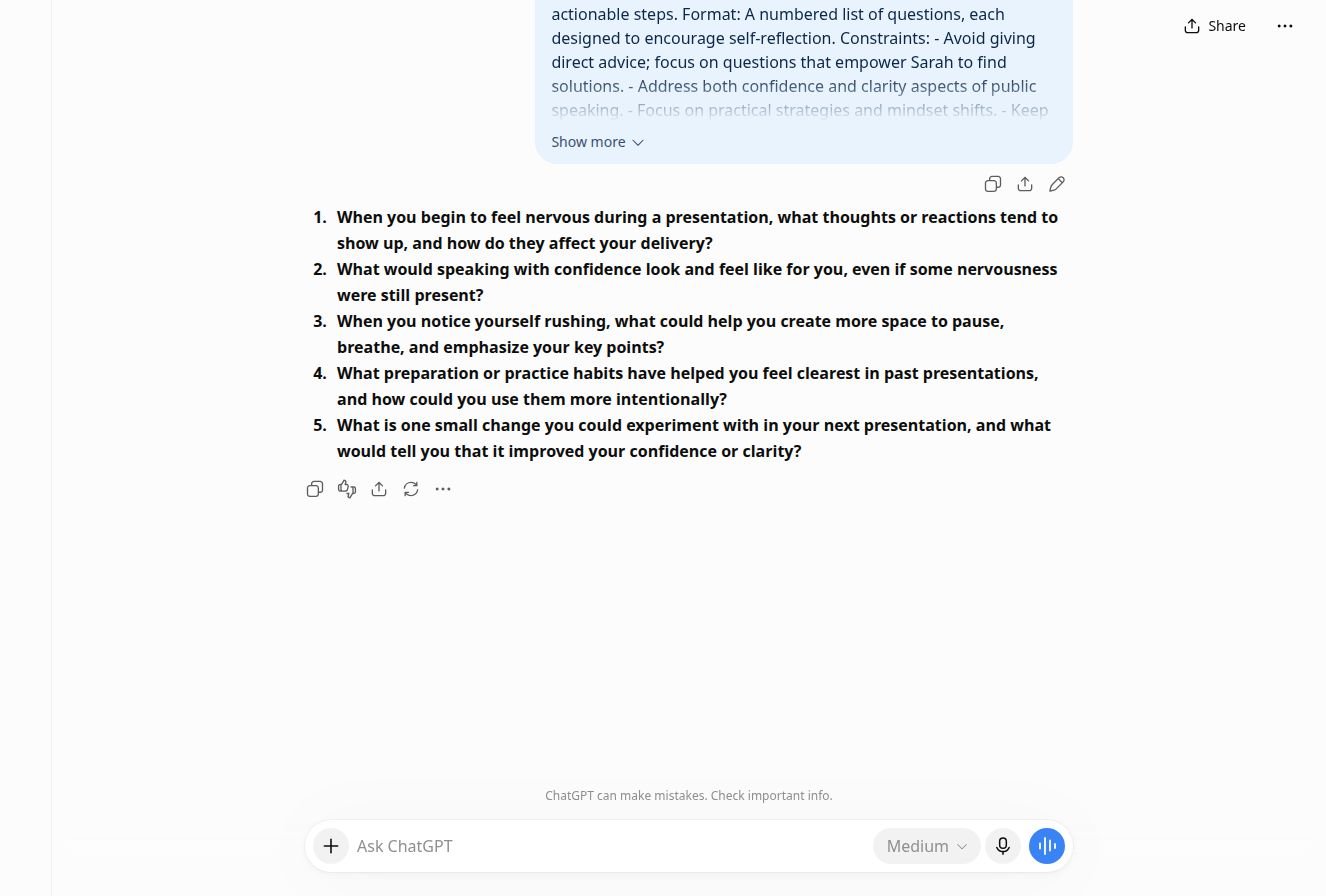
Imagine a team member named Sarah has expressed a goal to improve her public speaking confidence and clarity in team presentations, but she tends to rush and gets nervous under pressure. Rather than relying on generic public speaking tips, you could prompt ChatGPT: 'I'm an experienced executive coach specializing in communication skills. My team member Sarah wants to improve public speaking confidence and clarity in presentations, but she rushes and gets nervous under pressure. Please generate 5 open-ended, thought-provoking coaching questions to help her explore these challenges and identify solutions. Avoid direct advice; focus on self-reflection. Address both confidence and clarity. Format as a numbered list, concise and impactful.' ChatGPT might generate questions like: (1) 'When you think about your last presentation where you felt most rushed, what do you notice about what triggered that pace—was it the time constraint, your own internal anxiety, or something else?' (2) 'If you imagine giving the same presentation at a pace that felt comfortable and deliberate to you, what would be different about how the audience received your message?' (3) 'What does nervousness feel like in your body right before you present, and what's one small shift—in breathing, posture, or preparation—that you've noticed helps ground you?' (4) 'Who do you know who presents with clarity and confidence? What specifically do they do that you admire, and which of those habits could you experiment with?' (5) 'If clarity in a presentation means your ideas land with your audience, what's one key idea from your next presentation that absolutely has to come across clearly, and how might you structure your talk around that single idea?' Each question guides Sarah toward her own insights—about what triggers her rushing, how pacing affects impact, her nervous system, role models, and priorities. In your one-on-one, you'd ask these questions, listen deeply, and help her think through concrete next steps. The questions took seconds to generate, but they'll shape a meaningful development conversation that builds her confidence and capabilities. Over time, coaching conversations become a natural part of how you lead, because the upfront design work is handled efficiently.
Summary
ChatGPT is not a replacement for managerial judgment; it's an amplifier of managerial impact. Across communication, strategy, and team development, the pattern is the same: you provide context, intent, and constraints; ChatGPT generates options or drafts; you apply your leadership wisdom to evaluate, refine, and execute. The cumulative effect is significant. By spending less time on the mechanical work of drafting, brainstorming, and question-generation, you reclaim hours each week. More importantly, you shift your focus from 'How do I word this?' to 'Why does this matter and what's the right action?' and from 'What should I say in this conversation?' to 'How do I listen and guide?' These shifts transform how you lead. Your team experiences more consistent, thoughtful communication; you drive strategy more proactively rather than reactively; and you develop your people more deeply because coaching becomes a regular practice rather than an occasional luxury. The tool is powerful, but the magic happens when you use it to amplify your authentic leadership voice and your genuine commitment to your team's growth.
Next Steps
Start with one of these three areas where you feel the most time pressure: communication, strategy, or coaching. This week, take a single challenge in that area and draft a detailed prompt for ChatGPT, providing rich context about the situation, your intent, and any tone or format requirements. Review the output carefully, modify it to match your voice and values, and use it. Notice how much time you saved and how your team responded. Then experiment with the other two areas. As you build the habit of using ChatGPT as a co-pilot, you'll discover which types of prompts work best for your style and which refinements help you get output you can use with minimal editing. The goal is not perfection on the first try, but continuous improvement in your ability to delegate the mechanical work while keeping your judgment and presence at the center of leadership.