How Freshmen Actually Use ChatGPT to Survive and Thrive in Year One
It is week three, you have four deadlines, and your syllabus reads like a legal contract written by a robot. By the end of this lesson, ChatGPT becomes the study partner that never sleeps, never judges, and never does your homework for you.
Overview
First-year college students face an overwhelming combination of unstructured time, dense syllabi, competing deadlines, and study methods that feel productive but deliver poor results. ChatGPT can function as a genuine academic co-pilot—not by doing your work, but by helping you ask better questions and build sustainable systems. The RCTFC framework (Role, Context, Task, Format, Constraints) transforms vague requests into specific, actionable assistance. This guide teaches you how to use ChatGPT to decode your syllabi, build realistic schedules, generate practice questions from your own notes, and develop writing skills without crossing into academic dishonesty. The goal is not to work harder; it is to work smarter by treating AI as a briefing partner who needs the full picture to help effectively.
What You'll Learn
- Understand the RCTFC prompt framework and why specificity transforms AI output quality
- Decode a syllabus using ChatGPT to identify grade drivers and risk areas
- Build a realistic weekly schedule that accounts for sleep, meals, and sustainability
- Create a personalized quiz machine from your own course notes using active recall principles
- Use ChatGPT as a writing tutor and feedback partner without outsourcing your intellectual work
The RCTFC Framework: Five Elements That Transform Every Prompt
Most students approach ChatGPT the way they might text a stranger: with minimal context and vague intent. A prompt like "help me study" or "explain the French Revolution" produces generic, surface-level responses because the model has no guardrails, no specifics, and no sense of what you actually need. The RCTFC framework solves this by requiring you to brief ChatGPT the way you would brief a real tutor or academic advisor—with intention and detail. Role defines who you want the AI to be. Instead of treating ChatGPT as a generic answer machine, assign it a persona with expertise and judgment: an experienced academic advisor, a writing center coach, a subject-matter tutor, a study skills consultant. This priming helps the model adopt the right tone and decision-making framework for your request. Context is the messy, specific reality of your situation. Include the actual course name, the exact grade weights from your syllabus, your class schedule, your work obligations, your learning preferences, and any constraints on your time or energy. Real numbers and dates matter because they let ChatGPT prioritize instead of philosophize. Vague context produces vague advice; specific context produces actionable guidance. Task is the one thing you actually want done. Not "help me succeed" but "translate my syllabus into a plain-language risk assessment" or "identify which study sessions are most likely to slip and how to protect them." Specificity here is the entire game. Format is how you want the output delivered. A table you can scan beats three paragraphs you will never reread. A day-by-day calendar beats conceptual advice about time management. A numbered question list with answers hidden at the bottom beats explanations mixed throughout. Think about what format you will actually use later, and ask for that format explicitly. Constraints are the rules and limits that keep the output realistic and useful. Cap word counts so you have to read it. Specify block lengths so no single study session burns you out. Exclude jargon so the output remains accessible. Demand one evening off so the schedule survives real life. Constraints feel like you are asking for less, but they actually force the model to make smarter tradeoffs.
- Vague prompts ("help me study") produce generic, unhelpful responses; RCTFC prompts get specific guidance tailored to your actual situation
- Role primes the model to adopt expertise and the right decision-making framework
- Context must include real numbers, dates, and messy details—vagueness guarantees vague advice
- Task should be one specific thing, not a broad goal
- Format determines whether you will actually use the output later
- Constraints force the model to make realistic tradeoffs rather than suggest heroic schedules
Lab: Lab Exercise
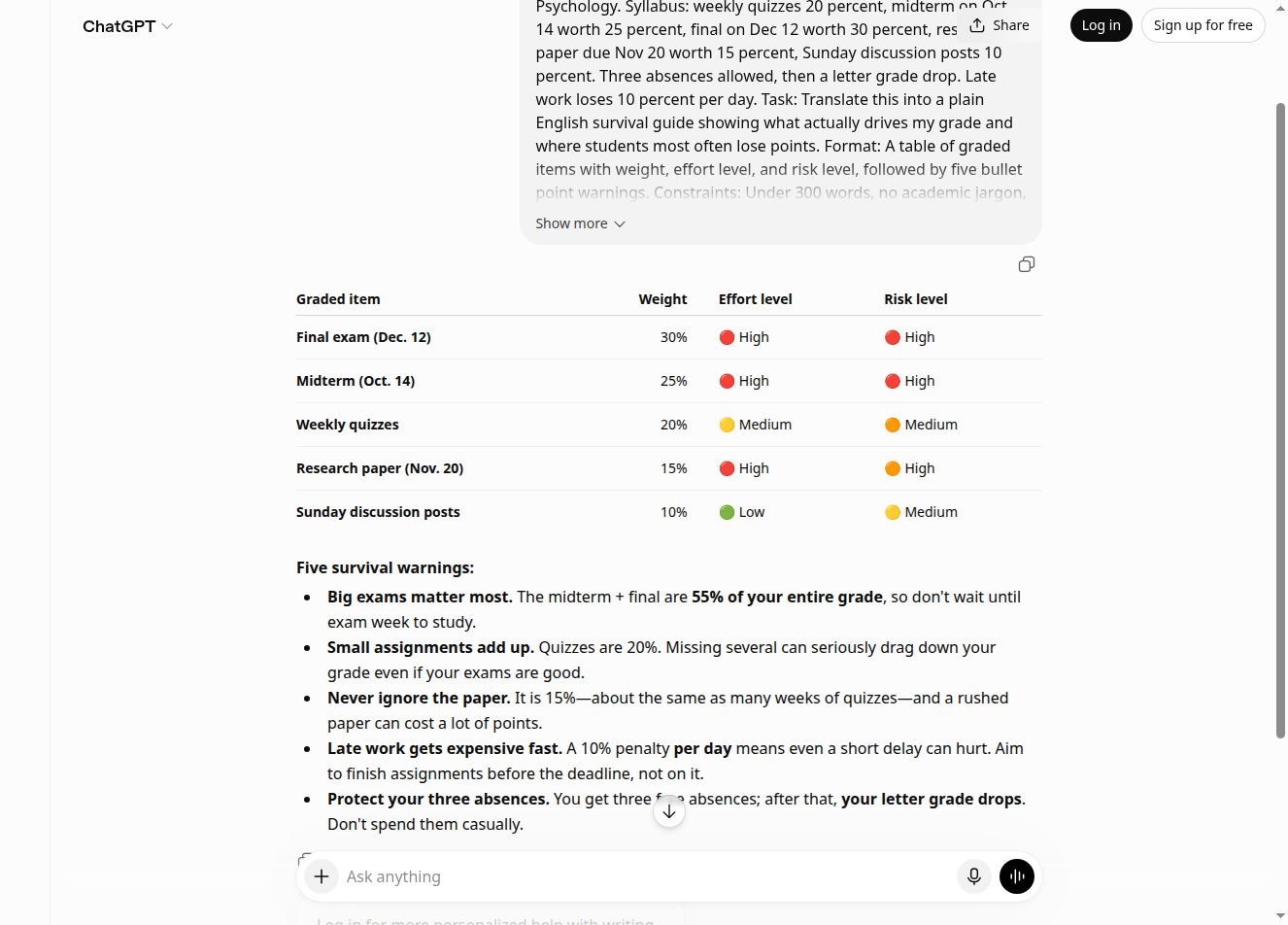
Compare these two prompts about an Intro to Psychology syllabus. Weak version: "Help me understand my grade breakdown." This produces generic advice about studying psychology. RCTFC version: "Role: You are an experienced academic advisor coaching first-year college students. Context: I am a freshman in Intro to Psychology. Here is my actual syllabus: weekly quizzes 20%, midterm on Oct 14 worth 25%, final on Dec 12 worth 30%, research paper due Nov 20 worth 15%, Sunday discussion posts 10%. Three absences allowed, then a letter grade drop. Late work loses 10% per day. Task: Translate this into a plain English survival guide showing what actually drives my grade and where students most often lose points. Format: A table of graded items with weight, effort level, and risk level, followed by five bullet point warnings. Constraints: Under 300 words, no academic jargon, assume I have never taken a college course before." The second prompt takes thirty seconds longer to type but produces a completely different quality of answer. ChatGPT now knows it is advising a first-year student (not a grad student), knows the exact grade breakdown (not generic advice about psychology), knows the specific dates and penalties (not theoretical discussion), and knows you want a scannable table plus warnings (not a paragraph you will never reread). The output becomes actionable rather than theoretical, specific rather than generic, and actually usable in your week.
Decoding Your Syllabus: Understanding What Actually Drives Your Grade
A syllabus is a contract written by someone who assumes you will read it carefully. Most freshmen do not. They glance at the grade breakdown, notice the percentages, and assume all assignments are equally important. This is wrong. A 20% quiz is not equal to a 20% research paper. The quiz happens eight times; the paper happens once. The quiz takes an hour per week; the paper takes weeks of work. The quiz forgives a bad day; the paper does not. ChatGPT can translate the dense language of your syllabus into a clear map of what actually matters and where students most often fail. The key is feeding it the exact numbers: point values, due dates, penalty structures, absence limits, late work policies. Then ask for a specific format that helps you prioritize. A table showing weight, effort level, and risk level lets you instantly see which assignments will drive your grade and which ones demand the most preparation. You also want ChatGPT to call out the land mines: the specific things the syllabus warns about that catch students off guard. Three absences allowed is not the same as "you can skip freely"—it means absence four tanks your grade. Late work loses 10% per day means submitting an assignment two days late costs you 20% of its value. Missing the research paper due date (not just being late, but missing it) might mean a zero. These are not academic advice; these are syllabus facts translated into freshman language. The format matters enormously here. A table is scannable. Five bullet-point warnings stick in memory better than paragraphs. Plain language without academic jargon means you will actually understand it at three in the morning when you are panicking about deadlines. Constraints on word count force ChatGPT to be ruthlessly strategic about what matters most.
- A syllabus is a contract with specific grade weights, deadlines, and penalties—all of which matter more than abstract study advice
- Not all assignments are equal: an 8-time quiz worth 20% is not the same as a one-time research paper worth 15%
- ChatGPT can translate dense syllabus language into plain-English risk assessment and prioritization
- Feed it exact numbers, dates, and penalty structures so it can prioritize instead of philosophize
- Ask for a format you will actually reference later (table, checklist, bullet points) rather than paragraphs you will never reread
- Demand that it call out the land mines: the specific policies that catch students off guard
Lab: Lab Exercise
A student's Intro to Psychology syllabus says: "Weekly quizzes 20%, midterm on Oct 14 worth 25%, final on Dec 12 worth 30%, research paper due Nov 20 worth 15%, Sunday discussion posts 10%. Three absences allowed, then a letter grade drop. Late work loses 10% per day." Using RCTFC, the student asks ChatGPT to translate this into a survival guide with a table and five warnings, under 300 words, no jargon. ChatGPT produces something like: Week-to-week grade drivers: Quizzes are 20% but happen weekly, so protecting quiz performance is your first priority. The research paper is 15% but compresses into three weeks in November, making it high-stress. The finals are combined 55% of your grade and arrive late semester, which means strong quiz and discussion performance now buys you buffer later. Risk factors: Absence 4 tanks your grade; the syllabus is not suggesting you can skip freely—it is counting. Late work loses 10% per day, so a research paper submitted two days late loses 20% of its value. Missing any deadline entirely might mean a zero. Weekly discussion posts compound over the semester; skipping one is a small hit, but skipping four is a lost assignment percentage. This translation accomplishes two things: it shows the student exactly which assignments drive the grade (finals and quizzes are 55% combined), and it calls out the specific ways students lose points (being casual about attendance and deadlines). Armed with this, the student can build a realistic plan.
Building a Realistic Weekly Schedule: Design Over Discipline
High school scheduled you. Bells rang, teachers appeared, parents followed up, and an alarm clock enforced wake-up times. College hands you thirty-five unstructured hours per week and calls it freedom. In reality, unstructured time is a trap. Without a deliberate system, you drift toward crisis management: ignoring assignments until they are due in five days, pulling all-nighters the week before midterms, discovering important deadlines thirty-six hours before they arrive. ChatGPT can build a realistic weekly schedule, but only if you give it three things: your immovable commitments, hard constraints on how you want to work, and the right format to reference later. Immovable commitments are your class times, your job shifts, your sleep window, and your athletic or other obligations. These go in first because a schedule that ignores reality does not survive contact with reality. Once the fixed points are on the calendar, you can map study blocks around them. The second part is constraints. If you do not cap total study hours, ChatGPT will cheerfully suggest forty hours per week and you will follow it for exactly two days before burning out. If you do not specify that no single block should exceed ninety minutes, it will create three-hour study sessions that crush your attention span. If you do not require a full evening off, you will run yourself ragged by October. These constraints feel like you are asking for less, but they are actually the difference between a plan you can sustain and a fantasy you will abandon. The format should be a day-by-day table with time blocks, activities, and the course or purpose of each block. You want something you can glance at on Sunday night and follow mechanically Monday through Friday. You also want three to five tips on how to actually protect these blocks when real life intrudes: how to recover from a missed session, which sessions are most critical to keep, what to do if you need to cut something. This transforms the schedule from a goal into a system.
- Unstructured time is a trap, not a reward; deliberate scheduling prevents crisis management
- Load your immovable commitments first (classes, work, sleep), then build study blocks around them
- Cap total study hours (under 25 hours is typical for a full-time student) so you do not plan yourself into burnout
- Limit individual study blocks to 90 minutes or less to match your actual attention span
- Always protect one full evening completely free to prevent exhaustion and maintain perspective
- Ask for a day-by-day table format plus tips on protecting the schedule when real life intrudes
Lab: Lab Exercise
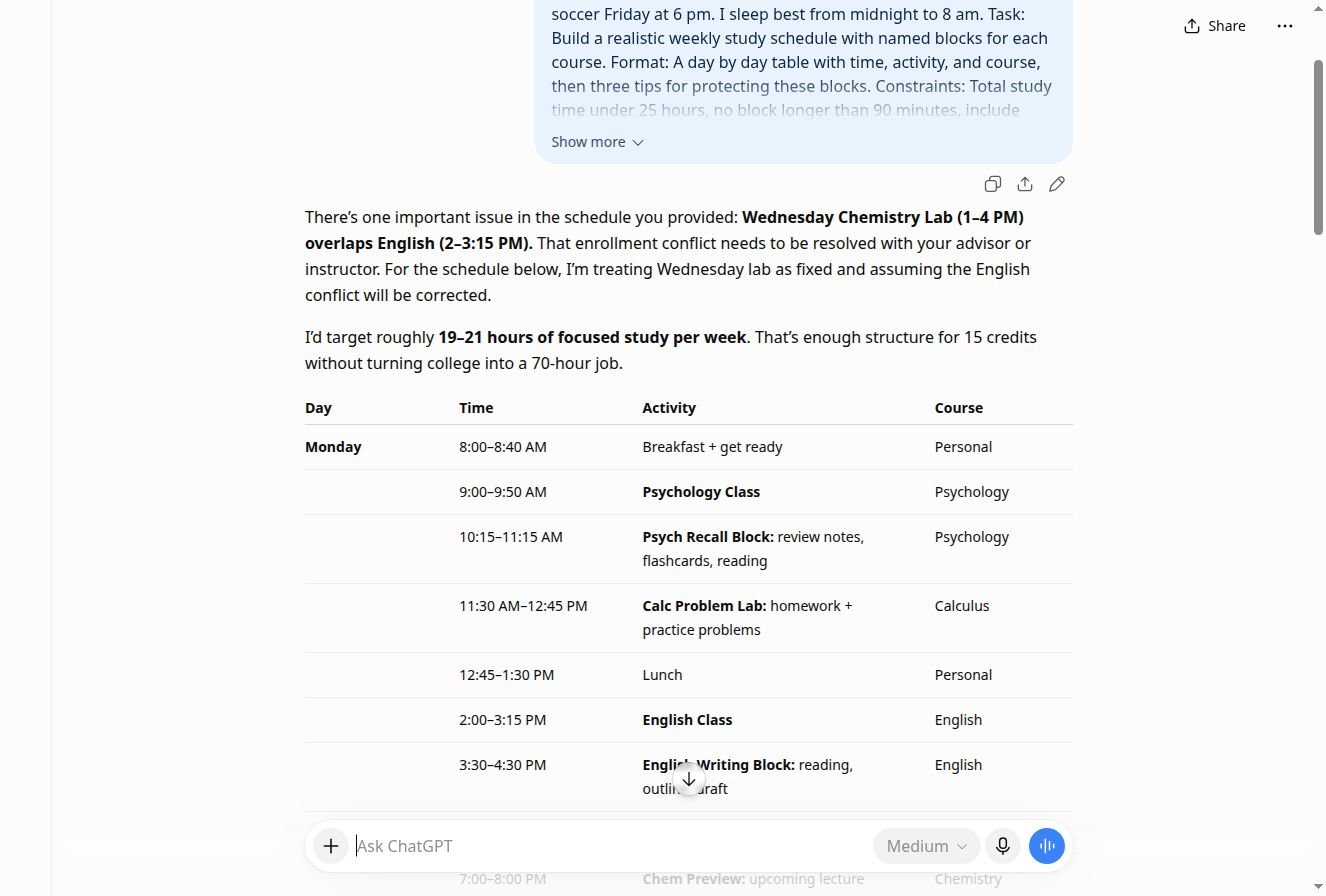
A student has this immovable schedule: Psychology MWF 9–9:50 am, Calculus TR 11 am–12:15 pm, English MWF 2–3:15 pm, Chemistry lecture TR 9–10:15 am plus lab Wednesday 1–4 pm, campus library job TR 5–9 pm, intramural soccer Friday 6 pm, best sleep window midnight–8 am. Using RCTFC, the student asks ChatGPT to build a realistic weekly study schedule with time and activity, plus tips for protecting the blocks. Constraints: total study under 25 hours, no block longer than 90 minutes, include meals, one evening completely free. ChatGPT produces a day-by-day calendar. Monday: breakfast, Psychology 9–10, review Psychology notes 10–11:30, lunch, English 2–3:15, study group or outline work 3:45–5:15, dinner, free evening. Tuesday: breakfast, Chemistry 9–10:15, Calculus 11–12:15, lunch, Calculus homework 1–2:30, library job 5–9. Wednesday: breakfast, Psychology 9–10, lab 1–4, review lab notes 4:30–5:30, dinner, free evening. And so on. The schedule includes meals, protects sleep, leaves one evening (Monday or Thursday) completely free, and caps study at 23 hours. Then the tips: "Quiz performance on Friday drives your grade, so protect those review sessions Monday and Thursday mornings. If you miss a session, swap it with a lower-priority block rather than skipping it entirely. If your library job runs late, study blocks can shrink but not disappear. The Wednesday lab is fixed, so plan light study Tuesday night." This transforms a static schedule into a system you can actually maintain.
Turn Your Notes Into a Quiz Machine: Active Recall Over Rereading
The most popular study method on earth is also one of the least effective: rereading your notes with a highlighter. It feels productive. The familiar material feels easy to recognize. Your notes get colorful. Your confidence soars. Then the exam asks you to actually retrieve something from memory—to answer a question you have not seen before using information you only passively reviewed—and your brain returns a 404 error. You did not learn the material; you just made it feel familiar. Active recall is the opposite. Instead of pushing information into your short-term memory by rereading, active recall forces your brain to pull information back out when you need it. This is hard, it feels inefficient, and it produces dramatically better retention. Quiz yourself instead of rereading, every single time. The challenge is that most quizzes are generic, covering textbook content instead of your professor's actual lecture. Your professor tests what they emphasized, what they repeated, what they put on slides, what they said would be on the exam. Generic quizzes miss all of that. ChatGPT can generate personalized quizzes directly from your messy class notes in about ninety seconds. The key is telling it to give you all the questions first, then all the answers at the end. Otherwise it helpfully spoils itself and you get the illusion of learning again, just faster. Feed it your actual notes on a topic (glycolysis, the French Revolution, photosynthesis), ask for questions of escalating difficulty, demand at least some application questions that require reasoning rather than pure recall, and ask for the answer key to be hidden until after all questions are listed. You now have a personalized practice exam built from your own class material, available whenever you need it. Application questions matter because they force your brain to do what the exam will ask: not just recognize information, but use it. A recall question might be "What is glycolysis?" An application question might be "If a cell could not produce pyruvate, which processes would fail: the Krebs cycle, electron transport, or fermentation?" The second question requires you to actually understand how the system works, not just memorize definitions.
- Rereading creates familiarity, not retention; active recall—forcing your brain to retrieve information—produces genuine learning
- Generic quizzes test generic content; use your own notes to generate personalized quizzes that match what your professor actually emphasized
- Always ask for questions first, answers second—otherwise you get spoiled and the exercise loses its learning power
- Include escalating difficulty (easy recall, then harder recall, then application questions) to test both knowledge and understanding
- Application questions require reasoning about how concepts connect, not just memorizing terms—these are what exams actually test
- Quiz yourself repeatedly on the same material across multiple sessions to build long-term retention
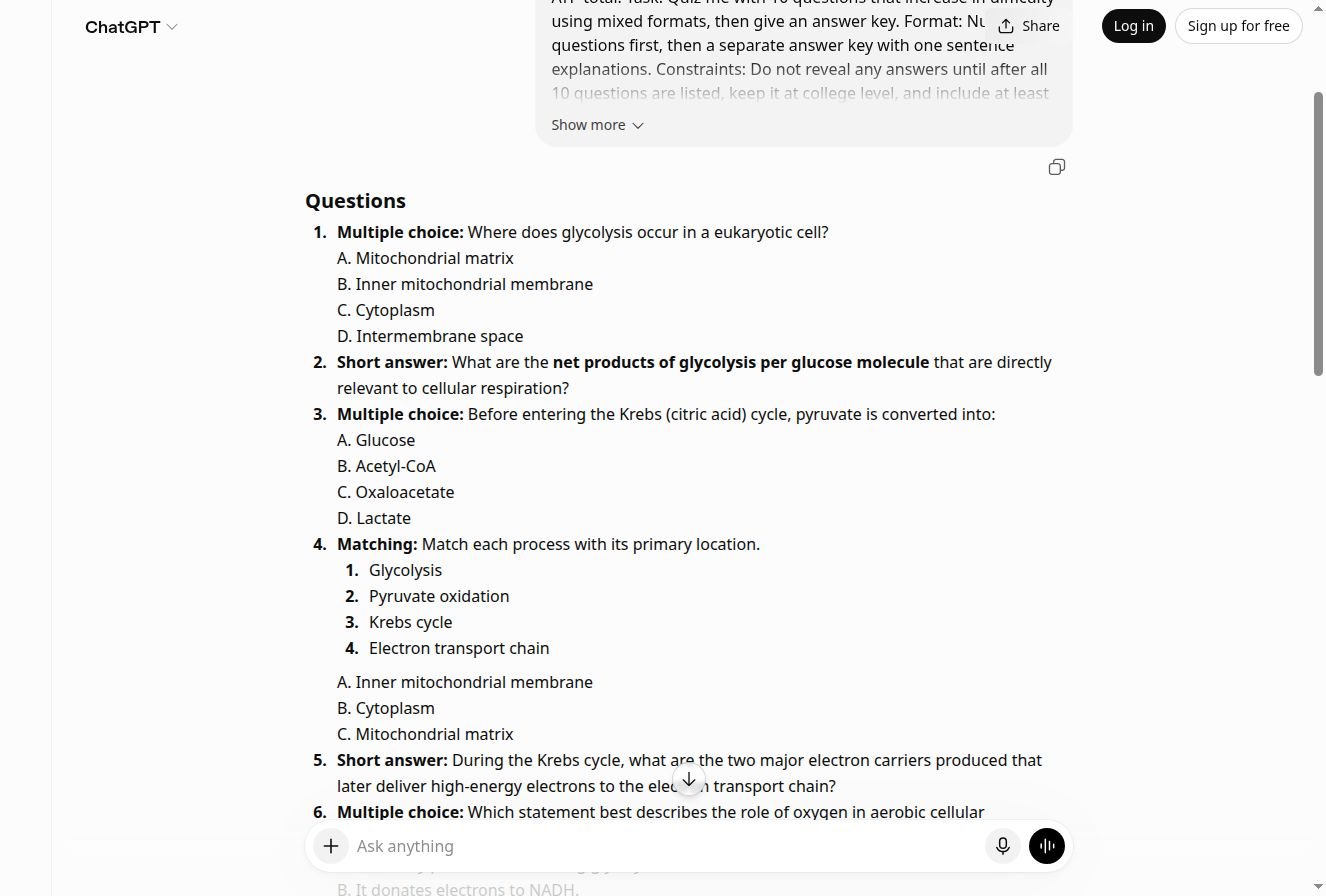
A student has messy notes on cellular respiration: "glycolysis in cytoplasm, net 2 ATP, pyruvate to acetyl CoA, Krebs cycle in mitochondrial matrix, produces NADH and FADH2, electron transport in inner membrane, oxygen final electron acceptor, roughly 32 ATP total." Using RCTFC, the student asks ChatGPT (role: college biology tutor) to create 10 quiz questions of escalating difficulty with mixed formats, then provide an answer key. Constraints: no answers revealed until after all questions are listed, college level, at least 2 application questions requiring reasoning. ChatGPT produces: Questions (answers hidden): 1. Where does glycolysis occur? (Recall) 2. How many ATP molecules does glycolysis directly produce? (Recall) 3. What molecule is pyruvate converted into after glycolysis? (Recall) 4. What are the two electron carriers produced during the Krebs cycle? (Recall) 5. Why does the electron transport chain require oxygen? (Understanding) 6. If a cell is in anaerobic conditions and cannot use the electron transport chain, what must happen to regenerate NAD+ for glycolysis to continue? (Application) 7. A researcher blocks the conversion of pyruvate to acetyl CoA. Which processes stop immediately and which continue briefly? (Application) 8–10. More advanced questions. Then the answer key (separate section): "1. Cytoplasm. 2. Two. 3. Acetyl CoA..." The student works through these questions repeatedly until the answers come automatically. This builds retrieval strength, not just familiarity.
Summary
ChatGPT becomes a genuine academic co-pilot when you treat it like a briefing partner instead of a magic answer machine. The RCTFC framework—Role, Context, Task, Format, Constraints—takes thirty seconds longer to set up than a vague question but produces a completely different quality of output. When you feed ChatGPT your actual syllabus with real numbers and due dates, you get a prioritized survival guide instead of generic study advice. When you feed it your immovable commitments and real constraints, you get a sustainable schedule instead of a fantasy. When you feed it your own messy notes, you get a personalized quiz machine that tests active recall instead of familiarity. The common thread across all three applications is specificity. Vague requests produce vague advice. Real details produce actionable guidance. The entire game is removing the emotional fantasy version of yourself (the student who wakes up at 5:30 am for calculus, the student who never needs a night off, the student who can write a perfect paper on the first try) and building systems around the real version of you. This is not about working harder. It is about working smarter by using AI to translate chaos into a plan, your notes into practice tests, and blank pages into arguments that are genuinely yours because you did the thinking.
Next Steps
Take one of the lab exercises in this guide—decode your actual syllabus, build your actual weekly schedule, or generate a quiz from your actual class notes—and use the RCTFC framework to prompt ChatGPT. Start with whichever assignment or course is causing the most stress right now. Copy the exact prompt format from the examples above and customize it with your real details. Once you see how much more specific and useful the output is, share the system with your roommate, your study group, or the freshman panicking about midterms. The goal is not to use ChatGPT as a crutch, but to build a repeatable system that keeps you organized, prevents crisis management, and lets you actually learn the material instead of just surviving the semester.