How Entrepreneurs Are Using ChatGPT to Turn Ideas Into Action
Ever had a brilliant business idea spark in your brain, only to have it fizzle out because you didn't know where to start? This lesson will show you how to transform those sparks into actionable plans with ChatGPT, faster and smarter than you ever thought possible.
Overview
Transforming a business idea from an exciting concept into a concrete, executable plan is where most entrepreneurs struggle. This lesson shows how to leverage ChatGPT as a strategic thinking partner to move from vague inspiration to actionable blueprints. By systematically clarifying your idea, understanding your customers deeply, and crafting a targeted initial marketing strategy, you can accelerate the journey from "wouldn't it be cool if" to "here's exactly how we're building this"—with AI helping you think faster, deeper, and smarter at every stage.
What You'll Learn
- Clarify vague business ideas into focused concepts with clear unique selling propositions
- Develop detailed customer personas that reveal pain points, motivations, and desired outcomes
- Design an initial content and outreach strategy tailored to reach early adopters
- Learn how to prompt ChatGPT effectively to serve as a strategic business advisor
- Convert entrepreneurial insights into concrete, executable first steps
Idea Refinement: From Spark to Clarity
Every entrepreneur experiences the exhilaration of a brilliant idea followed immediately by the paralysis of not knowing where to begin. The gap between inspiration and action is where most ideas die. Idea refinement bridges that gap by forcing you to make your concept concrete, specific, and testable. This process isn't about judging whether your idea is "good"—it's about clarifying what your idea actually is, what makes it different, and who would care enough to pay for it. When you work with ChatGPT in this phase, you're essentially hiring a strategic advisor who specializes in startup thinking. By casting ChatGPT in a specific role (such as a business consultant experienced with innovative startups) and giving it clear constraints (focus on practicality, market appeal, and scalability), you transform a general-purpose AI into a focused thinking partner. The key is to move from vague language ("a smart garden system") to specific clarity: What exactly does it do? How is it different from existing solutions? Who specifically needs this enough to adopt it early? Three critical elements emerge from effective idea refinement: First, your core concept must be articulated clearly enough that someone unfamiliar with your vision could understand it in one sentence. Second, your unique selling proposition (USP)—the specific reason your solution matters more than alternatives—must be grounded in real market need, not just novelty. Third, identifying your ideal early adopter segments ensures you're thinking about the right people from day one, which dramatically improves your odds of product-market fit.
- Clear vision makes action intuitive; vague ideas lead to paralysis
- Your unique selling proposition isn't what you do—it's why anyone should care about what you do
- Early adopter identification is a cheat code for understanding where to focus initial resources
- Effective prompting requires assigning ChatGPT a specific role and clear constraints
- Idea refinement transforms inspiration into an actionable blueprint
Lab: Lab Exercise
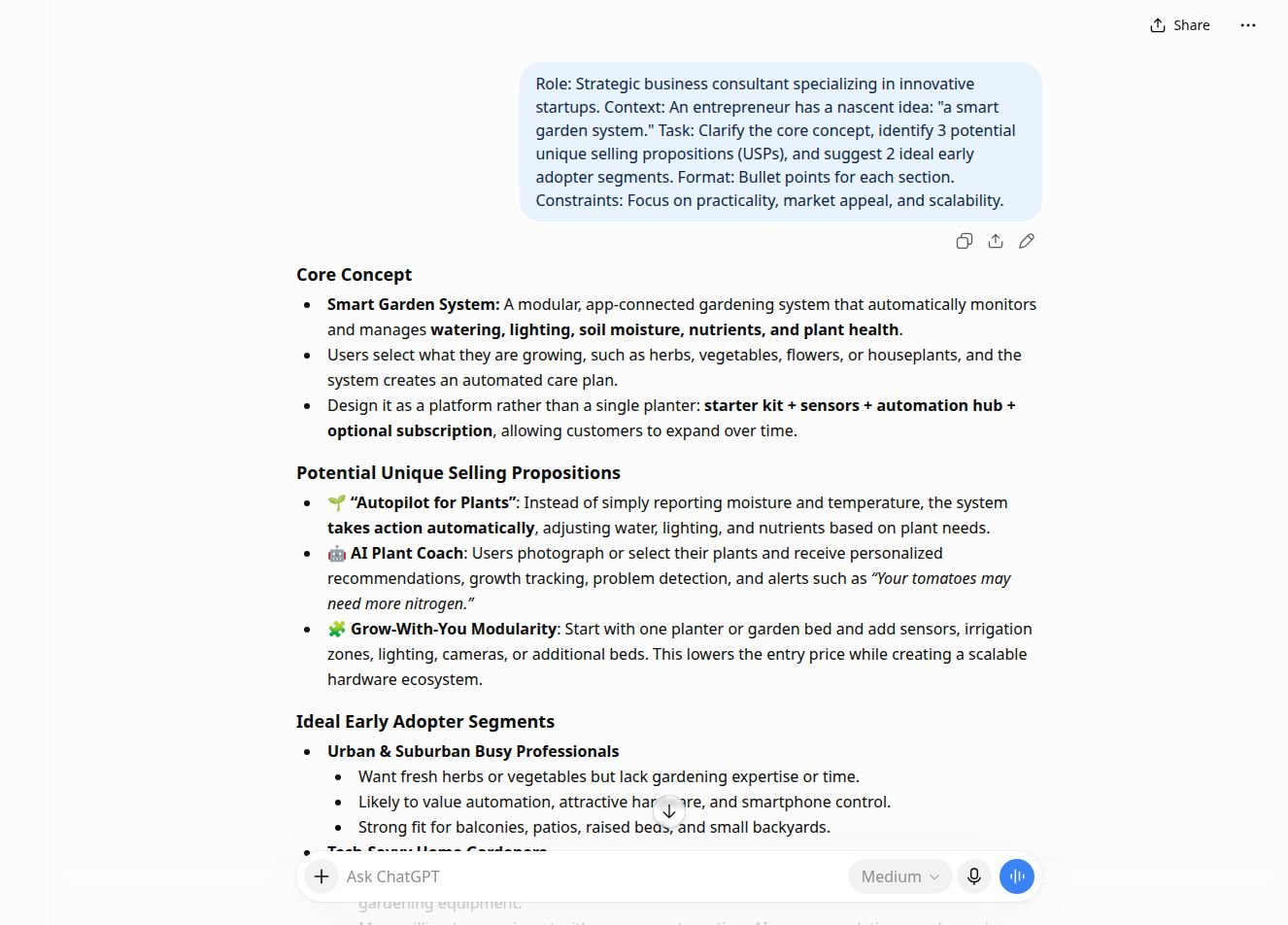
Consider an entrepreneur with the initial idea: "a smart garden system." This is too vague to act on. By prompting ChatGPT to act as a strategic business consultant, you ask it to clarify the core concept (Is this for urban apartment dwellers? Suburban homeowners? Commercial farms? Indoor hydroponic systems?), identify three unique selling propositions that matter in the market (perhaps: AI-powered watering based on weather and soil sensors; saves 60% water; requires zero gardening knowledge), and pinpoint two ideal early adopter segments (health-conscious millennials wanting fresh herbs at home; corporate offices wanting biophilic workspace benefits). The output transforms "a smart garden system" into something specific: "An AI watering system for apartment dwellers who want fresh herbs without the learning curve, priced at $200-300, targeting eco-conscious urban professionals aged 28-40." This specificity immediately reveals next steps: Where do these people hang out online? What content would speak to their concerns about sustainability and convenience? What competitors already exist in this space?
Decoding Your Audience: Customer Persona Development
An excellent idea aimed at the wrong audience or misunderstood audience is a guaranteed path to failure. Customer persona development forces you to shift from thinking about an abstract market to thinking about real, specific people. A persona isn't a demographic profile; it's a richly detailed model of your ideal customer that includes their daily frustrations, their aspirations, their decision-making process, and the language they use when talking about problems like the one you're solving. When you develop personas with ChatGPT's assistance, you're building empathy at scale. Instead of guessing at what customers want, you're actively researching and articulating their world. The personas become a reference point for every subsequent decision: What features matter most? How should you talk about your product? Which communication channels will actually reach these people? Which objections or concerns will you need to address? A well-developed persona acts like a North Star, keeping your entire operation aligned with actual customer needs rather than founder assumptions. The process involves moving beyond surface-level demographics into psychological depth. What specific pain points keep your ideal customer up at night? What have they already tried to solve this problem, and why didn't it work? What outcome are they ultimately seeking? For example, if you're building the AI-powered snack dispenser for offices, understanding that your target customer (corporate professionals aged 25-45) struggles not just with finding healthy options but with the decision fatigue of multiple daily food choices, and that they value convenience almost as much as health, completely changes how you position and market your solution.
- Personas are vivid, detailed models of ideal customers—not just demographic categories
- Understanding customer pain points reveals opportunities for your solution to deliver genuine value
- Psychographic depth (values, aspirations, frustrations) matters more than demographic data alone
- Speaking in the language of customer needs and desires cuts through market noise
- Empathy is the shortest path to building products people actually love
Lab: Lab Exercise
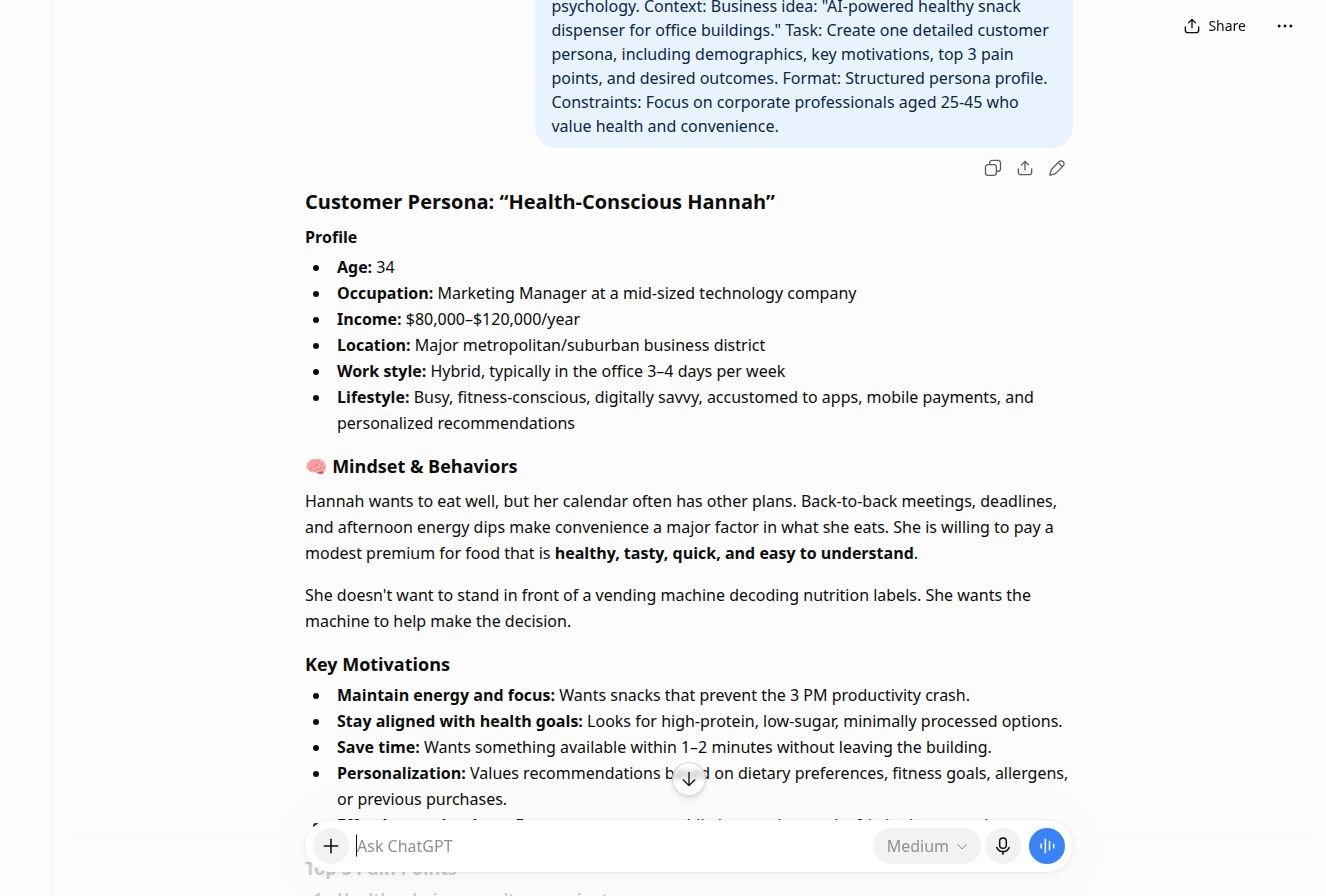
Beginning with a business idea (AI-powered healthy snack dispenser for offices) and a broad target segment (corporate professionals aged 25-45 who value health and convenience), you prompt ChatGPT to develop a detailed customer persona. The output includes: Demographics (e.g., Sarah, 32, marketing manager at mid-size tech company); Daily reality (arrives at 7:45 a.m., back-to-back meetings until lunch, often skips breaks, energy crashes by 3 p.m.); Pain points (no time to plan healthy snacks, guilt about vending machine choices, decision fatigue around food); Motivations (wants to eat better, maintain energy for productivity, feel like she's making responsible choices); Desired outcome (a no-friction way to make healthy snacking the default, not an exception). With this level of detail, you now understand that Sarah isn't just buying snacks—she's buying relief from decision fatigue and alignment between her health values and her actual behavior. Your marketing message, product design, and go-to-market strategy all shift to address this deeper need.
Spreading the Word: Content and Outreach Strategy
Having a clear idea and understanding your customer is incomplete without a strategy to reach them and communicate why your solution matters. Initial marketing strategy for an early-stage venture isn't about expensive campaigns or viral content—it's about strategic, focused outreach that efficiently connects you with early adopters who are genuinely ready to listen. This phase involves identifying the specific channels and content types most likely to reach your personas, then crafting messages that speak directly to their pain points and aspirations. ChatGPT accelerates this process by helping you brainstorm content angles, identify which platforms your audience frequents, and draft actual content that resonates with their values and concerns. The key is to move from generic marketing noise to specific, value-driven communication. For early-stage ventures, this typically means focusing on education, problem-solving, and driving genuine interest in pilot programs or early access, rather than hard selling. LinkedIn for B2B audiences, targeted Facebook or Instagram communities for B2C, Reddit communities where your audience hangs out naturally—the choice depends entirely on where your specific personas spend attention. A structured content strategy ensures that each piece of content serves a purpose within your overall narrative. Rather than posting randomly, you're building a progression: raising awareness of the underlying problem, positioning your solution as a thoughtful answer, building credibility and social proof, and finally inviting specific action (joining a pilot program, requesting a demo, signing up for early access). This approach treats content as a tool for building relationships with potential customers, not just broadcasting about your product. Over time, you iterate based on what resonates: Which topics generated engagement? Where did people actually click through? What questions kept coming up? This feedback loop transforms initial strategy into increasingly refined strategy.
- Strategy precedes execution; a well-thought-out plan ensures every effort counts
- Value-driven content attracts the right audience; generic messaging gets lost in noise
- Channel selection matters enormously—be where your personas actually spend their attention
- Early-stage marketing focuses on education and driving genuine interest, not hard sales
- Test, learn, and adapt: entrepreneurship is a continuous loop of launching and refining
Lab: Lab Exercise
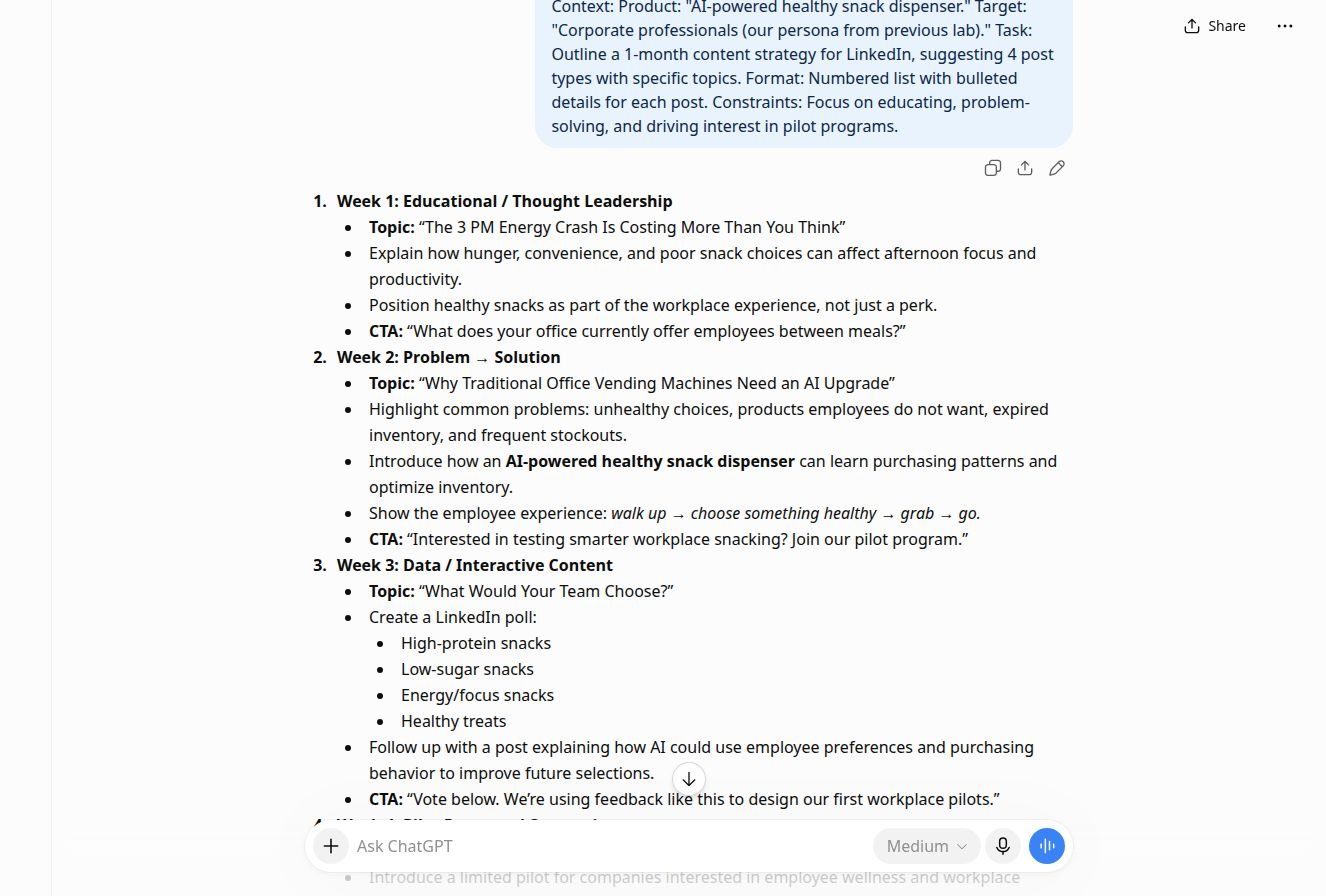
Given the AI-powered healthy snack dispenser targeting corporate professionals, and armed with persona insights about Sarah and her peers, you prompt ChatGPT to develop a one-month LinkedIn content strategy with four specific post types. The output might include: (1) Educational posts about workplace wellness trends and the hidden cost of poor nutrition on afternoon productivity; (2) Problem-focused posts that pose questions like "How many healthy eating goals fail because of friction in the environment, not willpower?"; (3) Credibility-building posts featuring research, expert insights, or pilot program results; (4) Engagement-driving posts inviting companies to join the pilot program. Rather than posting "Try our snack dispenser!" repeatedly, you're building a narrative that helps Sarah and her colleagues understand why this problem matters, positioning your solution as thoughtful and research-backed, and creating multiple touchpoints that make joining a pilot feel like the natural next step. Each post type serves a specific purpose in the customer journey, and the structured approach ensures consistency across the month rather than sporadic, reactive posting.
Summary
The journey from entrepreneurial spark to executable action follows a clear progression: First, clarify your idea by defining exactly what it is, why it's different, and who specifically would adopt it. This transforms vague inspiration into a focused concept. Second, develop deep customer understanding through detailed personas that reveal not just demographics but motivations, pain points, and decision-making processes. This empathy becomes the foundation for every subsequent product and marketing decision. Third, design a strategic outreach and content plan that efficiently reaches your early adopters with value-driven communication tailored to their specific concerns. Each stage builds on the previous one, with ChatGPT serving as a strategic advisor that helps you think through each layer more deeply and thoroughly than you would alone. The result isn't just a better idea—it's a detailed blueprint for how to bring that idea to market, complete with clarity about what you're building, who needs it, and exactly how to reach them.
Next Steps
Take one business idea you're genuinely excited about and work through each of these three stages using ChatGPT. Start with idea refinement: assign ChatGPT the role of a business consultant and ask it to clarify your core concept, identify three unique selling propositions, and suggest early adopter segments. Next, develop a customer persona by prompting ChatGPT to create a detailed profile of your ideal early customer, including their daily reality, pain points, and motivations. Finally, outline a one-month content strategy for the platform where your target persona spends time. The combination of these three outputs gives you a concrete, actionable blueprint for your venture's first phase. Pay attention to how the clarity increases at each stage and how subsequent insights build directly on previous work—this is the power of systematic, strategic thinking applied to entrepreneurial challenges.