How Customer Support Teams Use ChatGPT to Define SLAs for an Incident
The site is down, forty tickets just landed, and someone in leadership asks "what's our SLA on this?" — and nobody actually knows. By the end of this lesson, you'll be able to write clear, defensible incident SLAs in minutes, not meetings.
Overview
Service Level Agreements (SLAs) for incidents are promises—not documents gathering dust in a folder. Most support teams have SLAs that are either vague, undocumented, or invented during crises, which leads to inconsistent responses, confused customers, and demoralized staff. This lesson shows you how to use ChatGPT and the RCTFC prompt framework to draft clear, defensible, and actually operational incident SLAs for customer support teams. By combining ChatGPT's ability to structure complex logic with your operational reality, you can create severity matrices, customer-facing commitments, escalation paths, and stress-tested policies that your team will actually follow—in minutes instead of months of meetings.
What You'll Learn
- Understand why most incident SLAs fail and what makes them real promises instead of documents
- Learn the RCTFC framework (Role, Context, Task, Format, Constraints) and apply it to turn vague requests into precise SLA outputs
- Build a severity classification matrix that distinguishes between response time, status update frequency, and resolution time
- Design time-based escalation paths with named owners and documented handoff requirements
- Stress-test your SLA by identifying failure scenarios, edge cases, and promises you cannot operationally keep
- Turn your drafted SLA into a one-page reference guide and training material your team will actually use
Why Incident SLAs Break Down
Most support teams do have SLAs on paper, but they are rarely useful in practice. The typical SLA lives in an onboarding document written years ago by someone long gone, opened once, and never consulted again. When an incident strikes—the site is down, forty tickets land in the queue, and leadership asks "what's our SLA on this?"—teams improvise promises in real time. Those ad-hoc commitments made under pressure become the actual SLA, and they are inconsistent, unmeasurable, and customer-facing, which is precisely when they should not be invented. Three structural failures plague most SLAs. First, severity definitions are vague. "Critical" and "high priority" mean different things to different people, especially to a tired agent at 2 a.m. deciding whether an incident is truly urgent. Ambiguous severity language does not save time; it wastes it in arguments and inconsistent responses. Second, response time and resolution time are blurred or conflated. A 15-minute response means something only if customers know what "response" means—is it acknowledging the ticket, sending a human reply, or having a fix in hand? These are wildly different promises and customers notice when you confuse them. Third, undocumented SLAs get invented during incidents, which means your most important commitments are decided by whoever is awake and desperate, not by your team's actual capacity. The good news is that ChatGPT is unusually good at the structural, rules-based, slightly tedious work of defining severity and accountability. You bring the operational reality—your team size, coverage hours, customer base, product complexity. ChatGPT brings the structure, consistency, and patience to hold all the branches of a severity matrix steady without abbreviating or second-guessing. Together, you can build an SLA that is clear enough for a tired human to apply without debate, documented enough that nobody invents a new one during a crisis, and realistic enough that your team can actually achieve it.
- An SLA is a promise enforced by behavior, not a document sitting in a folder
- Vague severity definitions cause response chaos because agents interpret them differently under stress
- Response time and resolution time are two separate clocks that serve different customer needs
- Undocumented SLAs get invented during incidents, when pressure is the worst possible editor
- ChatGPT excels at structured, rule-based definition work when you provide operational context
Lab: Lab Exercise
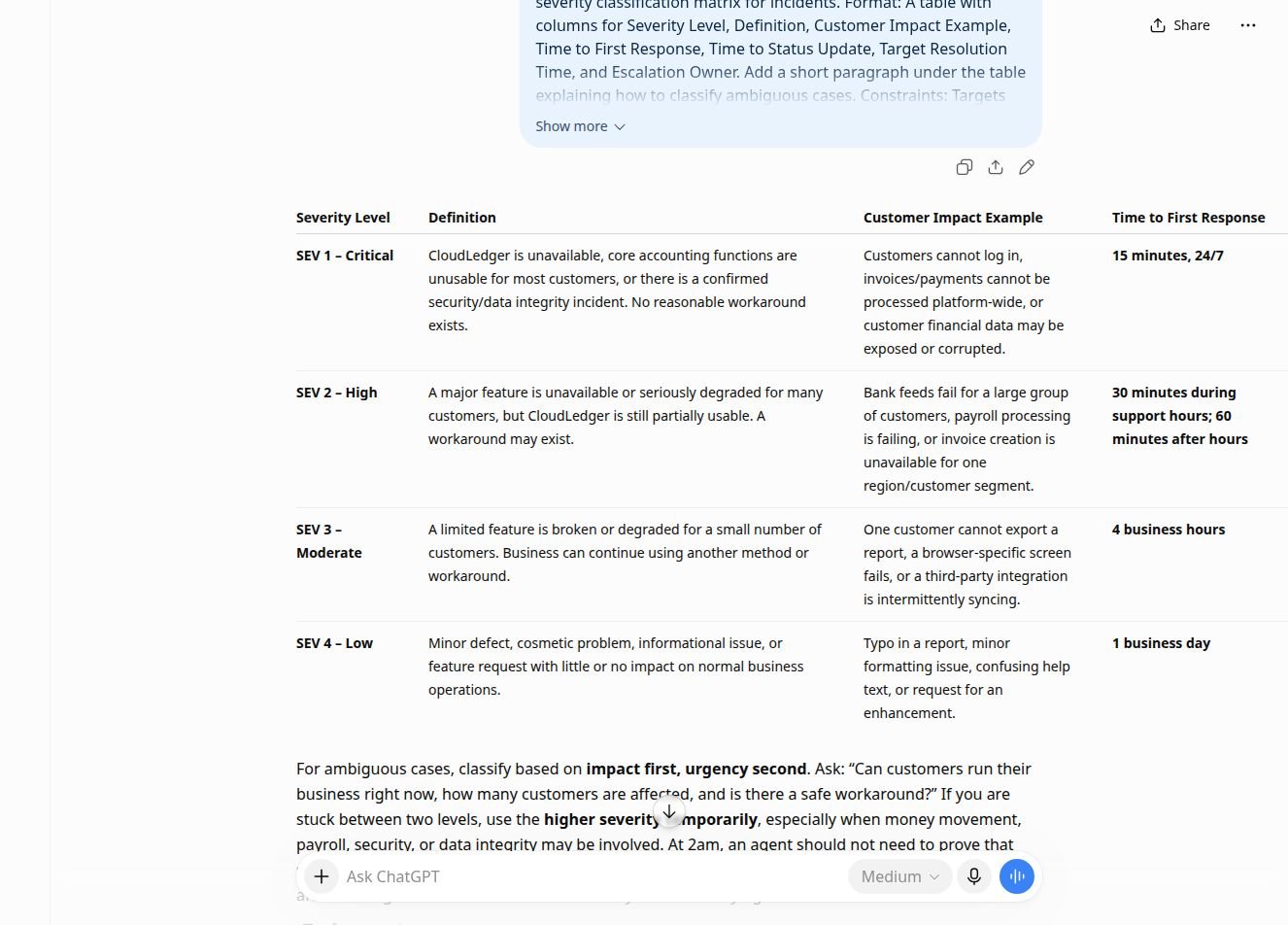
Consider a SaaS support team running CloudLedger, a cloud accounting platform with 4,000 paying customers and 9 support agents. Their current SLA documentation states that "critical issues" receive "urgent" attention with "fast" resolution times. When the platform experiences a partial data sync failure affecting 120 customers, the team faces immediate uncertainty: Is this critical because the feature is broken, or is it non-critical because it affects a small percentage of the user base? One agent escalates to the engineering team immediately; another tells customers to try again in an hour. Leadership hears two different promises about the same incident. The vagueness cost the team 30 minutes of confusion and consistency on a problem that needed a single, clear response. A well-drafted severity matrix would have defined this case in advance: "Degraded performance affecting less than 5% of users = Severity 3" or "Data integrity issues = Severity 1 regardless of scope." The promise becomes objective, the response becomes consistent, and the team's credibility holds.
The RCTFC Framework: From Vague Requests to Precise Outputs
RCTFC is a five-part prompt structure that converts fuzzy requests into usable, specific outputs. Think of it as the difference between telling a contractor "build me something nice" and handing them actual blueprints. The five parts—Role, Context, Task, Format, and Constraints—each serve a precise function in shaping what ChatGPT produces. Role decides which version of ChatGPT shows up to your request. Ask for an "ITIL-certified incident management consultant" and you get frameworks, escalation logic, and accountability structures. Ask for nothing and you get a helpful generalist with broad knowledge but no specialized vocabulary or methodology. The role primes the model to think in your domain's native language and logic. Context is where your specifics live and where most prompts fail. This is not the place to be vague. Feed in your actual team size, coverage hours, customer count, product type, and current pain points. Context is what turns generic advice into your advice. A Severity 1 response target for a 9-person team is wildly different from the same target for a 90-person organization, and ChatGPT cannot know your constraints unless you name them. Task is the single deliverable you want. One clear ask beats five fuzzy ones every time. "Draft a severity matrix" is better than "help us think about SLAs." Format controls the shape of the output: a table, a matrix, a bullet list, an email template, a runbook. Without specifying format, you might get paragraphs when you needed a grid, or nested hierarchies when you wanted a flat list. Finally, Constraints keep the output honest and usable. Word limits, tone, realism checks, compliance requirements, and operational guardrails all belong here. Constraints are your quality control department. Five parts. Two minutes to write. Dramatically better output. The difference is not subtle.
- Role selects the expertise and vocabulary ChatGPT uses to respond
- Context supplies your actual operational reality—team size, coverage, customer base, product details
- Task is the single clear deliverable, not a fuzzy request with five hidden sub-questions
- Format controls the shape: table, email, runbook, matrix, bullet list
- Constraints enforce realism, word limits, tone, and operational guardrails
Lab: Lab Exercise
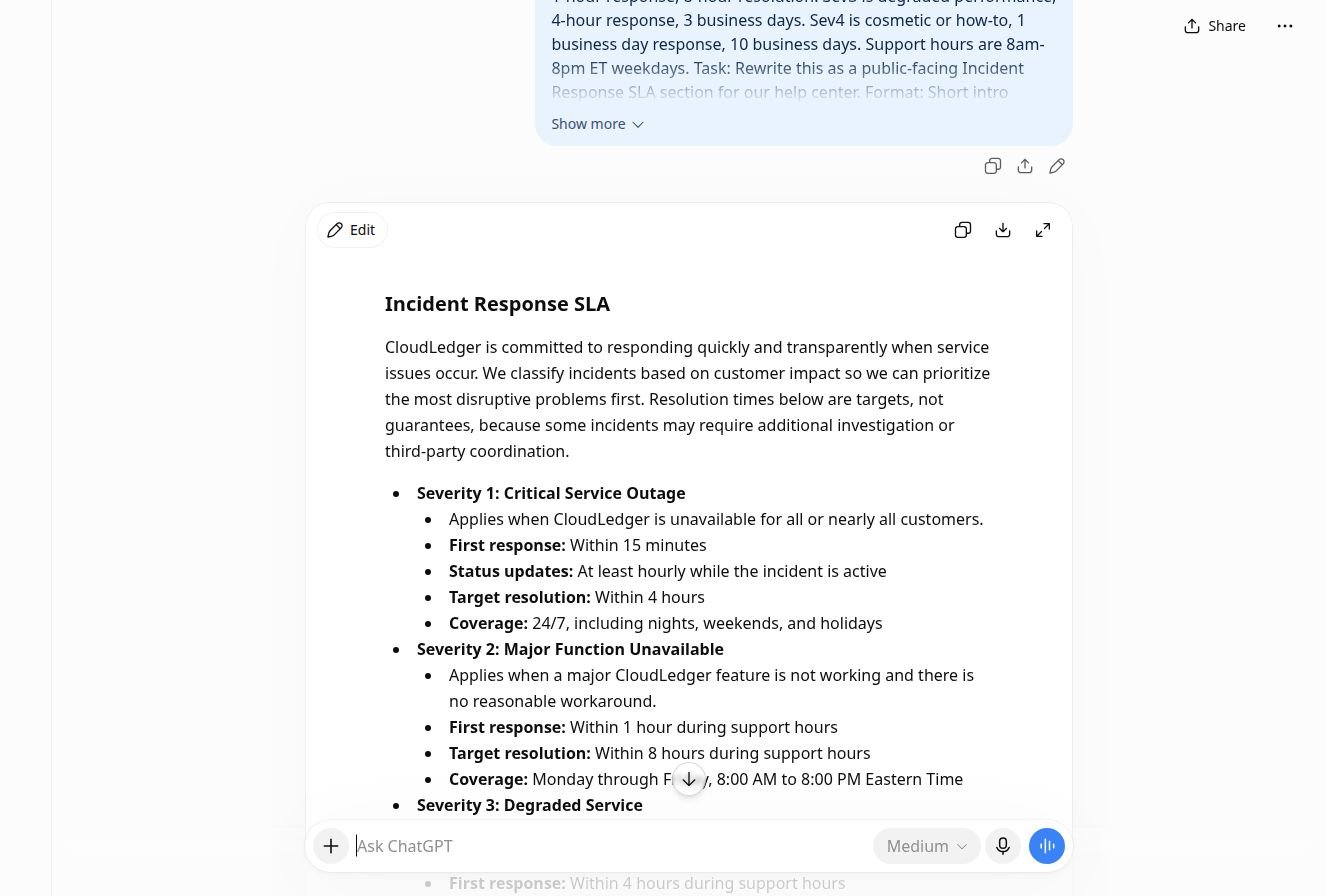
Consider two prompts asking for the same thing—a public-facing SLA description—but with different structure. Weak version: "Can you help us write our SLA for customers?" This yields a generic, safe, somewhat boring paragraph that could apply to any SaaS company. Better version using RCTFC: Role: "You are a customer communications lead who translates technical operations into clear commitments." Context: "CloudLedger is a SaaS accounting platform with 4,000 small-business customers and 9 support agents. We cover 8am-8pm ET weekdays only. Our internal severity matrix defines Sev1 as total outage (15-min response, 4-hour resolution), Sev2 as major feature broken (1-hour response, 8-hour resolution), and Sev3 as degraded performance (4-hour response, 3 business days)." Task: "Rewrite this as a public-facing Incident Response SLA section for our help center." Format: "Short intro paragraph, then one bullet block per severity level, then a closing note on how customers report incidents." Constraints: "Under 350 words. Confident but not over-promising. No internal jargon. Clearly state that after-hours coverage applies only to Sev1." The difference in output is dramatic. The RCTFC version produces something your team can publish immediately—it is specific, grounded in your real operations, appropriately cautious about what you cannot do, and organized in a way customers can scan. It even handles the awkward fact that you do not have 24/7 coverage without making it sound like a limitation.
Building a Severity Classification Matrix
A severity matrix is the spine of your SLA. It separates incidents into discrete levels, defines what each level looks like in plain language, and attaches specific time commitments to each. A good severity matrix has four elements: a clear definition of each level, a concrete example of what that level looks like, the time commitment for first response, and the time commitment for resolution. Many matrices also separate status update frequency from resolution time, which is important because customers need to know their issue is being actively worked even if a fix is not ready yet. When building a matrix for a 9-person team with 8am-8pm coverage, realism is mandatory. Promising a 15-minute response to every incident sounds professional but destroys your credibility when you cannot deliver it. Instead, build a matrix that maps time commitments to severity and to what your team can actually achieve. Severity 1 (total outage or data loss) might justify a 15-minute response and 4-hour resolution target because outages affect all customers and justify emergency action. Severity 2 (major feature broken with no workaround) might justify 1-hour response and 8-hour resolution because it blocks important work but affects a subset. Severity 3 (degraded performance or workaround available) might justify 4-hour response and 3 business days because it is annoying but not blocking. Severity 4 (cosmetic or how-to questions) might justify 1 business day response and 10 business days resolution because it is informational. The key is defensibility: you must be able to explain to a customer why this incident fell into this level and what that level promises them. Plain language is non-negotiable. Your definition must be something a tired agent at 2 a.m. can apply without debate. "Total outage affecting all users" is clear. "Critical business impact" is not. "Feature is completely unavailable, no workaround exists" is clear. "High priority for enterprise customers" is not. Ambiguity does not save time; it creates arguments. The time commitment numbers should be specific and realistic: 15 minutes, 1 hour, 4 hours, 1 business day. Not "quickly" or "ASAP." And the matrix should include a paragraph addressing how to classify ambiguous cases—the incident that sounds like it could be Severity 2 or 3, or the customer who insists something is more critical than the matrix suggests.
- A severity matrix must define each level in plain language a tired agent can apply without debate
- Include both response time and resolution time; they are separate promises
- Ground time commitments in your actual team capacity, not in aspirational numbers
- Add concrete customer impact examples so agents can map real incidents to the right level
- Include a tiebreaker paragraph explaining how to handle ambiguous cases
Lab: Lab Exercise
A complete severity matrix for CloudLedger might look like this: Severity 1 (Total Outage): Definition—Platform is completely unavailable to all users or data integrity is compromised. Customer Impact Example—No users can log in; all API calls fail; customer data is being lost. Time to First Response—15 minutes. Time to Status Update—Every hour. Target Resolution Time—4 hours. Escalation Owner—Support Manager, with on-call Engineer immediately engaged. Severity 2 (Major Feature Broken): Definition—Core feature is completely unavailable with no workaround, affecting multiple customers' ability to complete essential workflows. Customer Impact Example—Invoicing system won't save; export function returns errors; account reconciliation fails. Time to First Response—1 hour. Time to Status Update—Every 4 hours. Target Resolution Time—8 hours (business day). Escalation Owner—Tier 2 Technical Specialist, with Tier 1 remaining primary contact. Severity 3 (Degraded Performance): Definition—System is available but performance is degraded, or a feature has a workaround. Customer Impact Example—Reports take 10x longer to generate; dashboard loading is slow; some users can sync but others cannot. Time to First Response—4 hours (business hours). Time to Status Update—Every business day. Target Resolution Time—3 business days. Escalation Owner—Tier 2 if urgent, otherwise Tier 1 manages to resolution. Severity 4 (Minor Issue or How-To): Definition—Cosmetic issues, documentation questions, feature requests, or configuration help. Customer Impact Example—Button is misaligned; customer does not know how to enable two-factor auth; UI color looks odd. Time to First Response—1 business day. Time to Status Update—As needed. Target Resolution Time—10 business days. Escalation Owner—Tier 1 completes; no escalation unless it reveals a product bug. Tiebreaker Paragraph: If an incident could fit two levels, apply these rules in order: (1) If data is at risk, it is Severity 1. (2) If the feature is completely broken and blocking revenue work, it is Severity 2. (3) If the customer is an enterprise account and a major feature is unavailable, escalate one level up. (4) When in doubt, ask your Tier 2 specialist; they own the final classification. This matrix is specific, defensible, and something a new agent can apply at 2 a.m. without second-guessing.
Designing Escalation Paths That Actually Trigger
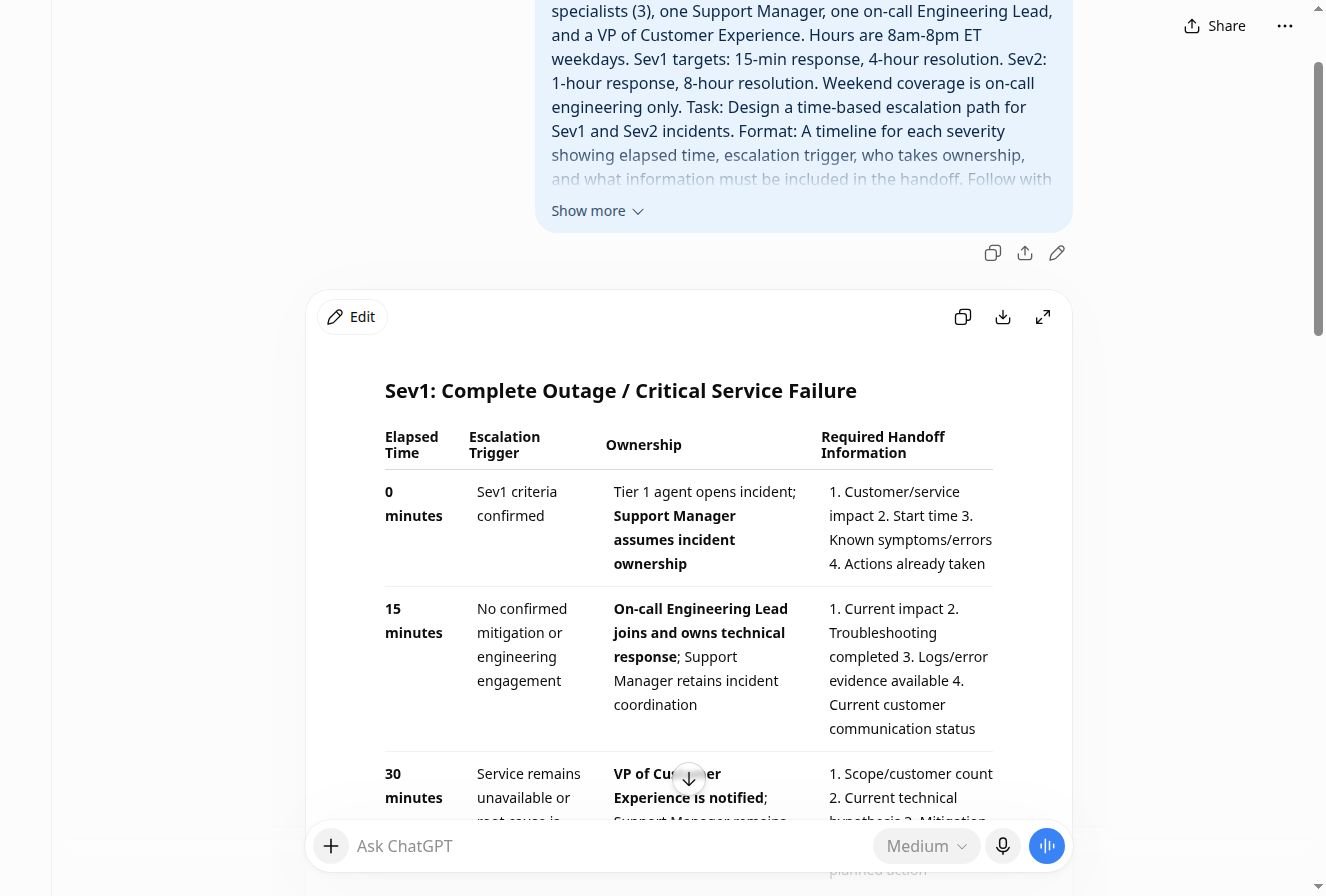
An SLA without an escalation path is a suggestion with a stopwatch. You can define beautiful response targets and write them into a policy, but if nobody knows who owns the problem at minute sixteen, or what information they need to take over, your SLA becomes ornamental. Real escalation design answers three questions: What is the trigger (and it must be time-based, not mood-based)? Who is the next owner by name or by role, and do they know that in advance? What exactly gets handed over—not just a panicked message but documented context and action history. Time-based triggers are essential because emotion-based judgment fails under stress. "Escalate if it feels urgent" is not a trigger; it is a license to argue. "Escalate if a Severity 1 is not acknowledged within 15 minutes" is a trigger. The distinction matters because a tired agent or manager will not reliably judge urgency; they will reliably notice a clock. Pair the time trigger with a specific condition where possible: "If Severity 2 is not assigned to Tier 2 within 30 minutes, Support Manager gets a notification." "If Severity 1 has no engineering involvement after 45 minutes, escalate to VP and trigger on-call engineer page." The trigger can be compound (time AND lack of assignment) but it must be unambiguous. Named ownership is not optional. "Escalate to the next person" means nothing. "At minute 45, Support Manager takes ownership" means something. Even better: "At minute 45, Support Manager takes ownership and immediately pages the on-call Engineering Lead." Every escalation step should name a role and ideally a person or a rotation. This prevents the moment where everyone assumes someone else is handling it. And the handoff requires documentation. What does the next owner need to know? The ticket history? The attempts made so far? The customer's emotional state or urgency? The business impact? A real handoff includes 4–5 pieces of context, not a forwarded message saying "please help." For CloudLedger, an example handoff checklist might be: (1) What the customer is trying to do. (2) What error they are seeing, with exact error messages. (3) What steps have been tried. (4) The business impact on the customer (revenue blocked, data at risk, etc.). (5) When the issue started. This takes 2 minutes to document and saves 20 minutes of guessing on the other end.
- Every SLA breach needs a named next owner; implied ownership is absent ownership
- Escalation triggers must be time-based or condition-based, never mood-based or judgment-based
- Document what gets handed over: ticket history, attempts made, business impact, etc.
- Use a rotation or named role so escalations do not disappear into ambiguity
- Test escalations during quiet periods so they are not invented during a crisis
Lab: Lab Exercise
An escalation path for CloudLedger Severity 1 incidents might look like this: Timeline and Ownership: 0–15 minutes: Tier 1 agent owns incident. Action: Acknowledge customer immediately, begin diagnosis. Handoff items if escalating: exact symptom description, steps taken, initial scope (how many users affected). 15–30 minutes: If still not resolved, Tier 2 Technical Specialist takes ownership. Trigger: Automatic notification at 15-minute mark if Severity 1 is still "investigating" status. Handoff: Tier 1 provides ticket notes, customer's exact error message (not a summary), and which subsystems have been tested. 30–45 minutes: If still not resolved, Support Manager is notified and takes ownership of customer communication. Trigger: Automatic notification at 30-minute mark. Handoff: Everything above, plus current hypothesis and next planned action. 45+ minutes: On-call Engineer is paged and becomes technical lead. Support Manager remains customer-facing. Trigger: Automatic notification at 45-minute mark. Handoff: Full ticket history, all diagnostic steps, hypothesis, and current system state. For Severity 2, escalation is less urgent but follows the same logic: 0–60 minutes: Tier 1 owns incident, diagnoses and works toward fix. 60 minutes: If unresolved, Tier 2 takes technical ownership, Tier 1 stays customer-facing. Handoff at 60 minutes: ticket history, error message, attempted solutions, product area affected. 8 hours (end of business day): If Severity 2 is still open, Tier 2 briefs on-call engineer before shift ends, and on-call engineer gets context in case it is not resolved by start of next business day. This design removes ambiguity. An agent at 2 a.m. knows exactly when the next person takes over and exactly what they need to say. An on-call engineer knows they are getting paged at 45 minutes into a Sev1 and can prepare. The handoff checklist prevents the chaos of a Tier 2 person discovering a critical step was skipped two hours ago.
Stress Testing Your SLA Before Reality Does
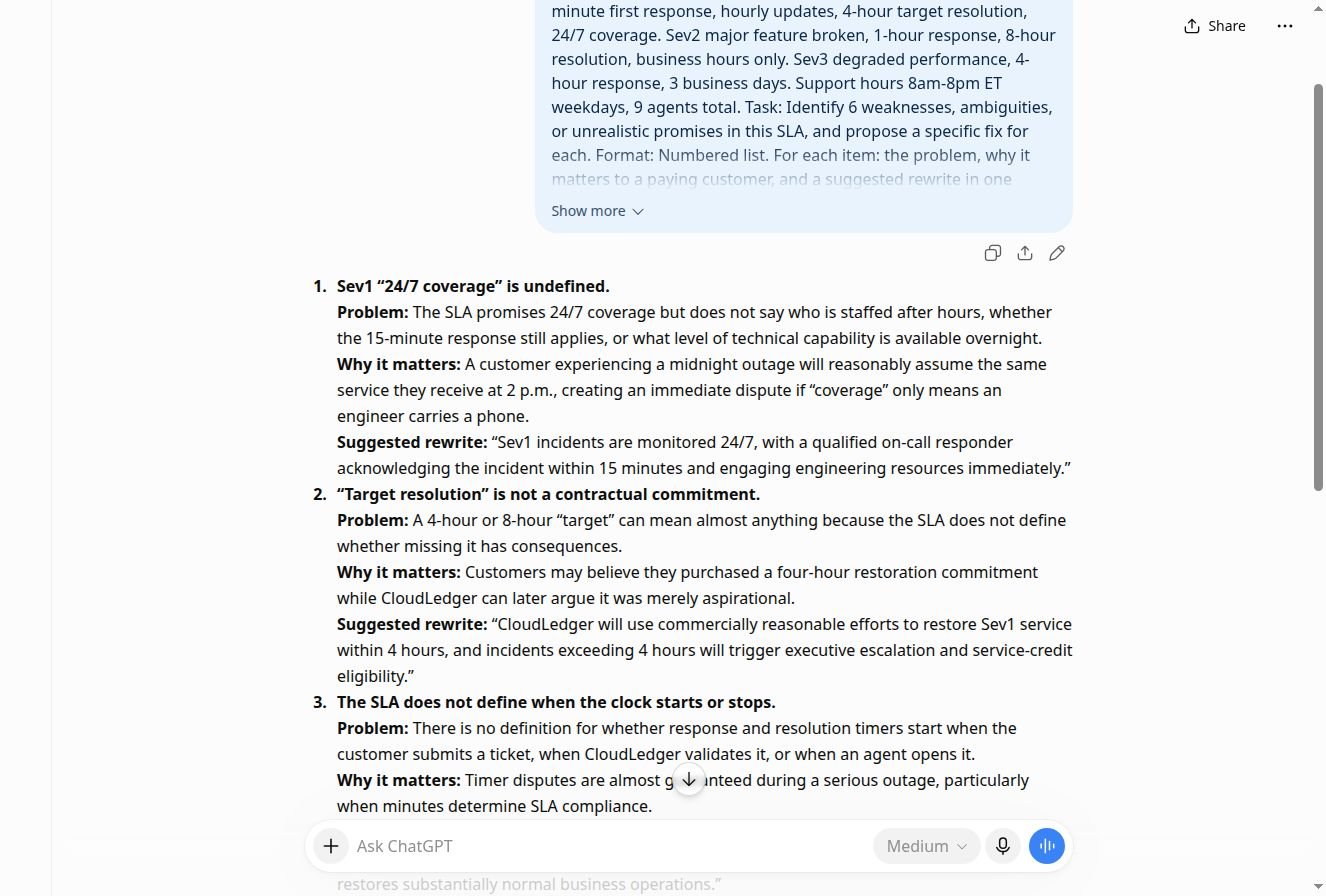
Once you have an SLA drafted, the move that separates good SLAs from durable ones is not asking ChatGPT if it looks good. It will tell you yes; it is agreeable to a fault. Instead, assign it an adversarial role: ask it to attack the document. Tell it to find the scenarios where your SLA breaks, the ambiguities a frustrated customer could exploit, the promises your team cannot keep during a holiday week with two people out sick, the partial outages that do not fit neatly into your severity levels. This is stress testing, and it is the cheapest quality control your support team will ever get. Every SLA eventually meets an edge case. A partial outage affecting 8% of users—is that Severity 2 or 3? An incident that starts at 7:55 p.m. on a Friday—does your 4-hour Sev2 target apply or do you pivot to business hours? A customer who insists their broken export function is a Severity 1 because the customer's business depends on it—how do you hold the line? A situation where your two on-call engineers are both on vacation and the third is covering two shifts. You can discover edge cases the hard way, in public, with an angry customer on Twitter or an escalated contract dispute. Or you can discover them now, for free, in a chat window, and rewrite your targets or add clarifications before they become real problems. The prompt is simple: "Identify six weaknesses, ambiguities, or unrealistic promises in this SLA. For each, explain why it matters to a paying customer and propose a one-sentence fix." Force it to give you a specific number so it cannot give you vague feedback. When you get the list of weaknesses back, do not dismiss the ones that are hard to fix. Those are the ones that matter most. If ChatGPT identifies that your Severity 1 target is unrealistic because you do not have true 24/7 staffing, that is not a weakness in the test; that is a weakness in the SLA. You have three choices: hire the staffing to meet the target, lower the target to match your staffing, or add a caveat that after-hours Sev1 response might be slower (which is honest and defensible). Do not try to defend a target you cannot actually hit. An SLA you routinely miss damages trust more than a modest one you always meet.
- Ask ChatGPT to critique, not to approve; assign an adversarial role to surface real problems
- Demand a specific number of issues (six, eight, ten) to force depth instead of generalities
- Test deliberately ugly edge cases: holidays, partial outages, Friday nights, understaffed periods
- If you cannot defend a target with math (staffing, availability, SLA math), change the target
- Document your fixes and the reasoning behind them so your team understands why the SLA is what it is
Imagine CloudLedger's initial public SLA claims: "Sev1 total outage, 15-minute first response, hourly updates, 4-hour target resolution, 24/7 coverage." Run the stress test by asking ChatGPT: "You are a skeptical enterprise procurement auditor. Identify six weaknesses in this SLA." Likely findings: (1) Problem: "Claims 24/7 coverage but only has one on-call engineer for nights and weekends." Why it matters: A customer in crisis cannot be assured two engineering resources exist after 6 p.m. Fix: "Sev1 on-call response is 30 minutes after-hours (vs. 15 minutes business hours), with escalation to on-call manager if first engineer cannot resolve in 2 hours." (2) Problem: "No definition of 'total outage'—is a partial outage affecting 2% of users a Sev1?" Why it matters: A customer with 50 users affected might insist on Sev1 treatment; your team might classify it as Sev2. Fix: "Sev1 is defined as zero successful authentications for more than 50 consecutive users OR any data loss event, regardless of scope." (3) Problem: "Four-hour resolution target is unachievable for certain classes of incidents (e.g., database corruption requiring recovery)." Why it matters: You guarantee 4 hours and hit it 60% of the time; customer gets upset. Fix: "4-hour target applies to outages resolvable by restart or failover; incidents requiring data recovery operations have a target of 8 business hours with hourly updates." (4) Problem: "No mention of what happens if multiple Sev1s hit simultaneously." Why it matters: You have 9 agents; if three major incidents hit at once, your 15-minute response becomes a lie. Fix: "If multiple Sev1s occur within 15 minutes, first-response window extends to 20 minutes for subsequent incidents and escalation to VP." (5) Problem: "Hourly status updates are promised but you have no automation; an agent must manually write them." Why it matters: In a real Sev1, agents are debugging, not writing emails. Fix: "Status updates are sent automatically at the 30-minute and 60-minute marks with a template; agents add details if progress is made." (6) Problem: "No mention of customer communication expectations for Friday 5 p.m. incidents affecting the weekend." Why it matters: An incident starting Friday evening that is not resolved until Monday morning gets no weekend updates; customer assumes you have abandoned them. Fix: "Sev1s that remain open at close of business Friday receive an end-of-day brief on weekend coverage and a guaranteed Monday 8 a.m. update." Running this test transforms a generic, somewhat unrealistic SLA into one that is honest about your capacity and prepared for the mess of real operations.
Summary
An operational incident SLA is built in layers. It starts with a severity matrix that uses plain language to distinguish severity levels and attach realistic time commitments to each. It extends into a customer-facing version that explains your promises without exposing internal mechanics. It includes an escalation path where every breach automatically triggers a named owner at a specific time, with a documented handoff. It gets stress-tested against edge cases before it meets a real crisis. And it sticks with your team through a one-page reference card, scenario training, and quarterly reviews against real data. This entire structure can be drafted, refined, and battle-tested in a fraction of the time it takes a traditional SLA process because ChatGPT handles the structural and logical heavy lifting while you provide the operational context. The result is an SLA that is clear enough for a tired agent to follow at 2 a.m., defensible enough to hold up under customer scrutiny, realistic enough that your team can achieve it, and documented enough that nobody has to invent a new one during a crisis. That shift—from improvisation to documentation, from vague to specific, from ornamental to operational—is the difference between a support team that reacts and one that leads.
Next Steps
Start with your current SLA (or lack of one) and run it through the RCTFC framework. Use ChatGPT to draft a severity matrix for your product and team size. Before you publish it, ask ChatGPT to attack it: assign it the role of a skeptical procurement auditor and ask it to identify six weaknesses. Fix the ones that are real, then turn the result into a one-page quick reference card and train your team with three sample scenarios. Finally, set a quarterly calendar reminder to review your SLA against real ticket data and adjust targets based on what you actually achieved. If you have escalation chaos or response time inconsistency on your team right now, three weeks of intentional SLA work using these techniques will transform that problem from chronic to solved.